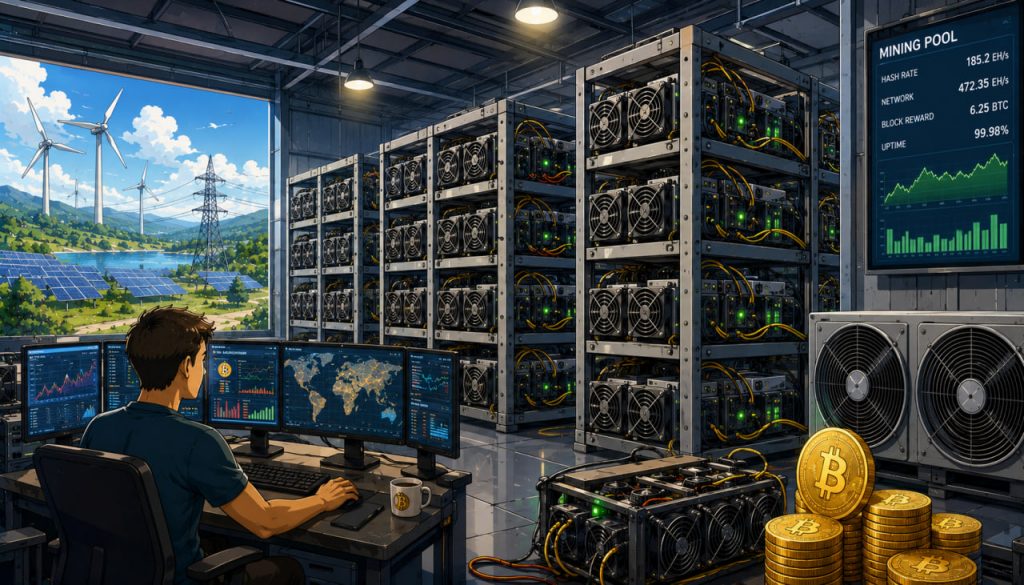
Cryptocurrency mining became one of the most discussed technological phenomena of the 21st century. What began as a small experimental digital system developed by computer enthusiasts eventually evolved into a global industry involving:
- Massive data centers
- Specialized processors
- Industrial cooling systems
- Billions of dollars in infrastructure
Today, cryptocurrency mining affects:
- Global energy consumption
- Financial markets
- Technology development
- Environmental debates
- Digital security systems
Supporters view crypto mining as a revolutionary decentralized financial technology, while critics argue it consumes enormous amounts of electricity and contributes to environmental problems.
Understanding how cryptocurrency mining works helps explain why digital currencies became both highly valuable and highly controversial.
What Is Cryptocurrency Mining?
Cryptocurrency mining is the process of verifying and recording transactions on certain blockchain networks.
Instead of relying on traditional banks or central authorities, some cryptocurrencies use decentralized computer systems to maintain transaction security.
Mining involves solving extremely difficult computational problems using specialized hardware.
When miners successfully validate transaction blocks, they may receive:
- Newly created cryptocurrency
- Transaction fees
This system helps maintain blockchain integrity and prevents fraud or double spending.
What Is Blockchain?
Most cryptocurrencies operate using blockchain technology.
A blockchain is a digital ledger that records transactions across many computers simultaneously.
Each block contains:
- Transaction data
- Cryptographic information
- Links to previous blocks
This creates a chain of verified records difficult to alter retroactively.
Blockchain systems are designed to function without centralized control.
Bitcoin, the first major cryptocurrency, introduced blockchain technology in 2009.
Why Mining Requires Powerful Computers
Cryptocurrency mining depends on massive computational power.
Miners compete to solve complex mathematical problems using:
- Graphics processing units (GPUs)
- Application-specific integrated circuits (ASICs)
- Specialized mining hardware
The faster and more powerful the hardware, the higher the chances of successfully validating blocks.
Modern industrial mining farms may contain:
- Thousands of machines
- Advanced cooling systems
- Dedicated electrical infrastructure
Mining has become far more technologically intensive than during cryptocurrency’s early years.
The Role of Proof-of-Work
Many cryptocurrencies originally used a system called:
- Proof-of-Work (PoW)
In this system, miners prove they performed large amounts of computational work to validate transactions.
Proof-of-Work helps secure blockchain networks because manipulating the system would require enormous computational resources.
However, PoW systems also consume huge amounts of electricity.
This energy demand became one of the biggest controversies surrounding cryptocurrency mining.
Why Cryptocurrency Mining Uses So Much Energy
Mining hardware operates continuously at extremely high processing intensity.
Major energy demands come from:
- Processor operation
- Cooling systems
- Server infrastructure
- Data transmission
Large mining operations may consume electricity comparable to:
- Factories
- Industrial facilities
- Small towns
Energy researcher Alex de Vries noted:
“Bitcoin mining has become a large-scale industrial energy consumer.”
This issue continues generating debate among economists, environmentalists, and technology experts.
Environmental Concerns
One of the biggest criticisms of cryptocurrency mining involves environmental impact.
If mining relies heavily on fossil fuel electricity, it may contribute to:
- Carbon emissions
- Air pollution
- Increased energy demand
Some countries expressed concerns about mining placing stress on national power grids.
Environmental debates intensified as cryptocurrency prices rose and mining activity expanded globally.
Critics argue certain mining systems may consume more electricity than some entire countries.
Renewable Energy and Mining
Supporters of cryptocurrency mining argue that many operations increasingly use:
- Hydroelectric power
- Solar energy
- Wind energy
- Surplus renewable electricity
Some mining companies intentionally locate facilities near:
- Dams
- Cold climates
- Cheap renewable power sources
Because mining equipment can operate flexibly, some researchers believe mining may potentially help absorb excess renewable energy production during low-demand periods.
The relationship between mining and renewable energy remains complex and debated.
Mining Pools and Industrialization
In the early days of cryptocurrency, individuals could mine using ordinary home computers.
Today, mining is dominated largely by industrial-scale operations.
Many miners join:
- Mining pools
Pools combine computational power from multiple participants and distribute rewards proportionally.
This industrialization made mining:
- More competitive
- More expensive
- More centralized in practice
Specialized mining companies now operate enormous facilities worldwide.
Cryptocurrency Beyond Bitcoin
Although Bitcoin remains the most famous mined cryptocurrency, many others also use mining systems.
Different cryptocurrencies use different mechanisms such as:
- Proof-of-Stake
- Hybrid systems
- Alternative consensus algorithms
Some newer systems attempt to reduce energy consumption significantly.
Ethereum, for example, transitioned away from energy-intensive Proof-of-Work toward a more energy-efficient model.
Mining Hardware and Technology
Mining hardware evolved rapidly over the past decade.
Early miners used:
- CPUs
Later systems shifted toward:
- GPUs
- ASIC devices
Modern ASIC miners are highly specialized machines designed specifically for mining algorithms.
These devices offer:
- Extremely high performance
- Greater energy efficiency compared to general-purpose computers
However, mining hardware becomes outdated quickly as technology advances.
Governments and Regulation
Governments worldwide respond differently to cryptocurrency mining.
Some countries:
- Encourage mining industries
- Invest in blockchain technologies
Others impose restrictions due to concerns about:
- Energy use
- Financial risks
- Illegal activities
- Grid stability
Regulation continues evolving as governments attempt to balance:
- Innovation
- Financial oversight
- Environmental concerns
Could Mining Continue Growing?
The future of cryptocurrency mining depends on several factors:
- Energy costs
- Regulation
- Cryptocurrency prices
- Technological innovation
- Environmental pressure
Some experts believe mining will become:
- More energy-efficient
- More integrated with renewable energy
Others predict stricter regulation may limit large-scale expansion.
The long-term future of mining remains uncertain.
Why Cryptocurrency Mining Matters
Cryptocurrency mining represents more than digital money creation.
It reflects broader technological trends involving:
- Decentralized systems
- Energy-intensive computing
- Financial innovation
- Digital infrastructure
Mining also demonstrates how virtual systems can produce very real physical effects on:
- Electricity grids
- Global energy demand
- Industrial development
- Environmental systems
As digital economies continue evolving, cryptocurrency mining may remain one of the most controversial intersections between technology, finance, and energy policy.
Interesting Facts
- Bitcoin was introduced in 2009 by the mysterious creator known as Satoshi Nakamoto.
- Early Bitcoin mining could be performed on ordinary home computers.
- Modern mining farms may contain thousands of specialized processors.
- Some mining facilities operate near renewable energy sources.
- Certain cryptocurrencies now use less energy-intensive validation systems.
Glossary
- Cryptocurrency — A digital currency secured using cryptographic systems.
- Blockchain — A decentralized digital ledger recording transactions.
- Mining — Computational processes used to validate blockchain transactions.
- ASIC Miner — Specialized hardware designed specifically for cryptocurrency mining.
- Proof-of-Work — A blockchain security system requiring computational effort for transaction validation.