Human civilization has always depended on food technology. Agriculture transformed ancient societies, refrigeration changed global trade, and industrial food production allowed cities with millions of inhabitants to exist. Today, however, scientists and futurists are imagining something even more radical:
Could humanity eventually create food directly from atoms or molecular building blocks?
The idea sounds like science fiction, yet modern science is already exploring technologies involving:
- Molecular engineering
- Synthetic biology
- 3D food printing
- Lab-grown meat
- Precision fermentation
- Nanotechnology
Future food systems may dramatically transform how humanity produces nutrition, especially as the world faces:
- Population growth
- Climate change
- Resource shortages
- Agricultural pressure
Although true “atomic food assembly” remains far beyond current capabilities, many researchers believe future food production may become increasingly programmable and technologically controlled.
Why Humanity Needs New Food Technologies
Global food demand continues rising rapidly.
The world population may exceed:
- 10 billion people during the coming century
Traditional agriculture already places heavy pressure on:
- Water systems
- Forests
- Soil
- Biodiversity
- Climate systems
Modern food production also contributes significantly to:
- Greenhouse gas emissions
- Land use
- Pollution
Scientists are therefore searching for more efficient ways to produce food using fewer natural resources.
Future food technology may become essential for long-term planetary sustainability.
What Does “Assembling Food From Atoms” Mean?
The phrase often refers to futuristic ideas where machines could build food molecule by molecule using raw chemical elements.
In theory, food consists mostly of:
- Proteins
- Fats
- Carbohydrates
- Vitamins
- Minerals
- Water
If technology could precisely arrange these molecules, it might eventually create customized foods with:
- Specific nutrition
- Flavor
- Texture
- Appearance
This concept resembles fictional “replicators” from science fiction.
However, current science is still extremely far from full atomic-level food construction.
Molecular Engineering and Food Science
Although true atomic assembly does not yet exist, scientists already manipulate food at molecular levels.
Modern food science studies:
- Protein structures
- Flavor chemistry
- Nutritional composition
- Fermentation biology
Researchers can already engineer:
- Artificial flavors
- Plant-based meat textures
- Precision nutritional products
The future may involve increasingly precise control over food chemistry.
Lab-Grown Meat and Cellular Agriculture
One of the most important future food technologies is:
- Cultivated meat
Scientists grow animal cells inside controlled laboratory environments rather than raising entire animals.
Potential advantages include:
- Reduced land use
- Lower water consumption
- Fewer animal welfare concerns
- Reduced environmental impact
The technology is still expensive but improving rapidly.
Food scientist Mark Post, who helped develop one of the first cultivated beef burgers, explained:
“We can potentially produce meat more efficiently and sustainably.”
Cellular agriculture may become a major part of future food systems.
Precision Fermentation
Precision fermentation uses microorganisms such as yeast or bacteria to produce specific food ingredients.
This technology can create:
- Proteins
- Dairy alternatives
- Nutritional compounds
- Flavor molecules
Some companies already use fermentation to produce milk proteins without cows.
This approach may reduce pressure on traditional livestock agriculture while maintaining familiar food characteristics.
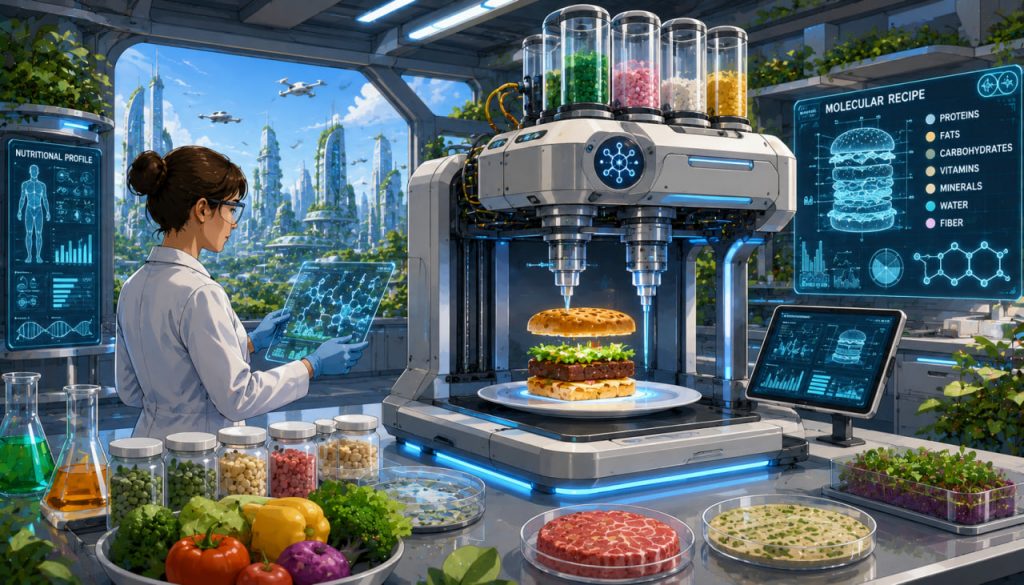
3D-Printed Food
3D food printing is another rapidly developing field.
These systems use programmable machines to create food layer by layer from edible ingredients.
Potential future applications include:
- Personalized nutrition
- Medical diets
- Space travel food systems
- Efficient food production
Astronauts on future long-duration space missions may eventually rely partly on advanced food-printing technologies.
Although still limited today, food printing demonstrates how digital manufacturing may influence nutrition.
Nanotechnology and Future Nutrition
Nanotechnology studies extremely small-scale structures and materials.
Some researchers believe nanotechnology may eventually improve:
- Nutrient delivery
- Food preservation
- Texture engineering
- Flavor enhancement
Future food systems could potentially become highly customizable at microscopic levels.
However, food nanotechnology also raises safety and regulatory concerns requiring careful scientific evaluation.
Could Food Be Created From Basic Elements?
In theory, all matter — including food — consists of atoms.
However, assembling complex biological molecules precisely remains extraordinarily difficult.
Foods contain:
- Highly complex proteins
- Organic compounds
- Biological structures
Current technology cannot economically build complex meals atom by atom.
The energy and precision required would be enormous.
For now, biology itself remains vastly more efficient than artificial molecular assembly systems.
Artificial Intelligence and Food Engineering
AI is increasingly influencing food science.
Artificial intelligence helps researchers:
- Design new food formulas
- Analyze nutrition
- Improve flavor combinations
- Optimize agriculture
Future AI systems may create highly personalized diets based on:
- Genetics
- Health conditions
- Metabolism
- Environmental sustainability
Digital technology may eventually transform nutrition into a highly individualized science.
Space Colonization and Synthetic Food
Future space exploration strongly motivates synthetic food research.
Long-term lunar or Martian colonies may require:
- Compact food systems
- Controlled biological production
- Minimal resource consumption
Transporting traditional agriculture into space is extremely difficult.
Scientists therefore explore:
- Closed-loop ecosystems
- Algae cultivation
- Lab-grown proteins
- Artificial food production systems
Future off-world civilizations may depend heavily on advanced synthetic nutrition technologies.
Ethical and Cultural Questions
Food is more than chemistry — it is also:
- Culture
- Tradition
- Emotion
- Social identity
Some people may resist highly artificial food technologies because they value:
- Natural farming
- Traditional cooking
- Cultural food practices
Others may embrace technological food systems for environmental or ethical reasons.
Future societies will likely debate how much food production should become industrialized or synthetic.
Will Traditional Agriculture Disappear?
Most experts believe traditional agriculture will continue existing for a very long time.
However, future food systems may combine:
- Conventional farming
- Vertical agriculture
- Synthetic biology
- Lab-grown foods
- Precision nutrition
The future of food may involve diversification rather than complete replacement.
Why Future Food Technology Matters
Food systems shape:
- Human health
- Environmental stability
- Economic systems
- Civilization itself
As populations grow and resources become more constrained, future food technologies may become critically important.
Although fully assembling meals atom by atom remains far beyond current science, humanity is already entering an era where food production becomes increasingly programmable, engineered, and technologically sophisticated.
The next century may transform food as dramatically as the Industrial Revolution transformed agriculture.
Interesting Facts
- Scientists have already produced cultivated meat in laboratories.
- Some companies create dairy proteins without using cows.
- 3D food printers can produce customized edible structures.
- Space agencies actively study future synthetic food systems.
- Food science increasingly combines biology, chemistry, and AI technologies.
Glossary
- Cellular Agriculture — Food production using cultured cells instead of whole animals.
- Precision Fermentation — Using microorganisms to produce specific food ingredients.
- Nanotechnology — Science involving extremely small-scale structures and materials.
- 3D Food Printing — Layer-by-layer manufacturing of edible products using programmable systems.
- Synthetic Biology — Engineering biological systems using advanced biotechnology.