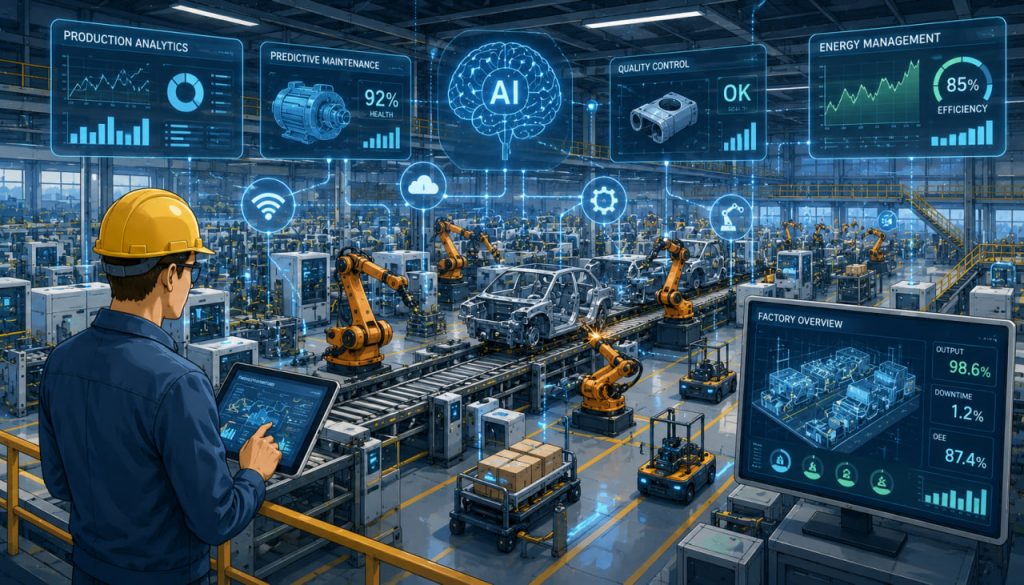
Artificial intelligence is rapidly transforming industrial manufacturing across the world. What once required large numbers of workers, manual monitoring, and repetitive mechanical processes is increasingly becoming automated through smart systems capable of:
- Data analysis
- Machine learning
- Predictive maintenance
- Robotic control
- Quality inspection
- Autonomous optimization
Modern factories are evolving into highly interconnected digital environments where machines communicate with each other and make decisions in real time.
This technological transformation is often called:
- Industry 4.0
AI-driven manufacturing is changing how products are:
- Designed
- Produced
- Transported
- Monitored
- Maintained
Supporters believe artificial intelligence may dramatically improve:
- Efficiency
- Precision
- Safety
- Sustainability
Critics, however, warn about:
- Job displacement
- Cybersecurity risks
- Dependence on automation
- Ethical concerns
As industrial AI systems continue advancing, manufacturing itself may become one of the most transformed sectors of the global economy.
What Is Artificial Intelligence in Manufacturing?
Artificial intelligence in manufacturing refers to computer systems capable of:
- Learning from data
- Recognizing patterns
- Making predictions
- Optimizing industrial processes
Unlike traditional automation, AI systems can adapt and improve over time based on new information.
These systems often combine:
- Sensors
- Robotics
- Cloud computing
- Machine learning
- Real-time analytics
Modern AI factories rely heavily on constant data collection and digital monitoring.
The Evolution of Industrial Automation
Factories have evolved through several major technological revolutions.
The first industrial revolution introduced:
- Steam power
- Mechanized production
The second brought:
- Electricity
- Mass production systems
The third introduced:
- Computers
- Early robotics
Today, Industry 4.0 combines:
- Artificial intelligence
- Smart sensors
- Autonomous machines
- Internet-connected infrastructure
This new phase allows manufacturing systems to become increasingly intelligent and self-optimizing.
Smart Factories and Real-Time Monitoring
Modern smart factories use AI to monitor operations continuously.
Sensors collect enormous amounts of information regarding:
- Temperature
- Pressure
- Machine vibration
- Production speed
- Energy use
AI systems analyze this data in real time to identify:
- Inefficiencies
- Equipment problems
- Production bottlenecks
This allows factories to respond quickly and reduce downtime.
Industrial engineer Klaus Schwab described Industry 4.0 as:
“A fusion of technologies blurring the lines between the physical and digital worlds.”
This concept strongly defines modern manufacturing transformation.
Predictive Maintenance
One of the most valuable industrial AI applications is:
- Predictive maintenance
Traditional factories often repaired machines only after breakdowns occurred.
AI systems now analyze machine behavior to predict failures before they happen.
This may help reduce:
- Downtime
- Repair costs
- Production interruptions
Predictive maintenance can improve both:
- Reliability
- Operational efficiency
Large industrial companies increasingly depend on these systems.
AI and Industrial Robotics
Industrial robots already perform many repetitive manufacturing tasks.
Modern AI allows robots to become:
- More adaptive
- More precise
- More autonomous
AI-driven robots can:
- Recognize objects
- Adjust movements
- Learn production patterns
- Collaborate with humans
Collaborative robots, often called “cobots,” are designed to work safely alongside human workers.
These systems are expanding rapidly in industries such as:
- Automotive manufacturing
- Electronics
- Logistics
- Packaging
Quality Control and Defect Detection
AI significantly improves industrial quality control.
Computer vision systems can inspect products using:
- Cameras
- Machine learning algorithms
- Pattern recognition
These systems may detect tiny defects faster and more accurately than humans in some situations.
AI inspection systems help improve:
- Product consistency
- Manufacturing precision
- Waste reduction
This is especially important in industries requiring extremely high accuracy.
Energy Efficiency and Sustainability
AI may also help reduce industrial environmental impact.
Smart systems can optimize:
- Energy consumption
- Resource allocation
- Waste management
- Supply chains
Factories increasingly use AI to improve sustainability and reduce operational costs simultaneously.
Environmental optimization is becoming a major industrial priority worldwide.
AI and Supply Chain Management
Modern manufacturing depends heavily on complex global supply chains.
AI systems help companies:
- Predict demand
- Optimize inventory
- Improve logistics
- Reduce delays
During global disruptions, AI may help factories adapt faster to changing conditions.
Supply chain intelligence became especially important after recent worldwide economic disruptions.
Human Workers and Automation Concerns
One of the biggest debates around industrial AI involves employment.
Automation may reduce demand for some repetitive jobs.
However, AI also creates new roles involving:
- Robotics maintenance
- Data analysis
- AI system management
- Advanced engineering
Most experts believe future manufacturing will combine:
- Human expertise
- Machine intelligence
rather than becoming completely human-free.
The workforce itself may increasingly require technical and digital skills.
Cybersecurity Risks
As factories become more digitally connected, cybersecurity becomes critically important.
Industrial AI systems may become targets for:
- Hacking
- Data theft
- Infrastructure disruption
Protecting industrial networks requires advanced security systems and continuous monitoring.
Future factories may depend heavily on secure digital infrastructure.
AI and Future Manufacturing
Future industrial systems may become even more autonomous.
Researchers are developing factories capable of:
- Self-optimization
- Autonomous logistics
- Real-time adaptation
- AI-driven production planning
Some futurists imagine highly automated industrial ecosystems operating with minimal human intervention.
However, achieving fully autonomous manufacturing remains technically complex.
Ethical and Economic Questions
Industrial AI raises broader societal questions involving:
- Labor markets
- Economic inequality
- Corporate power
- Technological dependence
Governments and companies increasingly debate how to balance:
- Innovation
- Worker protection
- Economic competitiveness
The future industrial economy may depend heavily on these decisions.
Why AI in Manufacturing Matters
Artificial intelligence is transforming manufacturing from rigid mechanical production into intelligent adaptive systems.
This shift may influence:
- Global economics
- Employment
- Energy use
- Technological development
- Industrial productivity
Factories of the future may become cleaner, smarter, safer, and more efficient than ever before.
At the same time, industrial AI demonstrates how deeply digital intelligence is becoming integrated into the physical infrastructure of modern civilization itself.
Interesting Facts
- Modern factories may contain thousands of interconnected sensors.
- AI systems can sometimes predict machine failures before breakdowns occur.
- Industrial robots are widely used in automotive manufacturing.
- Computer vision systems help detect microscopic production defects.
- Smart factories increasingly optimize energy use automatically.
Glossary
- Artificial Intelligence (AI) — Computer systems capable of learning and decision-making.
- Industry 4.0 — The modern phase of industrial automation using digital and AI technologies.
- Predictive Maintenance — AI-based prediction of equipment failures before breakdowns occur.
- Computer Vision — AI technology allowing machines to analyze visual information.
- Collaborative Robot (Cobot) — A robot designed to work safely alongside humans.