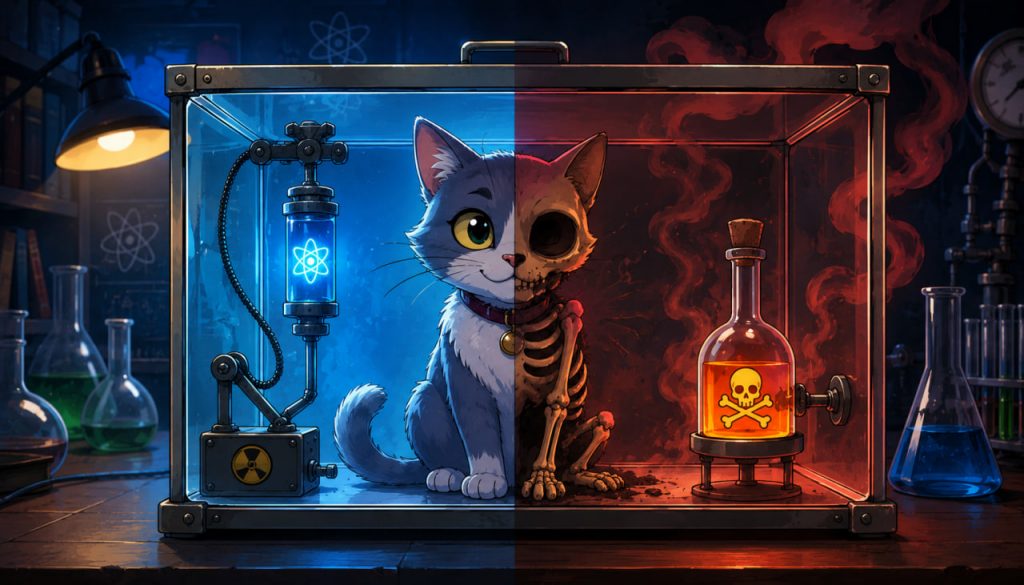
Few scientific ideas became as famous and mysterious as:
- Schrödinger’s Cat
Even people with little interest in physics often heard phrases like:
- “The cat is both alive and dead.”
At first glance, the idea sounds absurd or even humorous. However, Schrödinger’s Cat was actually created to demonstrate a serious scientific problem inside:
- Quantum mechanics
This thought experiment became one of the most famous attempts to explain how strange the quantum world truly is.
Quantum physics describes reality at extremely small scales involving:
- Atoms
- Electrons
- Photons
- Subatomic particles
At these scales, nature behaves very differently from everyday human experience.
Understanding Schrödinger’s Cat helps explain complex ideas involving:
- Probability
- Observation
- Measurement
- Quantum states
- Reality itself
Although the experiment sounds simple, it continues influencing modern physics, philosophy, computing, and debates about consciousness.
Who Was Erwin Schrödinger?
Erwin Schrödinger was an Austrian physicist and one of the founders of:
- Quantum mechanics
He helped develop mathematical equations describing quantum systems.
Schrödinger won the Nobel Prize in Physics for his contributions to modern science.
Interestingly, he did not invent the cat experiment to promote strange quantum ideas. Instead, he designed it partly to criticize certain interpretations of quantum theory.
What Is Quantum Mechanics?
Quantum mechanics studies how matter and energy behave at extremely small scales.
Unlike everyday objects, quantum particles may behave in ways that seem:
- Unpredictable
- Probabilistic
- Wave-like
- Strange
Quantum particles may exist in multiple possible states until measurements occur.
This idea became one of the biggest philosophical challenges in modern science.
The Original Schrödinger’s Cat Experiment
The thought experiment works like this:
Imagine a sealed box containing:
- A cat
- A radioactive atom
- A detector
- A poison mechanism
The radioactive atom has a:
- 50% chance of decaying
within a certain period.
If the atom decays:
- The detector activates
- The poison releases
- The cat dies
If the atom does not decay:
- The cat remains alive
According to some interpretations of quantum mechanics, before opening the box the system exists in a:
- Superposition
meaning the cat is mathematically described as:
- Both alive and dead simultaneously
until observation occurs.
What Is Superposition?
Superposition is one of the strangest ideas in quantum physics.
A quantum system may exist in:
- Multiple possible states at once
before measurement.
For example:
- An electron may behave like it occupies several possible positions simultaneously.
This does not mean the particle physically behaves like ordinary objects existing in two places in the normal human sense.
Quantum mathematics describes probabilities spread across multiple possible outcomes.
Why Schrödinger Created the Experiment
Schrödinger intended the experiment partly as a criticism.
He wanted to show how strange quantum interpretations become when applied to:
- Large everyday objects
like cats.
The experiment highlights the difficulty of understanding:
- When quantum possibilities become definite reality
This problem remains one of the deepest questions in modern physics.
The Observer Problem
One major issue involves:
- Observation
In some quantum interpretations, measurement appears to affect system outcomes.
This led to philosophical questions such as:
- Does reality exist before observation?
- What counts as a measurement?
- Does consciousness matter in quantum physics?
These questions continue generating debate among physicists and philosophers.
Does the Cat Really Exist Alive and Dead?
Not exactly — at least not in the simple literal sense often imagined online.
Physicists generally agree the experiment demonstrates:
- Mathematical quantum behavior
- Interpretation problems
rather than ordinary cats physically existing as zombies.
Quantum systems are extremely different from everyday human-scale objects.
Large objects interact constantly with environments, causing:
- Decoherence
which destroys delicate quantum superpositions rapidly.
What Is Decoherence?
Decoherence explains why quantum effects rarely appear in everyday life.
Quantum systems lose superposition when interacting with:
- Light
- Air
- Heat
- Other particles
The environment effectively “measures” the system continuously.
This is why humans do not observe:
- Cars existing in two places simultaneously
- People being both awake and asleep at once
Quantum weirdness mostly dominates microscopic scales.
The Copenhagen Interpretation
One famous interpretation of quantum mechanics is:
- The Copenhagen interpretation
According to this idea:
- Quantum systems exist as probability waves until measured.
Measurement causes the wave function to:
- Collapse into a definite state
Schrödinger’s Cat became one of the most famous examples illustrating this interpretation.
Alternative Interpretations
Not all physicists agree about what quantum mechanics means.
Other interpretations include:
- Many-worlds interpretation
- Pilot-wave theory
- Objective collapse models
For example, the many-worlds interpretation suggests:
- Every possible outcome actually occurs in separate branching realities.
In this interpretation:
- One universe contains a living cat
- Another contains a dead cat
Quantum theory therefore became deeply connected to philosophy.
Quantum Physics and Modern Technology
Despite its strange ideas, quantum mechanics is extremely successful scientifically.
Modern technologies based on quantum physics include:
- Lasers
- Smartphones
- Semiconductors
- MRI scanners
- Quantum computers
Quantum theory accurately predicts experimental results with extraordinary precision.
Quantum Computing and Superposition
Quantum computers use principles such as:
- Superposition
- Entanglement
to process information differently from traditional computers.
Instead of simple binary states:
- 0 or 1
quantum bits may represent multiple possibilities simultaneously.
This could eventually revolutionize:
- Cryptography
- Simulation
- Artificial intelligence
- Scientific research
Why Schrödinger’s Cat Became So Famous
The experiment became iconic because it translates extremely abstract quantum ideas into:
- A simple memorable story
It demonstrates how human intuition struggles to understand quantum reality.
Physicist Richard Feynman once famously said:
“I think I can safely say that nobody understands quantum mechanics.”
This quote reflects how counterintuitive quantum physics remains even for experts.
Science, Philosophy, and Reality
Schrödinger’s Cat exists at the intersection of:
- Physics
- Philosophy
- Mathematics
- Consciousness studies
The experiment forces people to question:
- What reality means
- How observation works
- Whether probability defines nature fundamentally
Even today, quantum mechanics remains one of humanity’s deepest scientific mysteries.
Why Schrödinger’s Cat Matters
Schrödinger’s Cat is not merely a strange science story.
It represents humanity’s attempt to understand reality at its most fundamental level.
The experiment reminds us that the universe may operate in ways far stranger than ordinary intuition suggests.
Quantum mechanics continues challenging how humans think about:
- Matter
- Observation
- Information
- Reality itself
And despite nearly a century of research, many quantum mysteries remain unsolved.
Interesting Facts
- Schrödinger created the cat experiment partly as criticism of quantum interpretations.
- Quantum mechanics accurately powers many modern technologies.
- Superposition allows quantum systems to exist in multiple possible states mathematically.
- Decoherence prevents large everyday objects from showing obvious quantum behavior.
- Quantum theory remains one of the most successful scientific frameworks ever created.
Glossary
- Quantum Mechanics — The physics of matter and energy at microscopic scales.
- Superposition — A quantum state involving multiple possible outcomes simultaneously.
- Decoherence — Loss of quantum behavior through environmental interaction.
- Wave Function — Mathematical description of a quantum system.
- Quantum Computer — A computer using quantum principles for information processing.