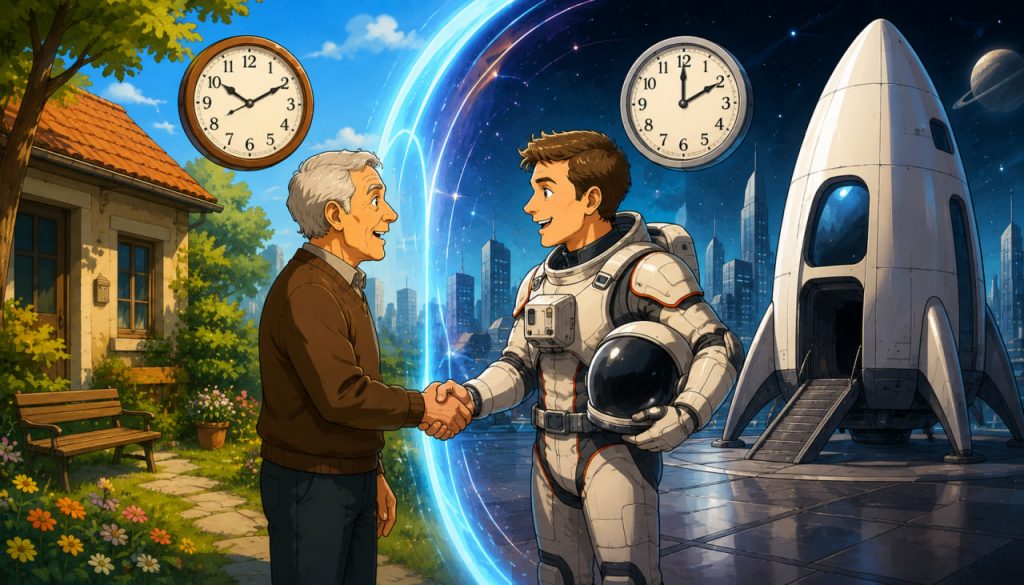
Few ideas in modern physics sound as strange and fascinating as:
- Time travel into the future
Unlike science fiction fantasies involving magical portals or time machines, real physics actually predicts that:
- Time itself can pass differently for different people.
One of the most famous demonstrations of this concept is:
- The Twin Paradox
The paradox comes from Albert Einstein’s:
- Theory of Relativity
and explores what happens when one twin travels through space at extremely high speed while the other remains on Earth.
According to relativity:
- The traveling twin ages more slowly.
When the space traveler returns home:
- Less time passed for them than for the twin who stayed behind.
This sounds impossible from everyday human intuition, yet experiments repeatedly confirmed that:
- Time dilation is physically real.
The Twin Paradox became one of the clearest examples showing that:
- Time is not absolute.
- Time depends on motion and gravity.
Understanding this paradox helps explain some of the most mind-bending aspects of modern physics.
What Is the Twin Paradox?
The Twin Paradox is a thought experiment involving:
- Two identical twins
One twin:
- Remains on Earth
The other twin:
- Travels into space at extremely high speed
- Then returns home
According to Einstein’s relativity:
- The traveling twin experiences less time.
After reunion:
- The space traveler is younger than the Earth twin.
This effect is not science fiction — it directly follows from relativistic physics.
Einstein and the Nature of Time
Before Einstein, scientists mostly believed:
- Time flows equally everywhere.
Isaac Newton described time as:
- Universal
- Constant
- Independent of motion
Einstein completely changed this idea.
His theory showed:
- Time and space are connected.
- Motion affects the passage of time.
This became known as:
- Special Relativity
published in 1905.
What Is Time Dilation?
The key idea behind the Twin Paradox is:
- Time dilation
Time dilation means:
- Moving clocks run more slowly relative to stationary observers.
The faster an object moves:
- The stronger the effect becomes.
At everyday speeds:
- The effect is tiny.
At speeds close to the speed of light:
- Time differences become dramatic.
This means astronauts traveling near light speed could effectively:
- Jump into Earth’s future.
Why Light Speed Matters
Einstein discovered something extraordinary:
- The speed of light remains constant for all observers.
To preserve this constant speed:
- Space and time must adjust themselves.
As speed increases:
- Time slows down
- Length contracts
- Mass behavior changes
The universe itself appears to “reshape” measurements of time and space.
Why the Paradox Seems Confusing
At first glance, the paradox appears contradictory.
If motion is relative, one might ask:
- Why doesn’t each twin see the other aging slower?
The answer involves:
- Acceleration
The traveling twin changes direction and reference frames during the journey.
The Earth twin remains in a relatively stable frame.
This breaks the symmetry between them.
Modern relativity calculations fully resolve the paradox mathematically.
Is Time Travel Into the Future Real?
Surprisingly:
- Yes
according to physics.
The Twin Paradox demonstrates a real form of:
- Forward time travel
The traveler does not move backward into the past.
Instead:
- They experience less elapsed time than people remaining behind.
This allows them to effectively reach the future faster than others.
Experimental Proof of Time Dilation
Time dilation is not merely theoretical.
Scientists experimentally confirmed it many times using:
- Atomic clocks
- High-speed particles
- Satellites
One famous experiment placed atomic clocks on:
- Airplanes
After flying around Earth:
- The moving clocks showed slight time differences compared to stationary clocks.
Relativity predictions matched observations extremely accurately.
GPS Satellites and Relativity
Modern GPS systems actually depend on:
- Relativity corrections
Satellites orbit Earth at high speed and experience:
- Motion-based time dilation
- Gravitational time effects
Without Einstein’s equations:
- GPS positioning would become inaccurate quickly.
This demonstrates relativity affects modern technology daily.
Gravity Also Affects Time
Einstein later expanded relativity into:
- General Relativity
This theory showed:
- Gravity also changes time flow.
Stronger gravity causes:
- Time to move more slowly.
This effect is called:
- Gravitational time dilation
Near extremely massive objects like:
- Black holes
time may slow dramatically.
Black Holes and Extreme Time Distortion
Black holes create some of the strongest known time distortions in the universe.
Near a black hole:
- Minutes for one observer could equal years for another observer farther away.
This concept appeared famously in science fiction movies such as:
- Interstellar
Interestingly, the underlying physics is scientifically grounded.
Why Humans Do Not Notice Time Dilation Normally
Humans move far too slowly to notice meaningful relativistic effects directly.
Cars, airplanes, and everyday motion produce:
- Extremely tiny time differences
Only at:
- Very high speeds
or: - Extreme gravity
do relativistic effects become significant.
Could Humans Travel Far Into the Future?
In principle:
- Yes
If future spacecraft reached speeds close to light speed:
- Astronauts could experience far less time than Earth observers.
For example:
- A crew traveling near light speed for several years might return to find decades passed on Earth.
This is scientifically allowed by relativity.
However, enormous engineering challenges remain.
Why Faster-Than-Light Travel Is Difficult
Relativity also suggests:
- Objects with mass cannot reach light speed using ordinary physics.
As speed approaches light speed:
- Required energy increases enormously.
Scientists continue studying hypothetical ideas involving:
- Warp drives
- Wormholes
- Exotic spacetime geometry
but these remain speculative.
Philosophical Implications
The Twin Paradox deeply changed humanity’s understanding of:
- Time
- Reality
- Simultaneity
Einstein showed:
- Time is not universal.
Different observers may experience:
- Different amounts of elapsed time
depending on:
- Motion
- Gravity
- Spacetime geometry
This shattered many classical assumptions about reality.
Modern Physics and Spacetime
Today physicists describe the universe as:
- Spacetime
where:
- Space and time form one interconnected structure.
Motion through space affects movement through time.
This idea became foundational for:
- Cosmology
- Astrophysics
- Particle physics
- Modern technology
Why the Twin Paradox Matters
The Twin Paradox is far more than a science fiction idea.
It demonstrates that:
- Time is flexible
- Reality behaves differently at extreme scales
- Human intuition is limited
The paradox helped humanity realize the universe is stranger and more dynamic than classical physics ever imagined.
Most importantly:
- The Twin Paradox shows that a form of time travel into the future already exists within real physics.
And unlike fantasy stories, this version of time travel has been experimentally confirmed by science itself.
Interesting Facts
- Einstein published Special Relativity in 1905.
- GPS satellites require relativistic time corrections daily.
- High-speed astronauts age slightly slower than people on Earth.
- Time moves more slowly in stronger gravitational fields.
- Black holes create some of the most extreme time distortions known.
Glossary
- Time Dilation — Slowing of time caused by motion or gravity.
- Special Relativity — Einstein’s theory describing physics at high speeds.
- General Relativity — Einstein’s theory explaining gravity through spacetime curvature.
- Spacetime — The combined structure of space and time.
- Reference Frame — A perspective used to measure motion and physical events.