The Solar System may look stable and peaceful today, but its origin was violent, chaotic, and filled with cosmic collisions. Billions of years ago, before Earth, the Sun, or the planets existed, our region of space contained only:
- Gas
- Dust
- Heavy elements from ancient stars
Over time, gravity transformed this enormous cloud into:
- The Sun
- Eight planets
- Moons
- Asteroids
- Comets
- Entire planetary systems
Understanding how the Solar System formed helps scientists answer major questions about:
- Earth’s origin
- Planet formation
- The possibility of alien worlds
- The history of life itself
Modern astronomy, physics, and space exploration continue uncovering clues about the incredible events that shaped our cosmic neighborhood roughly:
- 4.6 billion years ago.
The story of the Solar System is ultimately the story of how chaos in deep space became an organized planetary system capable of supporting life.
The Giant Cloud Before the Sun
Scientists believe the Solar System began as part of a:
- Giant molecular cloud
These enormous clouds exist throughout galaxies and contain:
- Hydrogen
- Helium
- Dust particles
- Heavy elements created inside ancient stars
At some point, part of this cloud became unstable.
Possible triggers included:
- Nearby supernova explosions
- Shock waves
- Gravitational disturbances
Gravity then began pulling material inward.
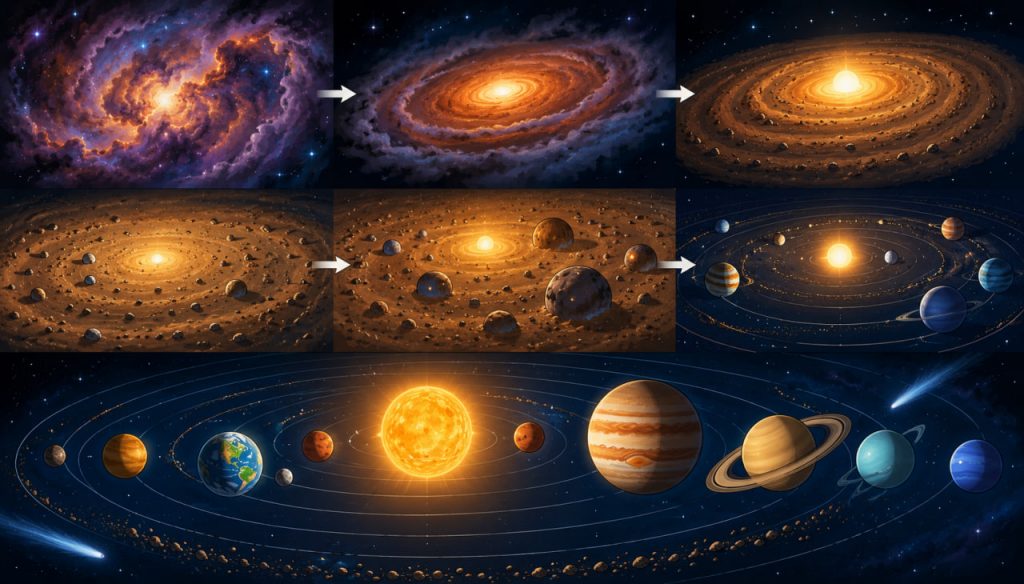
The Birth of the Solar Nebula
As the cloud collapsed:
- It started spinning faster.
This happened because of:
- Conservation of angular momentum
The collapsing material flattened into a rotating disk called:
- The solar nebula
At the center:
- Matter became denser and hotter.
This eventually formed:
- The proto-Sun
Meanwhile, the surrounding disk contained the material that would later become:
- Planets
- Moons
- Asteroids
- Comets
How the Sun Formed
As gravity compressed material in the center of the nebula:
- Temperatures rose dramatically.
Eventually the core became hot enough for:
- Nuclear fusion
to begin.
Hydrogen atoms fused into:
- Helium
releasing enormous amounts of energy.
This moment marked the birth of:
- The Sun
Astronomer Carl Sagan famously said:
“We are made of star stuff.”
This idea reflects how the elements inside humans, planets, and stars originated from ancient cosmic processes.
The Formation of the Planets
Inside the rotating disk surrounding the young Sun:
- Tiny dust particles collided and stuck together.
Over millions of years, these particles formed:
- Pebbles
- Rocks
- Planetesimals
- Protoplanets
Gravity helped larger objects attract more material.
Eventually:
- Planets began forming.
The inner Solar System became:
- Hotter
while the outer regions remained:
- Colder
This temperature difference strongly influenced planet composition.
Why Inner Planets Are Rocky
The planets closest to the Sun became:
- Mercury
- Venus
- Earth
- Mars
These worlds are mostly:
- Rocky
- Dense
because intense heat near the young Sun prevented lighter substances such as:
- Ice
- Volatile gases
from condensing easily.
Only heavier rocky materials survived near the center.
Why Outer Planets Became Giants
Farther from the Sun:
- Temperatures were much colder.
This allowed:
- Ice
- Methane
- Ammonia
- Hydrogen compounds
to accumulate.
As a result, giant planets formed:
- Jupiter
- Saturn
- Uranus
- Neptune
Jupiter became enormous because its gravity captured vast amounts of:
- Hydrogen
- Helium gas
before the solar nebula dispersed.
Asteroids and Leftover Debris
Not all material became planets.
Some leftover debris remained as:
- Asteroids
- Comets
- Meteoroids
The asteroid belt between:
- Mars and Jupiter
contains remnants from early Solar System formation.
Jupiter’s strong gravity may have prevented this material from forming another planet.
The Violent Early Solar System
The early Solar System was extremely unstable.
Young planets experienced:
- Constant collisions
- Asteroid impacts
- Orbital shifts
Large impacts helped shape planetary surfaces and atmospheres.
Scientists believe Earth itself experienced a massive collision with a Mars-sized object called:
- Theia
This collision likely formed:
- The Moon
through debris ejected into orbit.
How Earth Became Habitable
Early Earth looked nothing like the modern planet.
It was:
- Molten
- Volcanic
- Bombarded by asteroids
Over time:
- The planet cooled
- Oceans formed
- Atmospheres evolved
Eventually conditions became suitable for:
- Life
Earth’s location in the:
- Habitable zone
allowed liquid water to remain stable for long periods.
The Role of Gravity
Gravity was the main force shaping the Solar System.
It:
- Collapsed the nebula
- Formed the Sun
- Built planets
- Stabilized orbits
Without gravity:
- Stars and planets could never form.
Even today gravity continues controlling:
- Planetary motion
- Moon orbits
- Comet trajectories
throughout the Solar System.
Evidence Supporting Solar System Formation Theory
Scientists support the solar nebula theory using evidence from:
- Meteorites
- Planetary chemistry
- Computer simulations
- Observations of young stars
Astronomers now observe:
- Protoplanetary disks
around young stars in distant regions of space.
These disks appear remarkably similar to what scientists believe existed around the young Sun billions of years ago.
Could Other Solar Systems Form the Same Way?
Modern astronomy discovered:
- Thousands of exoplanets
orbiting distant stars.
This suggests planetary systems may be:
- Common throughout the galaxy.
Some exoplanetary systems look very different from ours, showing that planet formation can produce many possible outcomes.
Studying our Solar System helps scientists understand:
- Planetary evolution across the universe.
The Kuiper Belt and Oort Cloud
The Solar System extends far beyond the visible planets.
Distant regions contain icy objects including:
- Dwarf planets
- Comets
- Frozen debris
These areas include:
- The Kuiper Belt
- The Oort Cloud
They preserve ancient material from the Solar System’s earliest history.
Scientists study these objects to better understand:
- Primitive planetary formation conditions.
Why the Solar System Matters
The Solar System is humanity’s cosmic home.
Its formation determined:
- Earth’s environment
- The existence of oceans
- Planetary climates
- Conditions for life
Understanding how the Solar System formed helps explain:
- Why Earth exists
- Why humans exist
- How planets emerge throughout the universe
The atoms inside every human body were once part of ancient stars and cosmic dust clouds long before Earth itself formed.
A Cosmic Story Still Being Studied
Although scientists understand much more today than in the past, many mysteries remain involving:
- Planet migration
- Water delivery to Earth
- Moon formation
- Early Solar System instability
Space missions and telescopes continue uncovering new evidence.
The story of the Solar System is still being explored — billions of years after its formation began inside a collapsing cloud of gas and dust in deep space.
Interesting Facts
- The Solar System formed about 4.6 billion years ago.
- Jupiter contains more mass than all other planets combined.
- The Moon likely formed after a giant collision with Earth.
- Scientists now observe young planetary systems forming around distant stars.
- Every atom heavier than hydrogen originally formed inside stars.
Glossary
- Solar Nebula — Rotating cloud of gas and dust that formed the Solar System.
- Protoplanet — Early developing planetary body.
- Nuclear Fusion — Process powering stars through atomic fusion reactions.
- Exoplanet — Planet orbiting a star outside our Solar System.
- Habitable Zone — Region around a star where liquid water may exist.