Artificial intelligence, often called:
- AI
is one of the most transformative technologies in human history.
Today AI can:
- Generate text
- Recognize images
- Translate languages
- Analyze data
- Drive vehicles
- Assist scientific research
Yet the dream of creating intelligent machines is far older than modern computers.
For centuries, humans imagined:
- Mechanical minds
- Thinking machines
- Artificial beings capable of reasoning
The history of artificial intelligence combines:
- Mathematics
- Philosophy
- Neuroscience
- Computer science
- Engineering
and reflects humanity’s attempt to understand:
- Intelligence itself.
Modern AI emerged through decades of:
- Scientific breakthroughs
- Failures
- Technological revolutions
- Powerful new algorithms
What once belonged mainly to science fiction gradually became one of the most important fields in modern civilization.
Understanding the history of AI helps explain:
- How machines became increasingly intelligent
- Why AI developed so rapidly
- What challenges humanity may face in the future.
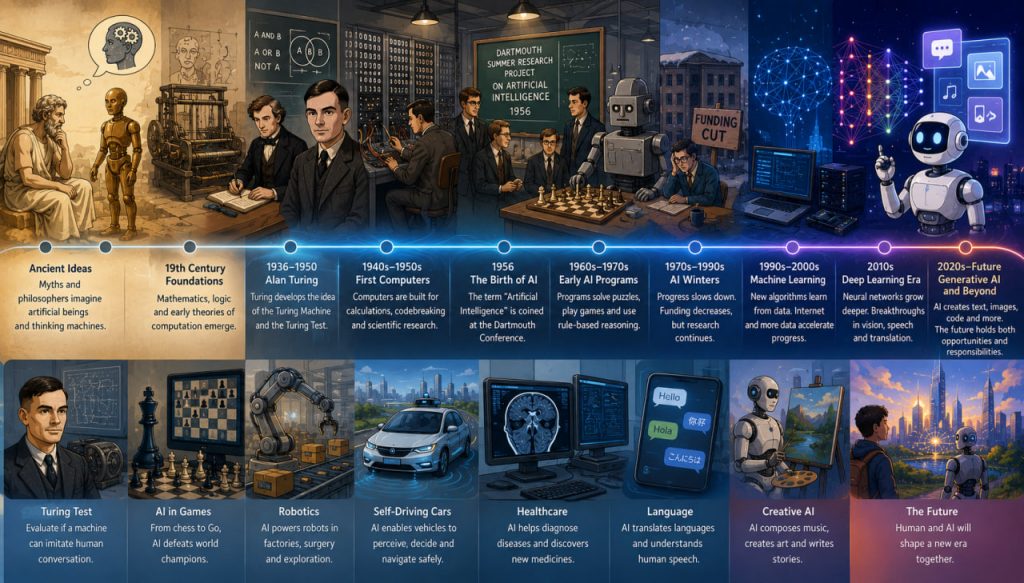
Early Ideas About Artificial Minds
Long before computers existed, philosophers and inventors imagined:
- Artificial beings capable of thinking
Ancient myths described:
- Mechanical servants
- Intelligent statues
- Artificial creatures
Greek mythology included stories about:
- Talos
a giant bronze automaton said to protect Crete.
Later philosophers began asking:
- Could reasoning itself follow logical rules?
These ideas eventually influenced:
- Mathematics
- Logic
- Computer science.
Mathematics and Logic Built the Foundation
In the 19th and early 20th centuries, scientists developed formal systems for:
- Logic
- Computation
- Symbolic reasoning
Mathematicians such as:
- George Boole
helped create:
- Boolean logic
which later became fundamental for computers.
The idea slowly emerged that:
- Thinking processes might be represented mathematically.
Alan Turing and the Birth of Modern Computing
One of the most important figures in AI history was:
- Alan Turing
During the 1930s and 1940s, Turing developed theories about:
- Computation
- Algorithms
- Machine intelligence
He proposed the concept of:
- The Turing Machine
which became foundational for computer science.
Turing later asked the famous question:
“Can machines think?”
This question became central to artificial intelligence research.
He also proposed:
- The Turing Test
designed to evaluate whether a machine could imitate human conversation convincingly.
The First Computers Changed Everything
Early electronic computers appeared during:
- World War II
Initially they were used for:
- Calculations
- Codebreaking
- Military research
Scientists quickly realized computers might eventually handle:
- More complex reasoning tasks.
As computing power improved, researchers began exploring whether machines could:
- Learn
- Solve problems
- Simulate intelligence.
The Official Birth of Artificial Intelligence
The term:
- Artificial Intelligence
was officially introduced in:
- 1956
during the:
- Dartmouth Conference
organized by researcher John McCarthy.
Scientists believed machines might soon achieve:
- Human-like reasoning
Many early researchers were extremely optimistic.
They expected rapid progress in:
- Language understanding
- Problem-solving
- Machine learning
However, reality proved much more difficult.
Early AI Programs
The first AI systems focused mainly on:
- Logic
- Symbolic reasoning
- Rule-based problem solving
Programs successfully solved:
- Mathematical puzzles
- Chess positions
- Logical equations
These systems worked well in narrow situations but struggled with:
- Real-world complexity
- Common sense reasoning
- Uncertainty
The human brain turned out to be vastly more complicated than researchers expected.
AI Winters and Scientific Frustration
During several periods, AI research experienced major setbacks called:
- AI winters
Funding and public enthusiasm declined because:
- Progress was slower than expected
Computers remained too weak for ambitious AI goals.
Researchers struggled with problems involving:
- Language
- Vision
- Learning
- Real-world adaptation
Despite setbacks, scientists continued improving algorithms and computational methods.
Machine Learning Changed AI
One major breakthrough came from:
- Machine learning
Instead of programming every rule manually, researchers developed systems capable of:
- Learning from data
Machine learning allowed computers to:
- Recognize patterns
- Improve performance
- Adapt automatically
This approach became far more powerful than earlier rigid rule-based systems.
Neural Networks and Brain Inspiration
Scientists became inspired by:
- Biological brains
They developed:
- Artificial neural networks
designed loosely around how neurons connect in the human nervous system.
Early neural networks remained limited because computers lacked enough:
- Processing power
- Data
- Memory
However, the underlying idea eventually became extremely important.
The Internet Accelerated AI Development
The rise of:
- The internet
dramatically accelerated AI progress.
Suddenly researchers gained access to:
- Massive datasets
- Global computing networks
- Enormous digital information
AI systems improved rapidly using:
- Text
- Images
- Videos
- User behavior data
Modern AI depends heavily on:
- Large-scale data processing.
Deep Learning Revolution
Around the 2010s, AI experienced another enormous breakthrough involving:
- Deep learning
Deep learning uses:
- Large neural networks
- Multi-layer processing systems
These models achieved remarkable success in:
- Speech recognition
- Image recognition
- Translation
- Game playing
AI systems began outperforming humans in certain specialized tasks.
AI Beats Human Champions
Several famous events demonstrated AI progress publicly.
Examples included:
- IBM Deep Blue defeating chess champion Garry Kasparov
- AlphaGo defeating world Go champion Lee Sedol
These victories shocked many experts because games like:
- Go
were once considered too complex for machines.
AI systems demonstrated extraordinary pattern-recognition abilities.
Modern Generative AI
Recent AI systems can now:
- Generate text
- Create images
- Write code
- Compose music
- Simulate conversations
These systems are often called:
- Generative AI
Large language models analyze enormous text datasets and predict:
- Complex language patterns
This technology rapidly transformed:
- Education
- Media
- Programming
- Business
- Creative industries
Concerns About Artificial Intelligence
AI also raises major concerns involving:
- Privacy
- Misinformation
- Job automation
- Bias
- Surveillance
- Autonomous weapons
Scientists and governments increasingly debate:
- AI safety
- Ethical regulation
- Responsible development
Computer scientist Geoffrey Hinton warned:
“We have to think hard about how to control AI systems more intelligent than us.”
These discussions continue growing globally.
Could AI Become Truly Intelligent?
One major unresolved question is whether machines may eventually achieve:
- Artificial General Intelligence (AGI)
meaning systems capable of:
- Broad flexible reasoning similar to humans.
Current AI remains mostly:
- Narrow AI
specialized for particular tasks.
Scientists still debate whether:
- Consciousness
- Self-awareness
- Human-like understanding
can emerge in machines.
Why AI History Matters
The history of artificial intelligence reflects humanity’s effort to:
- Understand intelligence itself
AI development forced scientists to study:
- Learning
- Language
- Perception
- Decision-making
- The brain
The field evolved from:
- Philosophical speculation
into one of the most powerful technological revolutions in history.
The Future of Artificial Intelligence
AI will likely continue transforming:
- Medicine
- Science
- Transportation
- Education
- Industry
- Daily life
At the same time, humanity faces difficult questions involving:
- Ethics
- Control
- Responsibility
- Human identity
The future of AI may become one of the defining stories of the 21st century.
And the history of artificial intelligence demonstrates how a scientific dream once considered impossible gradually became reality through decades of persistence, mathematics, and technological innovation.
Interesting Facts
- The term “Artificial Intelligence” was introduced in 1956.
- Alan Turing helped create modern computer science foundations.
- Early AI systems struggled heavily with common sense reasoning.
- Modern AI relies on enormous amounts of data and computing power.
- Neural networks were inspired partly by biological brains.
Glossary
- Artificial Intelligence (AI) — Machines performing tasks associated with human intelligence.
- Machine Learning — Systems improving automatically from data patterns.
- Neural Network — AI model loosely inspired by biological neurons.
- Algorithm — Step-by-step computational procedure.
- Artificial General Intelligence (AGI) — Hypothetical AI capable of broad human-like reasoning.