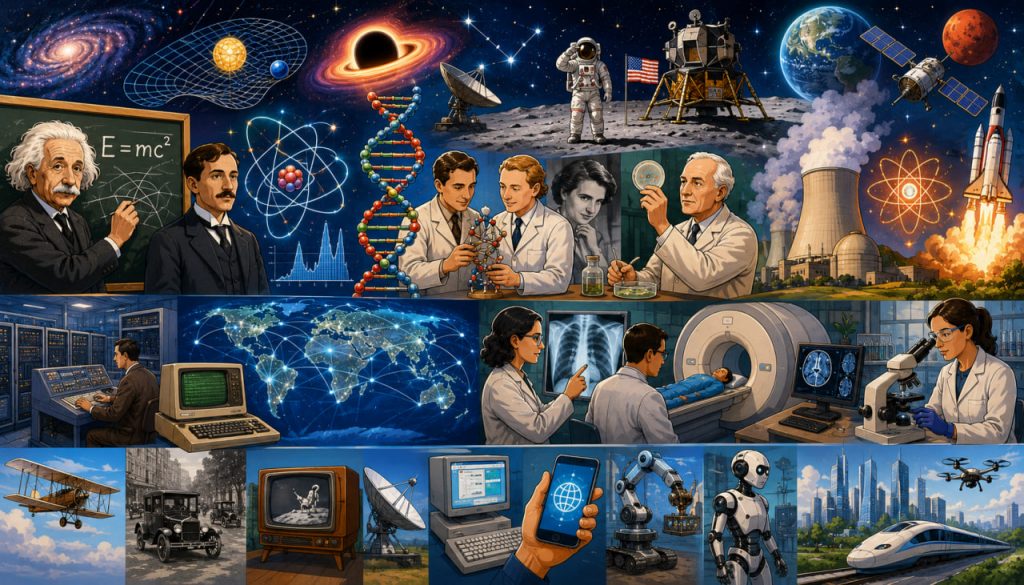
The 20th century completely transformed humanity’s understanding of:
- The universe
- Matter
- Life
- Space
- Technology
- The human body
In just one hundred years, science advanced faster than during many previous centuries combined.
Humanity moved from:
- Early airplanes
to: - Space travel
- Quantum physics
- Nuclear energy
- Computers
- Genetic engineering
- Artificial intelligence foundations
Many discoveries from the last century changed not only:
- Science itself
but also: - Civilization
- Medicine
- Industry
- Communication
- Everyday life
Some breakthroughs revealed astonishing truths about:
- Reality
- Time
- Space
- Human biology
while others created technologies that permanently changed modern society.
Understanding the greatest scientific discoveries of the previous century helps explain why modern civilization looks radically different from the world of the 1800s.
Relativity Changed the Understanding of Space and Time
One of the most important scientific revolutions came from:
- Albert Einstein
His theories of:
- Special Relativity
and: - General Relativity
completely transformed physics.
Einstein showed that:
- Time is not absolute
- Space and time are connected
- Gravity bends spacetime itself
These ideas helped explain:
- Black holes
- Cosmic expansion
- Time dilation
- Modern GPS systems
Physicist Stephen Hawking called relativity:
“Probably the greatest scientific achievement of the human mind.”
Relativity became one of the foundations of modern cosmology.
Quantum Mechanics Revealed a Strange Microscopic Universe
While relativity explained large cosmic structures, scientists also discovered that:
- The microscopic world behaves very differently from everyday reality.
Quantum mechanics revealed phenomena such as:
- Wave-particle duality
- Quantum uncertainty
- Probability-based physics
- Quantum tunneling
Particles no longer behaved like simple tiny objects.
Instead:
- Matter and energy followed bizarre probabilistic laws.
Quantum mechanics eventually enabled technologies including:
- Semiconductors
- Lasers
- Computers
- MRI scanners
- Modern electronics
Without quantum physics:
- Modern digital civilization would not exist.
The Discovery of DNA Changed Biology Forever
One of the greatest biological discoveries involved:
- DNA structure
In 1953, scientists:
- James Watson
- Francis Crick
with crucial contributions from: - Rosalind Franklin
helped reveal the:
- Double helix structure of DNA
This discovery explained how living organisms:
- Store genetic information
- Pass traits between generations
Modern genetics, biotechnology, and medicine were transformed completely afterward.
DNA research later enabled:
- Genome sequencing
- Genetic engineering
- Modern forensic science
Antibiotics Revolutionized Medicine
Before antibiotics:
- Minor infections could become deadly.
The discovery of:
- Penicillin
by Alexander Fleming became one of medicine’s greatest breakthroughs.
Antibiotics dramatically reduced deaths from:
- Bacterial infections
- Pneumonia
- Wound infections
- Surgical complications
Millions of lives were saved during the 20th century because of antimicrobial medicine.
However, scientists now face growing concerns involving:
- Antibiotic resistance.
Nuclear Physics Unlocked Atomic Energy
The discovery of:
- Nuclear fission
changed both science and geopolitics permanently.
Scientists learned atoms contain:
- Enormous stored energy
This led to:
- Nuclear reactors
- Atomic weapons
- Nuclear medicine
The atomic age demonstrated humanity’s ability to harness:
- Fundamental forces of matter
for both:
- Progress
and: - Destruction
Nuclear science remains one of the most powerful and controversial scientific achievements ever made.
Space Exploration Changed Humanity’s Perspective
The 20th century also marked humanity’s first steps into:
- Outer space
Major milestones included:
- Satellites
- Moon landing
- Planetary probes
- Space telescopes
In 1969:
- Humans walked on the Moon for the first time.
Astronauts and spacecraft transformed understanding of:
- Earth
- The Solar System
- The universe
Images of Earth from space also deeply influenced:
- Environmental awareness
- Global thinking
- Planetary identity
Computers Created the Digital Age
The invention of:
- Electronic computers
became one of the most civilization-changing developments of the century.
Early computers evolved into:
- Personal computers
- Smartphones
- The internet
- Artificial intelligence systems
Computer science revolutionized:
- Communication
- Economics
- Science
- Engineering
- Education
Virtually every modern industry now depends on:
- Computational technology.
The Internet Connected Humanity
The development of:
- The internet
transformed global communication faster than almost any technology in history.
Information became:
- Instantly accessible
- Globally distributed
The internet reshaped:
- Business
- Science
- Media
- Politics
- Education
- Human relationships
At the same time, it introduced new challenges involving:
- Misinformation
- Privacy
- Cybersecurity
- Digital addiction
The Expansion of Cosmology
20th-century astronomy revealed astonishing facts about the universe.
Scientists discovered:
- Galaxies beyond the Milky Way
- The expanding universe
- Cosmic background radiation
- Black holes
Modern cosmology suggested the universe began with:
- The Big Bang
roughly:
- 13.8 billion years ago.
These discoveries radically changed humanity’s understanding of cosmic history.
Medical Imaging Allowed Humans to See Inside the Body
Technologies such as:
- X-rays
- MRI
- CT scanning
- Ultrasound
transformed medicine.
Doctors could now observe:
- Organs
- Bones
- Tumors
- Brain activity
without invasive surgery.
Medical imaging dramatically improved:
- Diagnosis
- Surgery
- Emergency medicine
- Neuroscience research
Evolution and Modern Biology Advanced Rapidly
Biology expanded enormously during the 20th century through discoveries involving:
- Genetics
- Evolution
- Molecular biology
- Ecology
- Microbiology
Scientists learned how:
- Cells function
- Genes operate
- Proteins form
- Ecosystems interact
This created modern biotechnology and advanced medicine.
Artificial Intelligence Began Emerging
Although AI became more advanced mainly in the 21st century, its foundations were created during the previous century.
Scientists developed:
- Machine learning concepts
- Neural networks
- Computer logic systems
Computer scientist Alan Turing helped establish many principles of:
- Modern computing
- Artificial intelligence theory
These early breakthroughs laid the groundwork for modern AI systems.
Why the 20th Century Was So Unique
The previous century compressed extraordinary scientific progress into a very short historical period.
Humanity moved from:
- Horse transportation
to: - Spaceflight and global digital networks
within only a few generations.
This rapid acceleration changed:
- Society
- Warfare
- Medicine
- Industry
- Human identity itself.
Science Also Created Ethical Challenges
Many discoveries brought both:
- Benefits
and: - Risks
For example:
- Nuclear energy created atomic bombs
- The internet enabled misinformation
- Genetic technologies raised ethical questions
Scientific progress alone does not automatically guarantee:
- Wisdom
- Stability
- Responsible use
Human ethics remain critically important.
Why These Discoveries Still Matter Today
Modern civilization continues relying on:
- Quantum physics
- Computers
- Antibiotics
- Space technology
- Genetics
- Relativity
These discoveries shaped nearly every aspect of modern life.
The scientific revolutions of the 20th century permanently changed how humanity understands:
- Reality
- Life
- The universe
- Technology
- Itself
And many scientists believe the next century may bring discoveries even more transformative than those already achieved.
Interesting Facts
- GPS systems require Einstein’s relativity corrections daily.
- Quantum mechanics powers modern electronics.
- Penicillin saved millions of lives worldwide.
- Humans first landed on the Moon in 1969.
- DNA structure discovery revolutionized modern biology.
Glossary
- Relativity — Einstein’s theory describing space, time, and gravity.
- Quantum Mechanics — Physics governing microscopic particles.
- DNA — Molecule carrying genetic information in living organisms.
- Nuclear Fission — Splitting atomic nuclei to release energy.
- Artificial Intelligence — Computer systems performing intelligent tasks.