Modern people constantly use:
- Hours
- Minutes
- Seconds
without thinking about where these strange numbers actually came from.
Why does a day contain:
- 24 hours
instead of:
- 10 or 100?
And why are time units divided into:
- 60 minutes
- 60 seconds
instead of simpler decimal systems?
The answer lies deep in:
- Ancient astronomy
- Mathematics
- Early civilizations
- Human observation of the sky
Modern timekeeping combines traditions developed thousands of years ago by:
- Babylonians
- Egyptians
- Greek astronomers
Long before mechanical clocks existed, humans already needed reliable ways to measure:
- Daylight
- Seasons
- Planetary motion
- Agricultural cycles
The strange structure of modern time is essentially a surviving piece of ancient mathematics still used every day across the planet.
Understanding the history of time measurement reveals how astronomy shaped civilization itself.
Humans Measured Time Using the Sky
Long before clocks existed, humans relied on:
- The Sun
- The Moon
- Stars
to measure time.
Ancient civilizations observed:
- Sunrise and sunset
- Seasonal changes
- Star movement across the sky
These observations were critically important for:
- Agriculture
- Navigation
- Religion
- Survival
As societies became more organized, people needed increasingly accurate systems for:
- Calendars
- Daily schedules
- Ritual timing
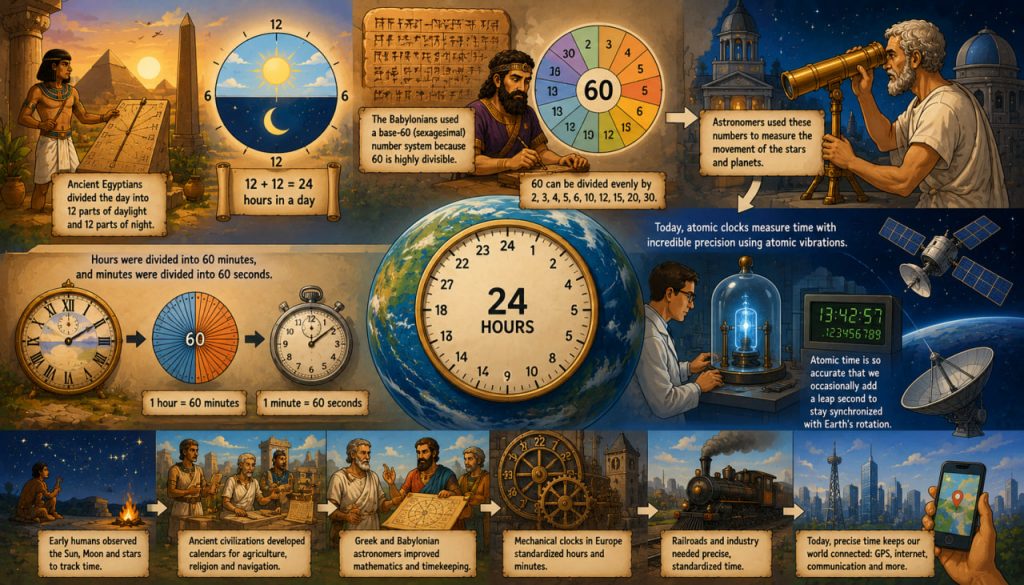
Why the Day Was Divided Into 24 Hours
The idea of dividing the day into 24 parts likely originated partly from:
- Ancient Egyptians
Thousands of years ago, Egyptians used:
- Sundials
- Star observations
to track time.
They divided:
- Daylight into 12 parts
and: - Nighttime into 12 parts
creating:
- 24 total divisions
One reason for the number 12 may involve:
- Astronomy
- Finger counting systems
Some historians believe ancient people counted finger bones using their thumbs, allowing easy counting to:
- 12 on one hand.
The 24-hour system gradually spread and became deeply connected to:
- Astronomy
- Navigation
- Timekeeping traditions.
Why 60 Became So Important
The number:
- 60
came mainly from:
- Ancient Babylonian mathematics
The Babylonians used a:
- Base-60 numbering system
called:
- Sexagesimal mathematics
instead of the modern:
- Base-10 decimal system.
This may sound strange today, but 60 has remarkable mathematical advantages.
Why Ancient Mathematicians Loved the Number 60
The number 60 is extremely divisible.
It can be divided evenly by:
- 2
- 3
- 4
- 5
- 6
- 10
- 12
- 15
- 20
- 30
This made calculations much easier before:
- Calculators
- Computers
- Modern algebra
Astronomers and merchants benefited enormously from flexible fractions and divisions.
Because of this, Babylonian mathematics strongly influenced:
- Astronomy
- Geometry
- Time measurement
for thousands of years.
How Hours Became 60 Minutes
Once the 24-hour system existed, later astronomers and mathematicians applied the Babylonian:
- Base-60 system
to subdivide hours.
Each hour became:
- 60 minutes
The word:
- Minute
originally came from Latin phrases meaning:
- “small division.”
Later:
- Minutes were divided again into 60 smaller parts called seconds.
Why Seconds Are Called “Seconds”
The word:
- Second
comes from:
- “second division”
because it represented:
- The second subdivision of an hour.
Historically:
- Hour → first division (minutes)
- Minute → second division (seconds)
This naming system originated in medieval Latin scientific terminology.
Astronomy Played a Huge Role
Timekeeping developed mainly because ancient civilizations needed accurate:
- Astronomical observations
Astronomers tracked:
- Planetary movement
- Solar cycles
- Lunar cycles
- Seasonal changes
Babylonian and Greek astronomers especially influenced:
- Mathematical astronomy
- Early calendars
- Time systems
Modern timekeeping still reflects these ancient astronomical traditions.
Mechanical Clocks Standardized Time
For most of history, time measurement remained:
- Inconsistent
- Localized
Mechanical clocks appearing in medieval Europe gradually standardized:
- Hours
- Minutes
- Daily schedules
Eventually:
- Railroads
- Industry
- Global trade
required increasingly precise time synchronization.
This helped establish modern:
- Standard time systems.
Why Decimal Time Failed
Some societies attempted replacing traditional time systems with:
- Decimal time
During the:
- French Revolution
France briefly experimented with:
- 10-hour days
- 100-minute hours
However, the system proved:
- Impractical
- Confusing
- Unpopular
The ancient 24-hour and 60-based structure remained deeply established globally.
Why Circles Also Use 360 Degrees
Interestingly, the Babylonian base-60 system also influenced:
- Geometry
A circle contains:
- 360 degrees
because:
- 360 works well mathematically and relates closely to ancient astronomical calculations.
Time and geometry therefore share the same ancient mathematical roots.
Modern Atomic Timekeeping
Today humanity measures time with extraordinary precision using:
- Atomic clocks
These clocks track vibrations inside atoms such as:
- Cesium atoms
Modern definitions of the second are based on:
- Atomic physics
rather than:
- Astronomy alone
This allows incredibly accurate systems used in:
- GPS
- Satellites
- Telecommunications
- Scientific research
Earth’s Rotation Is Not Perfect
Although humans define days as:
- 24 hours
Earth’s rotation is not perfectly constant.
Factors such as:
- Tidal forces
- Earthquakes
- Planetary motion
slightly affect rotation speed.
Scientists occasionally add:
- Leap seconds
to maintain synchronization between:
- Atomic clocks
and: - Earth’s rotation.
Why Time Feels Natural Today
Modern people rarely question:
- 24-hour days
- 60-minute hours
- 60-second minutes
because humans grow up using these systems constantly.
But these divisions are not:
- Universal laws of nature
They are historical inventions shaped by:
- Ancient civilizations
- Astronomy
- Mathematics
- Human practicality
The structure of timekeeping represents thousands of years of accumulated scientific tradition.
The Influence of Ancient Civilizations Still Exists
Every time humans:
- Check a clock
- Schedule meetings
- Use GPS
- Measure seconds
they are indirectly using systems created by civilizations that existed:
- Thousands of years ago.
Ancient Babylonian mathematics and Egyptian astronomy still influence modern daily life in surprisingly direct ways.
Why Timekeeping Changed Civilization
Precise time measurement helped humanity develop:
- Navigation
- Astronomy
- Engineering
- Industry
- Global communication
Without standardized time:
- Modern civilization would function very differently.
Timekeeping became one of humanity’s most important scientific and technological achievements.
Why This Ancient System Survived
The reason the 24/60 system survived for thousands of years is simple:
- It works extremely well.
The combination of:
- Astronomical observation
- Mathematical flexibility
- Cultural tradition
created a system efficient enough to remain useful even in the age of:
- Atomic physics
- Satellites
- Artificial intelligence
Modern clocks may be digital, but their structure still carries the mathematical fingerprints of ancient civilizations watching the sky thousands of years ago.
Interesting Facts
- The Babylonians used a base-60 number system.
- Ancient Egyptians helped develop the 24-hour day concept.
- France once experimented with decimal time.
- Atomic clocks are accurate to tiny fractions of a second.
- Modern GPS systems depend on extremely precise time measurement.
Glossary
- Sexagesimal System — Number system based on 60 instead of 10.
- Atomic Clock — Ultra-precise clock using atomic vibrations.
- Astronomy — Scientific study of celestial objects and space.
- Leap Second — Small time adjustment added to synchronize clocks with Earth’s rotation.
- Decimal System — Number system based on powers of 10.