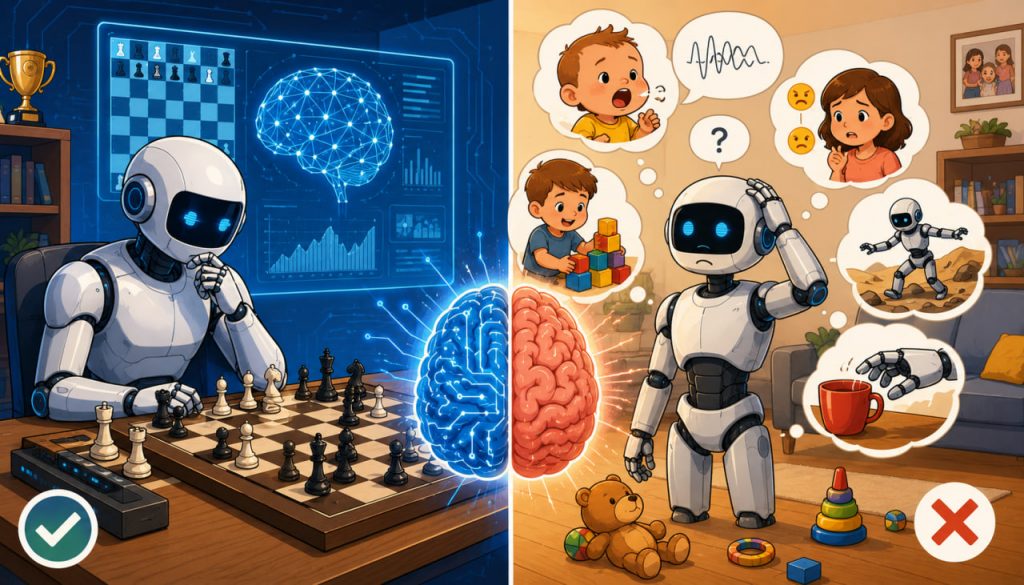
At first glance, artificial intelligence seems astonishingly smart.
Modern AI systems can:
- Defeat chess champions
- Solve complex equations
- Analyze massive datasets
- Write computer code
- Simulate human conversation
Yet surprisingly, many tasks that feel effortless to humans remain extremely difficult for machines.
For example:
- Walking through a crowded room
- Recognizing emotions
- Understanding sarcasm
- Grabbing objects naturally
- Learning language like a small child
This strange contradiction is known as:
- Moravec’s Paradox
The paradox reveals that:
- High-level reasoning tasks may actually be easier for computers than basic human sensory and motor skills.
In other words:
- A machine can beat grandmasters in chess
while still struggling with abilities possessed by: - Toddlers
- Animals
- Ordinary humans
Understanding Moravec’s Paradox helps explain:
- The strengths of AI
- The weaknesses of AI
- The incredible complexity of the human brain
and why true human-like intelligence remains one of science’s greatest challenges.
What Is Moravec’s Paradox?
Moravec’s Paradox is the observation that:
- Tasks humans find difficult are often easy for computers
while: - Tasks humans find effortless are often extremely difficult for AI.
The paradox was described by researchers including:
- Hans Moravec
- Marvin Minsky
- Rodney Brooks
during the 1980s.
The central idea is simple:
- Human evolution spent millions of years optimizing sensory and motor abilities.
As a result:
- Basic human perception is incredibly sophisticated.
Why Chess Is Relatively Easy for AI
Chess appears extremely intelligent because it involves:
- Strategy
- Planning
- Calculation
- Logic
However, chess also follows:
- Clear rules
- Predictable structure
- Defined possibilities
Computers are excellent at:
- Searching possibilities
- Calculating moves
- Evaluating positions rapidly
AI systems can analyze millions of chess positions per second.
This makes games like:
- Chess
- Checkers
- Go
well suited for:
- Computational brute force
- Pattern recognition
- Statistical optimization
Why Human Perception Is Much Harder
Now consider something seemingly simple:
- Recognizing a face in poor lighting
- Understanding a child’s emotional tone
- Catching a falling object
- Walking on uneven ground
Humans perform these tasks:
- Instantly
- Automatically
- Unconsciously
But for AI, these abilities require enormous computational complexity.
The brain continuously processes:
- Vision
- Sound
- Balance
- Spatial awareness
- Movement
- Context
- Emotion
all simultaneously.
Evolution Built the Human Brain for Survival
Hans Moravec explained the paradox partly through:
- Evolutionary history
Humans and animals spent hundreds of millions of years evolving:
- Perception
- Movement
- Reflexes
- Sensory processing
These abilities became deeply optimized biologically.
In contrast:
- Abstract mathematics
- Logic
- Chess
are relatively recent human inventions.
The brain performs ancient survival tasks extraordinarily efficiently because evolution refined them over vast timescales.
Baby Talk Is Surprisingly Complex
One famous example involves:
- Human language acquisition
A small child learns language through:
- Observation
- Social interaction
- Context
- Emotional cues
- Environmental feedback
Children understand:
- Tone
- Intention
- Facial expression
- Ambiguity
long before mastering formal grammar.
For AI systems:
- Natural language understanding remains enormously difficult despite major advances.
Human Vision Is Incredibly Advanced
Humans often underestimate how complicated:
- Vision
really is.
The brain instantly recognizes:
- Objects
- Faces
- Motion
- Distance
- Shadows
- Context
under changing conditions.
Computer vision systems improved dramatically in recent years, yet they still struggle with situations humans solve effortlessly.
For example:
- A toddler can identify a cat from unusual angles more reliably than many older AI systems.
Movement and Robotics Are Hard Problems
Walking appears simple for humans because the brain controls:
- Muscles
- Balance
- Reflexes
- Spatial coordination
automatically.
But robots struggle greatly with:
- Uneven surfaces
- Stairs
- Dexterous hand movement
- Object manipulation
Robotic movement requires extremely complicated:
- Sensor integration
- Real-time adjustment
- Environmental interpretation
Why AI Seems Smart but Limited
Modern AI excels in:
- Narrow specialized tasks
These systems can become:
- Superhuman in specific domains
Yet they often lack:
- Common sense
- Flexible reasoning
- Deep contextual understanding
An AI might solve advanced equations while failing at:
- Understanding ordinary social situations.
The Human Brain Is Massively Parallel
One reason humans handle perception so well is that the brain processes information through:
- Massive parallel neural systems
Billions of neurons simultaneously analyze:
- Vision
- Sound
- Touch
- Body position
- Memory
- Emotions
Modern computers process information differently from:
- Biological brains
which helps explain why human sensory intelligence remains difficult to reproduce.
AI Learned Games Before Common Sense
One fascinating consequence of Moravec’s Paradox is that AI mastered:
- Chess
- Complex calculations
- Data analysis
before achieving reliable:
- Human-like perception
- Common sense reasoning
- Everyday understanding
This surprised many early AI researchers.
People assumed:
- “Hard intellectual tasks”
would be the greatest challenge.
In reality:
- Basic perception turned out far more difficult.
Deep Learning Improved AI Dramatically
Modern:
- Deep learning systems
greatly improved:
- Image recognition
- Speech recognition
- Language models
These advances partially reduced some aspects of:
- Moravec’s Paradox
However, AI still struggles with:
- General understanding
- Physical reasoning
- Flexible adaptation
compared to humans.
Expert Opinion on the Paradox
Robotics researcher Rodney Brooks explained:
“The world is its own best model.”
This means humans interact naturally with reality because biological brains evolved directly inside:
- Complex physical environments
AI systems still lack much of this:
- Embodied experience.
The Paradox Reveals Human Complexity
Moravec’s Paradox demonstrates that:
- Human intelligence is not mainly about formal logic.
Instead, much of intelligence involves:
- Perception
- Context
- Motor coordination
- Social understanding
- Emotional interpretation
These abilities are deeply rooted in:
- Evolutionary biology.
Why Common Sense Is Difficult for AI
Humans possess enormous amounts of:
- Implicit knowledge
For example, humans automatically understand:
- Gravity
- Object permanence
- Social behavior
- Physical danger
- Emotional tone
AI systems often lack this broad intuitive understanding unless specifically trained.
Could AI Eventually Overcome the Paradox?
Scientists continue improving AI through:
- Robotics
- Neural networks
- Reinforcement learning
- Multimodal systems
Some experts believe future AI may eventually approach:
- Human-like sensory intelligence
However, replicating the full flexibility of the human brain remains extremely difficult.
Moravec’s Paradox still highlights one important truth:
- The abilities humans take for granted are often the most extraordinary.
Why Moravec’s Paradox Matters
The paradox changes how people think about:
- Intelligence itself
It reveals that:
- Human cognition is deeply shaped by evolution and embodiment.
Tasks humans consider “easy” are often actually:
- Computational miracles
performed effortlessly by the brain.
Meanwhile:
- Logic and calculation
which humans perceive as difficult:
- Fit naturally into computer architecture.
Moravec’s Paradox therefore reminds humanity that the ordinary abilities of:
- Children
- Animals
- Everyday human perception
may represent some of the most advanced forms of intelligence found in nature.
Interesting Facts
- AI mastered chess long before reliable robotic walking.
- Toddlers outperform many machines in flexible learning.
- Human vision requires enormous neural processing power.
- Moravec’s Paradox was proposed during the 1980s.
- Evolution optimized sensory skills over hundreds of millions of years.
Glossary
- Moravec’s Paradox — Observation that human-like perception is harder for AI than logic tasks.
- Deep Learning — AI method using multi-layer neural networks.
- Computer Vision — AI field focused on image and visual interpretation.
- Neural Network — Computational model inspired by biological brains.
- Embodied Intelligence — Intelligence shaped by interaction with the physical world.