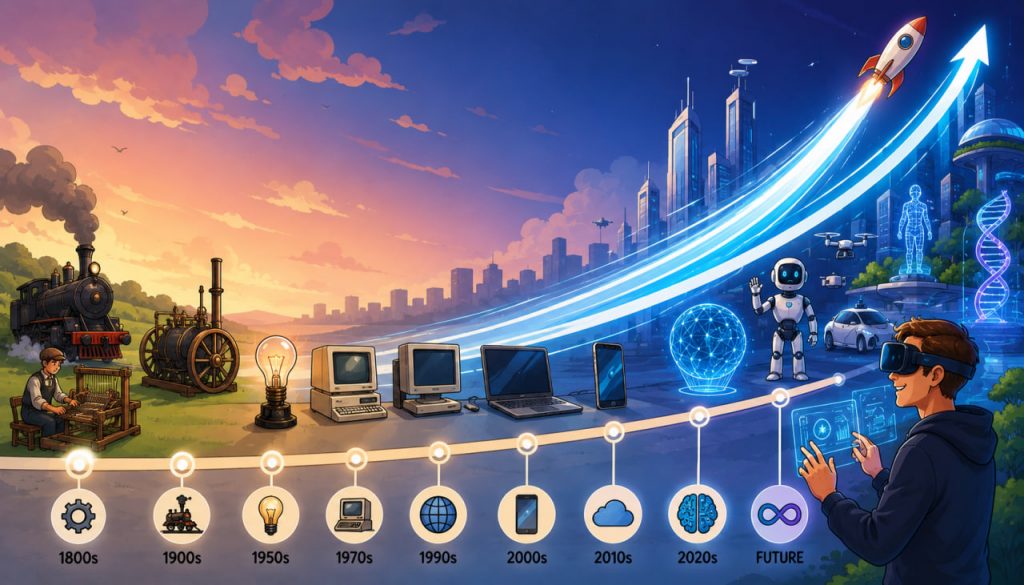
Human technological progress does not develop at a constant speed.
Instead, many scientists and futurists argue that innovation grows:
- Faster and faster over time
This idea became widely known through:
- The Law of Accelerating Returns
popularized by inventor and futurist:
- Ray Kurzweil
The concept suggests that technological progress often grows:
- Exponentially
rather than: - Linearly
This means each new generation of technology helps create even more powerful technologies at increasing speed.
For example:
- Computers help design better computers
- AI helps accelerate scientific research
- Faster communication speeds global innovation
As progress compounds, technological change may begin to feel:
- Explosive
- Unpredictable
- Civilization-transforming
The Law of Accelerating Returns is often connected to discussions about:
- Artificial intelligence
- Biotechnology
- Robotics
- Space technology
- The future of humanity
Understanding this idea helps explain why modern technological development sometimes appears to accelerate dramatically within only a few decades.
What Is the Law of Accelerating Returns?
The Law of Accelerating Returns proposes that:
- Technological progress accelerates because each advancement increases humanity’s ability to create further advancements.
In simple terms:
- Technology improves the tools used to create new technology.
This creates a:
- Positive feedback loop
where innovation continuously speeds up itself.
Ray Kurzweil argued that many important technologies follow:
- Exponential growth curves
rather than gradual linear development.
Linear Growth vs Exponential Growth
Humans naturally think in:
- Linear patterns
For example:
- 1, 2, 3, 4, 5
However, exponential growth behaves differently:
- 1, 2, 4, 8, 16, 32
At first exponential growth appears:
- Slow
but eventually it becomes:
- Extremely rapid
This explains why technological change sometimes seems manageable for decades before suddenly transforming society very quickly.
Moore’s Law Became a Famous Example
One major example involves:
- Moore’s Law
which observed that computer processing power roughly doubled every:
- Two years
for many decades.
As computing improved:
- Technology became smaller
- Faster
- Cheaper
- More powerful
This helped drive:
- Smartphones
- Internet expansion
- Artificial intelligence
- Modern digital society
Moore’s Law became one of the strongest examples supporting accelerating technological progress.
Why Technology Speeds Up Technology
Modern innovation rarely happens in isolation.
New technologies often improve:
- Research tools
- Communication systems
- Manufacturing
- Data analysis
- Automation
For example:
- Supercomputers accelerate scientific simulations
- AI assists drug discovery
- The internet spreads knowledge instantly
This creates increasing interconnectedness between:
- Scientific fields
- Engineering
- Global collaboration
Human Knowledge Accumulates
Scientific knowledge does not reset each generation.
Instead:
- Humanity builds on previous discoveries.
Modern scientists inherit:
- Libraries
- Databases
- Mathematical theories
- Experimental results
- Global communication networks
This cumulative process allows new breakthroughs to occur:
- Faster than in earlier centuries.
Artificial Intelligence May Accelerate Progress Further
Many researchers believe AI could dramatically intensify:
- Accelerating technological growth
AI systems already assist with:
- Coding
- Medical analysis
- Language processing
- Scientific research
- Pattern recognition
If AI eventually improves:
- AI development itself
progress could potentially accelerate even more rapidly.
This possibility is sometimes connected to discussions about:
- Technological singularity.
The Industrial Revolution Started a Major Acceleration
For most of human history:
- Technological change was relatively slow.
However, the:
- Industrial Revolution
greatly accelerated innovation involving:
- Steam engines
- Manufacturing
- Transportation
- Energy production
After this period:
- Technological cycles became progressively shorter.
Modern digital revolutions accelerated even faster.
The Internet Changed Global Innovation
The internet dramatically increased humanity’s ability to:
- Share information instantly
Researchers worldwide can now collaborate in:
- Real time
Knowledge spreads globally within:
- Seconds
instead of:
- Years or centuries
This rapid communication helps accelerate:
- Science
- Engineering
- Education
- Technological development.
Smartphones Contain Extraordinary Technology
Modern smartphones demonstrate accelerating progress clearly.
A single phone now combines technologies involving:
- Supercomputing
- GPS
- Cameras
- Artificial intelligence
- Global communication
- Internet access
All inside a device smaller than:
- A notebook
Many experts note that smartphones possess vastly more computing power than:
- Early space program computers.
Biotechnology Is Also Accelerating
Progress is not limited to computers.
Fields such as:
- Genetics
- Biotechnology
- Medicine
are advancing increasingly rapidly.
Genome sequencing that once required:
- Years and billions of dollars
can now be completed:
- Much faster and far cheaper.
AI-assisted biology may further accelerate:
- Medical discoveries.
Some Scientists Disagree
Not all experts fully accept:
- Unlimited accelerating progress
Critics argue that:
- Physical limits
- Economic constraints
- Resource shortages
- Human institutions
may slow technological growth.
Some technologies become harder to improve over time rather than easier.
Progress may also vary greatly between:
- Scientific fields.
The Technological Singularity
One controversial idea connected to accelerating returns is:
- The technological singularity
This hypothetical scenario suggests AI could eventually become:
- Smarter than humans
and begin improving itself rapidly.
If this occurred:
- Technological progress might become extremely difficult for humans to predict or control.
Supporters and critics continue debating:
- Whether such a future is realistic.
Human Society Struggles to Adapt Quickly
Even if technology accelerates rapidly, human:
- Psychology
- Politics
- Social systems
often evolve much more slowly.
This creates challenges involving:
- Ethics
- Employment
- Privacy
- Education
- Economic inequality
Society may struggle adapting to technologies changing faster than:
- Human institutions can respond.
Why Exponential Growth Feels Counterintuitive
Humans evolved mainly in environments where:
- Change was gradual
The brain naturally expects:
- Slow steady progression
Exponential growth therefore feels:
- Surprising
- Sudden
- Overwhelming
Many technological revolutions appear:
- “Unexpected”
because humans underestimate how quickly compounding systems can grow.
Expert Opinion on Accelerating Progress
Ray Kurzweil explained:
“Technological progress is exponential, contrary to the common-sense ‘intuitive linear’ view.”
His ideas strongly influenced discussions about:
- AI
- Future technology
- Human civilization’s long-term trajectory.
Why the Law Matters
The Law of Accelerating Returns helps explain:
- Rapid digital transformation
- Fast scientific advancement
- Explosive computing growth
- Increasing automation
It suggests humanity may experience:
- More technological change in the coming decades
than occurred during: - Entire previous centuries.
Whether this future becomes:
- Beneficial
or: - Dangerous
depends largely on how wisely humanity manages:
- Innovation
- Ethics
- Artificial intelligence
- Global cooperation
The accelerating speed of progress may become one of the defining forces shaping the future of civilization itself.
Interesting Facts
- Modern smartphones are vastly more powerful than early Moon mission computers.
- Human genome sequencing became dramatically cheaper over time.
- Moore’s Law helped drive the computer revolution.
- Exponential growth initially appears deceptively slow.
- AI may eventually help accelerate scientific discovery itself.
Glossary
- Exponential Growth — Growth that increases increasingly rapidly over time.
- Moore’s Law — Observation that computer chip power doubles roughly every two years.
- Technological Singularity — Hypothetical point where AI surpasses human intelligence.
- Artificial Intelligence (AI) — Machines performing tasks associated with human intelligence.
- Positive Feedback Loop — Process where outputs reinforce and accelerate further growth.