Modern civilization depends heavily on:
- Computers
- Smartphones
- Artificial intelligence
- Internet infrastructure
- Digital technology
Yet only a few decades ago, computers were:
- Huge
- Slow
- Extremely expensive
The astonishing speed of technological progress in computing became closely associated with an idea called:
- Moore’s Law
This famous observation predicted that computer chips would become:
- More powerful
- Smaller
- Cheaper
at an extraordinary pace.
For decades, Moore’s Law accurately described the rapid growth of:
- Processing power
- Semiconductor technology
- Computing efficiency
Its influence helped drive:
- The computer revolution
- Modern electronics
- Artificial intelligence
- Global digital transformation
Although Moore’s Law is not a physical law like gravity, it became one of the most important guiding principles in:
- Technology
- Engineering
- Computer science
Understanding Moore’s Law helps explain why humanity moved so quickly from:
- Early room-sized computers
to: - Powerful smartphones and AI systems
within only a few generations.
What Is Moore’s Law?
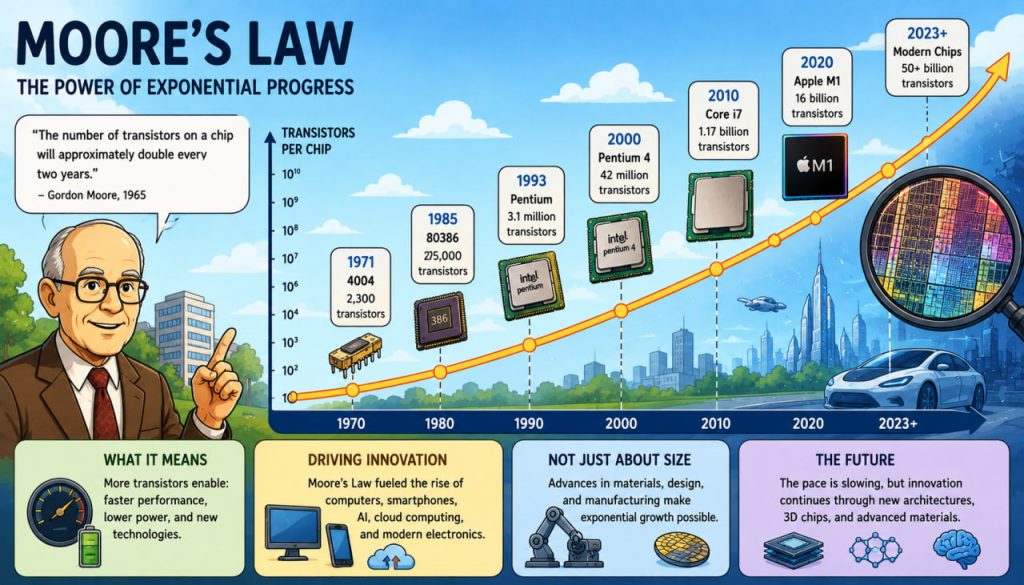
Moore’s Law is the observation that:
- The number of transistors on computer chips tends to double roughly every two years.
This idea was proposed in:
- 1965
by:
- Gordon Moore
co-founder of:
- Intel Corporation
Moore noticed semiconductor technology was improving at an astonishingly regular pace.
As transistors became:
- Smaller
- Faster
- More energy-efficient
computers rapidly increased in power while decreasing in:
- Size
- Cost
What Is a Transistor?
A transistor is a tiny electronic component that acts like:
- A microscopic switch
Modern processors contain:
- Billions of transistors
These transistors control electrical signals used for:
- Calculations
- Memory
- Logic operations
- Data processing
The smaller engineers could make transistors:
- The more powerful chips became.
Why Moore’s Law Was So Important
Moore’s Law became incredibly influential because it allowed the technology industry to:
- Predict future progress
Companies could plan around expectations that computing power would continue increasing rapidly.
This fueled massive innovation involving:
- Software
- Electronics
- Telecommunications
- Artificial intelligence
Many industries evolved assuming:
- Computers would become exponentially more capable over time.
Computing Power Grew Exponentially
Moore’s Law represented:
- Exponential growth
rather than:
- Linear improvement
At first progress appeared:
- Gradual
But over decades, exponential growth produced extraordinary changes.
For example:
- Early computers filled entire rooms
while: - Modern smartphones fit inside pockets
yet possess dramatically more computational power.
The Digital Revolution
Moore’s Law helped enable:
- Personal computers
- The internet
- Smartphones
- Cloud computing
- AI systems
Without rapidly improving semiconductor technology:
- Modern digital civilization would not exist in its current form.
Advances in computing transformed:
- Business
- Medicine
- Communication
- Science
- Entertainment
- Education
Why Smaller Transistors Matter
Smaller transistors improve computer performance because:
- Signals travel shorter distances
- Chips consume less power
- More components fit into smaller areas
This allows devices to become:
- Faster
- More compact
- More efficient
Engineers continuously pushed semiconductor manufacturing to astonishing microscopic scales.
AI and Moore’s Law
Artificial intelligence benefited enormously from:
- Increasing computing power
Modern AI systems require:
- Massive data processing
- Complex neural network calculations
- High-performance hardware
Without decades of semiconductor improvement:
- Modern AI breakthroughs would have been far more difficult.
Moore’s Law Was Not a Natural Law
Despite its name, Moore’s Law is not:
- A law of physics
It was mainly:
- An industry observation
However, it became surprisingly accurate for many decades.
This consistency amazed scientists and engineers because maintaining exponential growth required:
- Constant innovation
- New manufacturing methods
- Massive investment
The Semiconductor Industry Became Extremely Advanced
Modern chip manufacturing is among humanity’s most sophisticated technological achievements.
Creating advanced processors requires:
- Nanometer-scale engineering
- Ultra-clean facilities
- Precision photolithography
- Quantum-level material science
Some transistor features are now:
- Smaller than viruses.
Challenges to Moore’s Law
In recent years, Moore’s Law began facing increasing difficulties.
As transistors become extremely tiny:
- Physical limitations emerge
including:
- Heat problems
- Quantum effects
- Manufacturing complexity
- Rising costs
It became harder and more expensive to continue shrinking semiconductor components.
Quantum Physics Creates Problems
At microscopic scales:
- Quantum mechanics affects electronics
Electrons may begin behaving unpredictably when transistor sizes approach atomic dimensions.
This creates major engineering challenges involving:
- Leakage currents
- Heat generation
- Reliability issues
Physics itself now limits traditional chip scaling.
Engineers Developed New Solutions
To continue improving performance, companies began exploring:
- Multi-core processors
- Parallel computing
- Specialized AI chips
- 3D chip stacking
- Quantum computing research
Instead of relying only on transistor shrinking, engineers now seek:
- Alternative approaches to performance growth.
Moore’s Law Changed Human Expectations
One fascinating effect of Moore’s Law is psychological.
People became accustomed to technology improving:
- Constantly
- Rapidly
- Predictably
Modern consumers often expect:
- Faster devices every few years
This expectation shaped:
- Markets
- Innovation culture
- Consumer electronics industries
Smartphones Demonstrate Moore’s Law Clearly
Modern smartphones contain extraordinary technology including:
- Cameras
- AI processors
- Internet communication
- GPS systems
- Powerful graphics chips
All inside compact devices.
Compared to computers from the:
- 1970s or 1980s
modern phones are vastly more powerful.
Moore’s Law and the Future
Some experts believe traditional Moore’s Law is:
- Slowing down
However, computing innovation continues through:
- AI acceleration
- New architectures
- Quantum research
- Advanced materials
Future technological growth may follow different patterns while still maintaining rapid progress overall.
Expert Opinion on Moore’s Law
Gordon Moore originally explained:
“The complexity for minimum component costs has increased at a rate of roughly a factor of two per year.”
His prediction became one of the most influential observations in modern technological history.
Why Moore’s Law Matters
Moore’s Law helped humanity enter:
- The Information Age
It accelerated:
- Scientific research
- Communication
- Artificial intelligence
- Global connectivity
- Digital economies
The rapid increase in computing power transformed civilization faster than almost any previous technological development.
Even if Moore’s Law eventually slows, its historical impact remains enormous.
It demonstrated how exponential technological growth could reshape:
- Society
- Industry
- Human life itself
within only a few decades.
Interesting Facts
- Modern processors contain billions of transistors.
- Some transistor components are smaller than viruses.
- Gordon Moore proposed Moore’s Law in 1965.
- Smartphones today outperform many older supercomputers.
- Moore’s Law helped drive the global computer revolution.
Glossary
- Transistor — Tiny electronic switch used in computer chips.
- Semiconductor — Material used to control electrical conductivity in electronics.
- Exponential Growth — Growth increasing increasingly rapidly over time.
- Processor — Main computing chip performing calculations and instructions.
- Quantum Mechanics — Physics governing microscopic particles and atomic behavior.