Modern physics explains the universe using an incredibly successful framework called:
- The Standard Model
This theory describes:
- Fundamental particles
- Forces of nature
- Matter interactions
with astonishing accuracy.
Yet despite its success, physicists know the Standard Model remains:
- Incomplete
It cannot fully explain:
- Dark matter
- Gravity
- The enormous mass differences between particles
- The early universe’s extreme conditions
To solve these mysteries, scientists developed one of the most ambitious theories in modern physics:
- Supersymmetry
often abbreviated as:
- SUSY
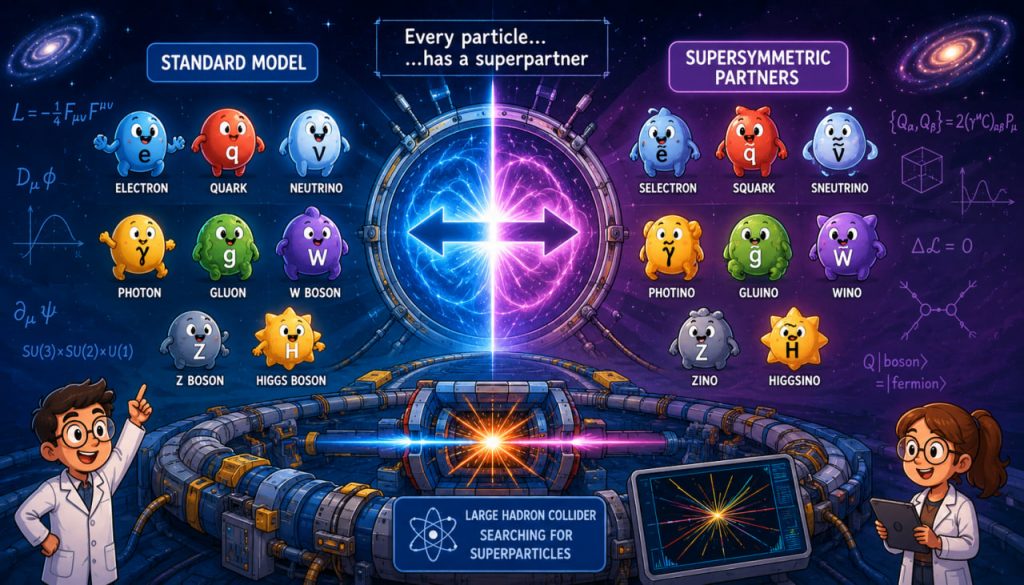
Supersymmetry proposes that every known particle in nature may have:
- A hidden “superpartner” particle
This elegant idea could potentially unify several major problems in physics while revealing entirely new forms of matter.
For decades, supersymmetry became one of the most influential ideas in:
- Particle physics
- Cosmology
- Quantum theory
- String theory
Although scientists have not yet proven supersymmetry experimentally, the theory continues shaping research into the deepest structure of reality.
Understanding supersymmetry helps reveal how physicists attempt to answer some of humanity’s biggest questions about:
- Matter
- Space
- Energy
- The origin of the universe itself.
What Is Supersymmetry?
Supersymmetry is a theoretical idea proposing that:
- Every fundamental particle has a corresponding superpartner particle.
In the Standard Model, particles belong mainly to two categories:
- Fermions
- Bosons
Fermions include:
- Electrons
- Quarks
- Neutrinos
These particles form:
- Matter
Bosons include:
- Photons
- Gluons
- Higgs bosons
These particles carry:
- Fundamental forces
Supersymmetry suggests every fermion has a boson partner, and every boson has a fermion partner.
Examples of Superpartners
If supersymmetry exists:
- Electrons would have “selectrons”
- Quarks would have “squarks”
- Photons would have “photinos”
These hypothetical particles have never been directly observed yet.
Physicists believe superpartners may be:
- Extremely massive
- Difficult to produce experimentally
which could explain why they remain hidden.
Why Physicists Invented Supersymmetry
Supersymmetry was not created randomly.
Scientists developed the theory because several deep problems appeared in:
- Modern physics
SUSY offered elegant mathematical solutions to some of these puzzles.
The Hierarchy Problem
One major issue involves:
- The Higgs boson
Quantum physics predicts the Higgs mass should become:
- Enormously large
because of quantum fluctuations.
However, experimentally:
- The Higgs mass remains relatively small.
This strange mismatch became known as:
- The hierarchy problem
Supersymmetry could help stabilize Higgs mass calculations through:
- Superpartner particle effects.
Supersymmetry and Dark Matter
One of the biggest mysteries in cosmology involves:
- Dark matter
Astronomers discovered most matter in the universe appears:
- Invisible
yet still exerts:
- Gravitational effects
Supersymmetry predicts stable weakly interacting particles that could potentially explain:
- Dark matter itself
This became one of the theory’s strongest attractions.
Unifying the Forces of Nature
Physicists dream of unifying all fundamental forces into:
- One elegant framework
The forces include:
- Electromagnetism
- Strong nuclear force
- Weak nuclear force
- Gravity
Supersymmetry helps mathematical models align more closely when scientists calculate:
- Force unification at extremely high energies.
Supersymmetry and String Theory
Supersymmetry became deeply connected to:
- String theory
which suggests particles may actually be:
- Tiny vibrating strings
Many versions of string theory mathematically require:
- Supersymmetry
to remain internally consistent.
This strengthened SUSY’s importance in theoretical physics.
Why Superpartners Matter
If superpartners exist, they could dramatically expand understanding of:
- Matter
- Energy
- Quantum fields
Entire hidden particle families may exist beyond:
- Ordinary visible matter
This would fundamentally reshape:
- Cosmology
- Particle physics
- The structure of reality itself.
The Large Hadron Collider Search
One of the largest scientific machines ever built:
- The Large Hadron Collider (LHC)
was partly designed to search for:
- Supersymmetric particles
Located near Geneva, the LHC accelerates particles to enormous energies and collides them together.
Scientists hoped these collisions might reveal:
- Superpartners
or indirect evidence supporting supersymmetry.
Why Supersymmetry Has Not Been Confirmed
So far:
- No confirmed supersymmetric particles have been detected.
This created growing debate among physicists.
Possible explanations include:
- Superpartners are heavier than expected
- Current experiments lack sufficient energy
- Supersymmetry may exist differently than predicted
- The theory could be incomplete or incorrect
Despite this uncertainty, many physicists still consider SUSY:
- Mathematically compelling.
The Theory Is Extremely Elegant
One reason scientists admire supersymmetry is:
- Mathematical beauty
Physicists often value theories showing:
- Symmetry
- Simplicity
- Internal consistency
Supersymmetry creates elegant relationships between:
- Matter particles
- Force particles
Many researchers believe nature often follows:
- Symmetrical mathematical principles.
Quantum Physics and Symmetry
Symmetry plays a central role in modern physics.
Many conservation laws arise from:
- Symmetrical properties of nature
Examples include:
- Energy conservation
- Momentum conservation
Supersymmetry extends these symmetry ideas much further.
Could Supersymmetry Exist in Nature?
Some physicists believe supersymmetry may appear only at:
- Extremely high energies
such as conditions shortly after:
- The Big Bang
This could explain why superpartners are not easily observed today.
The early universe may have behaved very differently from:
- Modern low-energy conditions.
Critics and Scientific Debate
Not all physicists support supersymmetry strongly.
Critics argue:
- Decades of failed detection weaken confidence in the theory.
Others believe physics may require:
- Entirely new ideas
rather than increasingly complex supersymmetric models.
This debate remains one of the most important discussions in:
- Modern theoretical physics.
Expert Opinion on Supersymmetry
Physicist Edward Witten once described supersymmetry as:
“One of the greatest intellectual achievements in theoretical physics.”
Even scientists uncertain about its physical reality often acknowledge:
- SUSY’s extraordinary mathematical influence.
Supersymmetry and the Future of Physics
If supersymmetry were eventually discovered, it could revolutionize:
- Cosmology
- Quantum physics
- Particle physics
- Understanding of dark matter
It might become one of the greatest discoveries in scientific history.
If experiments continue failing to find evidence, physics may face:
- Major theoretical reconsideration.
Either outcome would deeply affect humanity’s understanding of:
- The universe.
Why Supersymmetry Fascinates Scientists
Supersymmetry represents humanity’s attempt to uncover:
- Hidden layers of reality
The theory combines:
- Mathematics
- Quantum mechanics
- Cosmology
- Particle physics
into a grand effort to explain:
- Nature’s deepest structure
Whether supersymmetry ultimately proves correct or not, it already transformed modern theoretical physics and pushed scientists toward deeper questions about:
- Matter
- Energy
- Space
- Time
- The origins of existence itself.
Interesting Facts
- Supersymmetry predicts hidden partner particles for known particles.
- The Large Hadron Collider searches partly for SUSY evidence.
- Supersymmetry is closely connected to string theory.
- Some supersymmetric particles could potentially explain dark matter.
- No confirmed superpartners have been discovered yet.
Glossary
- Supersymmetry (SUSY) — Theory proposing partner particles for all fundamental particles.
- Fermion — Matter-forming particle such as electrons or quarks.
- Boson — Particle carrying fundamental forces.
- Dark Matter — Invisible matter affecting gravity in the universe.
- Large Hadron Collider (LHC) — World’s largest particle accelerator used for high-energy physics experiments.