Cooking technology evolved enormously over the last century. Traditional:
- Wood stoves
- Gas burners
- Electric heating coils
gradually gave way to more advanced kitchen systems.
One of the most innovative cooking technologies today is:
- The induction cooktop
Unlike ordinary electric or gas stoves, induction cooking uses:
- Electromagnetic fields
to heat cookware directly.
This allows induction cooktops to become:
- Faster
- More energy-efficient
- Safer
- Easier to clean
compared to many traditional cooking methods.
Induction technology is increasingly popular in:
- Homes
- Restaurants
- Professional kitchens
because it combines:
- Precise temperature control
- Rapid heating
- Modern design
At the same time, many people still misunderstand how induction cooking actually works.
Understanding induction cooktops reveals fascinating connections between:
- Physics
- Magnetism
- Electricity
- Modern engineering
while also showing how science transforms everyday household technology.
What Is an Induction Cooktop?
An induction cooktop is a cooking surface that heats pots and pans using:
- Electromagnetic induction
Instead of heating the stove surface first, induction systems generate:
- Magnetic fields
that directly heat compatible cookware.
The cookware itself becomes:
- The heating element
while the cooktop surface remains relatively:
- Cooler.
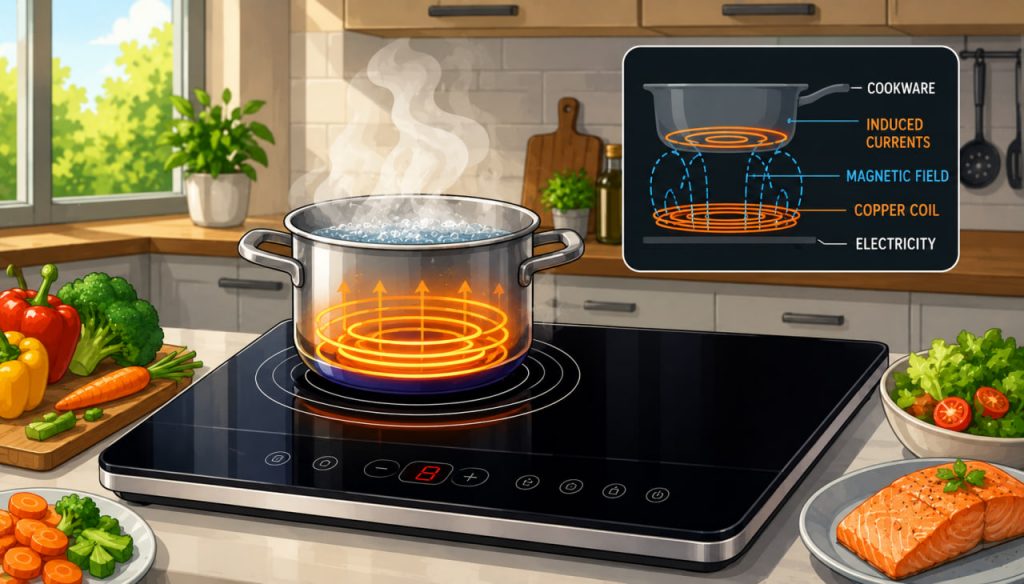
How Induction Heating Works
Inside the induction cooktop are:
- Copper coils
When electricity passes through these coils, they create:
- Rapidly changing magnetic fields
If magnetic cookware is placed on the surface:
- Electrical currents form inside the metal pan
These currents generate:
- Heat directly within the cookware.
This process is based on:
- Electromagnetic induction
a principle discovered by physicist:
- Michael Faraday.
Why the Surface Stays Cooler
Unlike traditional electric stoves:
- Induction cooktops do not heat the burner itself directly.
Most heat appears inside:
- The pan
rather than:
- The glass surface
The cooktop still becomes warm indirectly because:
- Hot cookware transfers heat back to the surface.
This makes induction cooking generally:
- Safer than exposed flames or glowing electric coils.
Induction Cooking Is Extremely Fast
One major advantage of induction cooktops is:
- Speed
Because heat transfers directly into cookware:
- Energy loss is reduced
Water often boils significantly faster compared to:
- Gas stoves
- Traditional electric burners
Professional chefs often value induction systems for:
- Rapid temperature response.
Energy Efficiency
Induction cooktops are usually more:
- Energy-efficient
than many traditional cooking systems.
Gas stoves lose substantial heat into:
- Surrounding air
Traditional electric burners also waste energy heating:
- Burner surfaces
Induction systems transfer much more energy directly into:
- The cookware itself.
This may help reduce:
- Electricity consumption
- Kitchen heat buildup.
Precise Temperature Control
Induction cooking allows highly accurate:
- Temperature adjustment
The heating response changes almost instantly when power levels are modified.
This precision helps with:
- Delicate sauces
- Chocolate melting
- Simmering
- Professional cooking techniques
Chefs often compare induction responsiveness to:
- Gas cooking
while maintaining electric efficiency.
Safety Advantages
Induction cooktops offer several important safety benefits:
- No open flame
- Reduced burn risk
- Automatic pan detection
- Faster shutdown
Many systems stop heating automatically when:
- Cookware is removed
This lowers risks involving:
- Accidental overheating
- Fire hazards.
Cookware Compatibility
Not all cookware works with induction systems.
Induction requires:
- Magnetic materials
Compatible cookware usually includes:
- Cast iron
- Carbon steel
- Magnetic stainless steel
Aluminum, copper, and glass cookware often require:
- Special induction-compatible bases.
A simple magnet test can help determine compatibility.
Why Induction Cooktops Use Glass Surfaces
Most induction cooktops feature:
- Smooth ceramic-glass surfaces
Glass itself does not interfere strongly with:
- Magnetic fields
This allows electromagnetic energy to pass through efficiently while maintaining:
- Easy cleaning
- Modern appearance
- Heat resistance.
Induction and Electromagnetism
Induction cooking demonstrates one of physics’ most important principles:
- Electromagnetic induction
This same principle is used in:
- Electric generators
- Transformers
- Wireless charging systems
- Industrial equipment
Induction cooktops essentially apply advanced electromagnetic engineering to:
- Everyday cooking.
Induction Cooktops and Health Concerns
Some people worry about:
- Electromagnetic fields
from induction stoves.
Current scientific evidence generally indicates properly designed induction cooktops are:
- Safe for normal household use
However, individuals with certain:
- Medical implants
such as older pacemakers may need:
- Additional precautions
depending on device specifications.
Why Restaurants Use Induction
Many professional kitchens increasingly adopt induction technology because it offers:
- Fast cooking
- Precise control
- Cooler kitchen temperatures
- Easier cleaning
Induction systems also reduce:
- Open flame hazards
in busy restaurant environments.
Cleaning Is Easier
Because the surface does not become extremely hot:
- Food spills burn less frequently
This makes induction cooktops often easier to:
- Wipe clean
compared to:
- Gas burners
- Traditional electric coil stoves.
Disadvantages of Induction Cooking
Despite many advantages, induction systems also have limitations.
Possible disadvantages include:
- Higher purchase cost
- Cookware compatibility requirements
- Dependence on electricity
- Expensive repairs in some cases
Some users also prefer:
- Traditional gas flame cooking experiences.
Induction Technology Continues Improving
Modern induction systems increasingly include:
- Smart sensors
- Touchscreen controls
- Automatic heat adjustment
- Safety monitoring
- Connectivity features
Kitchen technology continues evolving rapidly alongside:
- Smart home systems.
Expert Opinion on Induction Cooking
Chef and food scientist Hervé This noted:
“Precise temperature control changes the way cooking can be approached scientifically.”
Many culinary professionals appreciate induction systems because they combine:
- Efficiency
- Precision
- Modern engineering.
Induction Cooking and the Future
As energy efficiency becomes increasingly important, induction cooktops may continue growing in popularity.
Some governments and environmental researchers support technologies reducing:
- Indoor air pollution
- Gas emissions
- Energy waste
Induction systems fit well into:
- Electrified modern kitchens.
Why Induction Cooktops Matter
Induction cooking represents a fascinating intersection between:
- Physics
- Engineering
- Household technology
- Culinary science
What appears to be:
- Simple cooking equipment
actually relies on advanced principles involving:
- Magnetism
- Electromagnetic fields
- Electrical currents
Induction cooktops show how scientific discoveries from physics laboratories eventually become part of:
- Everyday life
transforming ordinary activities such as cooking through the invisible power of:
- Electromagnetism.
Interesting Facts
- Induction cooktops heat cookware directly using magnetic fields.
- Water often boils faster on induction than on gas stoves.
- The glass surface itself usually remains relatively cooler.
- Induction technology is based on Faraday’s electromagnetic principles.
- Many professional chefs now use induction cooking systems.
Glossary
- Electromagnetic Induction — Generation of electrical currents through changing magnetic fields.
- Magnetic Field — Invisible region where magnetic forces act.
- Cookware — Pots and pans used for cooking.
- Ceramic Glass — Heat-resistant smooth glass material used on cooktops.
- Electrical Current — Flow of electric charge through a material.