At first glance, empty space appears completely:
- Silent
- Motionless
- Void of matter
For centuries, many scientists believed a vacuum represented:
- True nothingness
However, modern quantum physics revealed something astonishing:
- Empty space is not truly empty.
Even in a perfect vacuum, invisible quantum activity constantly exists.
One of the strangest demonstrations of this hidden activity is:
- The Casimir Effect
a phenomenon where two extremely close objects in a vacuum begin attracting each other seemingly because of:
- “Nothing.”
This mysterious force emerges from:
- Quantum fluctuations
- Vacuum energy
- The strange behavior of virtual particles
The Casimir Effect became one of the most fascinating predictions of:
- Quantum field theory
because it shows that even empty space possesses:
- Physical properties
- Energy
- Measurable forces
Understanding the Casimir Effect helps reveal how reality behaves at extremely small scales where:
- Quantum mechanics dominates the universe.
What Is the Casimir Effect?
The Casimir Effect is a tiny attractive force that appears between:
- Two very closely spaced conductive surfaces in a vacuum.
The effect was predicted in:
- 1948
by Dutch physicist:
- Hendrik Casimir
He discovered that quantum physics predicts certain energy differences in empty space between:
- Parallel metal plates
This imbalance creates a measurable:
- Attractive force.
Empty Space Is Not Truly Empty
Classical physics once imagined vacuum as:
- Completely empty nothingness
Quantum mechanics changed this understanding dramatically.
According to quantum field theory:
- Space constantly experiences microscopic energy fluctuations.
Even in vacuum:
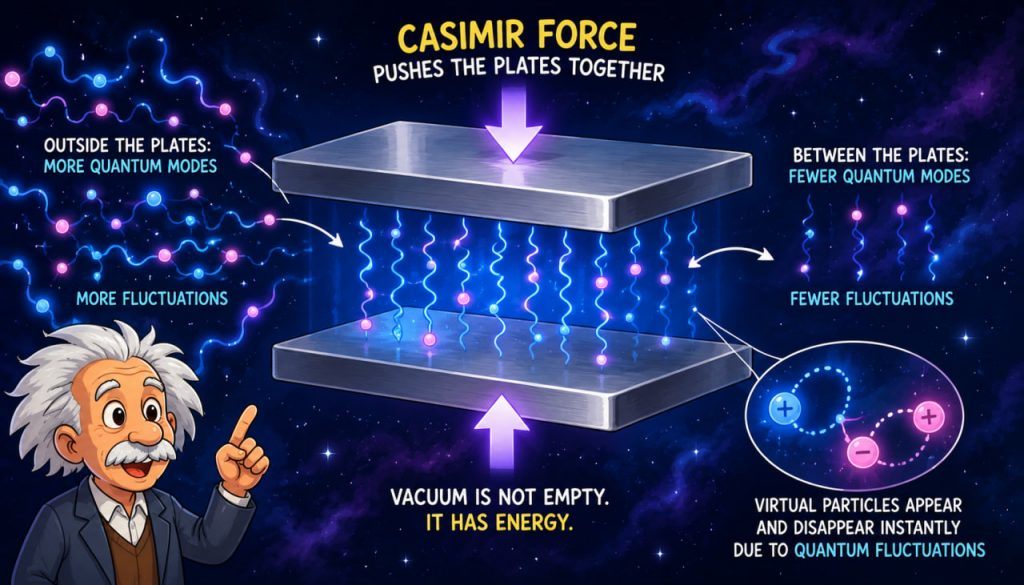
- Virtual particles continuously appear and disappear
for extremely short times.
This restless quantum activity fills all space.
Virtual Particles and Quantum Fluctuations
Quantum physics allows temporary particle creation because of:
- The uncertainty principle
Tiny particle-antiparticle pairs may briefly emerge before:
- Annihilating almost instantly
These are called:
- Virtual particles
Although they cannot normally be observed directly, their effects influence:
- Physical measurements
- Atomic behavior
- Vacuum energy.
How the Casimir Force Appears
Imagine placing:
- Two metal plates
extremely close together inside a vacuum.
Quantum fluctuations outside the plates differ slightly from:
- Fluctuations between the plates
because only certain electromagnetic wave patterns fit into the narrow gap.
This creates:
- Unequal vacuum pressure
which pushes the plates toward each other.
In simple terms:
- Empty space itself generates force.
The Plates Are Pulled Together
The Casimir force is usually:
- Extremely tiny
It becomes noticeable only at:
- Nanometer-scale distances
Yet experiments confirmed the force exists physically.
This means:
- Vacuum energy can produce measurable motion.
Objects may literally move because of:
- Quantum fluctuations in empty space.
Why the Casimir Effect Matters
The Casimir Effect became important because it demonstrates:
- Quantum vacuum energy is real
rather than purely mathematical.
It provides experimental evidence supporting:
- Quantum field theory
one of the most successful theories in modern physics.
Quantum Mechanics Makes Vacuum Strange
The Casimir Effect reveals that vacuum is not:
- Passive emptiness
Instead, quantum vacuum behaves more like:
- A dynamic energetic field
filled with:
- Invisible fluctuations
- Electromagnetic activity
- Temporary particle interactions.
This challenges ordinary human intuition about:
- “Nothingness.”
The Effect Was Experimentally Confirmed
For decades the Casimir Effect remained difficult to measure because the force is:
- Extremely weak
However, modern precision experiments successfully detected it.
Scientists used:
- Microscopic plates
- Lasers
- Sensitive instruments
to verify the phenomenon.
Today the Casimir Effect is considered:
- Experimentally established physics.
The Force Is Tiny but Important
Although the Casimir force is small, it becomes significant in:
- Nanotechnology
- Microelectronics
- MEMS devices
At microscopic scales:
- Tiny quantum forces can strongly affect engineering systems.
Researchers study Casimir forces when designing:
- Nanomachines
- Microchips
- Precision instruments.
The Casimir Effect and Nanotechnology
In microscopic devices, tiny moving components may unintentionally:
- Stick together
because of Casimir attraction.
This phenomenon is sometimes called:
- Stiction
and engineers must account for it in:
- Nano-engineering design.
Quantum physics therefore directly affects modern technology.
Vacuum Energy and Cosmology
The Casimir Effect also connects to deeper mysteries involving:
- Dark energy
- Vacuum energy density
- The expansion of the universe
Physicists still struggle to fully understand how quantum vacuum energy relates to:
- Cosmology
One of the biggest unsolved problems in physics involves explaining:
- Why vacuum energy behaves the way it does.
Einstein and Quantum Vacuum
Although Einstein helped revolutionize physics, the strange vacuum concepts behind the Casimir Effect emerged later through:
- Quantum field theory
This theory combined:
- Quantum mechanics
- Special relativity
- Electromagnetism
into one mathematical framework describing:
- Fields and particles.
The Casimir Effect Challenges Human Intuition
Humans evolved in:
- Large-scale classical environments
Our intuition expects:
- Empty space to do nothing.
The Casimir Effect demonstrates that at quantum scales:
- Reality behaves very differently.
Vacuum itself becomes:
- Active
- Energetic
- Physically influential.
Could the Casimir Effect Be Used for Future Technology?
Scientists continue exploring whether vacuum forces might someday help with:
- Nanomachines
- Quantum devices
- Advanced engineering systems
However, practical large-scale applications remain:
- Extremely challenging
because the effect is so weak at ordinary distances.
The Casimir Effect and Science Fiction
The idea that:
- “Empty space contains energy”
inspired many:
- Science fiction concepts
- Futuristic energy theories
However, real Casimir forces are far too small for dramatic fictional technologies such as:
- Unlimited vacuum energy machines.
Still, the effect remains one of physics’ strangest verified phenomena.
Expert Opinion on Vacuum Physics
Physicist Richard Feynman once emphasized how strange quantum physics truly is:
“I think I can safely say that nobody understands quantum mechanics.”
The Casimir Effect perfectly illustrates why quantum reality often feels:
- Counterintuitive
- Mysterious
- Difficult to visualize.
Why the Casimir Effect Is So Fascinating
The Casimir Effect reveals that:
- “Nothing” is not truly nothing.
Even empty vacuum contains:
- Quantum fields
- Energy fluctuations
- Invisible activity
This discovery transformed scientific understanding of:
- Space
- Matter
- Reality itself
The effect also demonstrates how modern physics uncovers hidden behaviors far beyond ordinary human experience.
At microscopic scales, the universe becomes a place where:
- Empty space pushes objects
- Virtual particles flicker in and out of existence
- Vacuum itself possesses measurable force
making the Casimir Effect one of the most extraordinary predictions ever confirmed by quantum physics.
Interesting Facts
- The Casimir Effect was predicted in 1948.
- Vacuum is not truly empty according to quantum physics.
- The force becomes noticeable only at extremely tiny distances.
- Quantum fluctuations constantly occur even in empty space.
- The Casimir Effect influences nanotechnology research.
Glossary
- Casimir Effect — Quantum force causing nearby objects in vacuum to attract each other.
- Quantum Fluctuation — Temporary change in energy occurring in empty space.
- Virtual Particle — Short-lived particle appearing temporarily due to quantum effects.
- Vacuum Energy — Energy associated with empty space in quantum physics.
- Quantum Field Theory — Framework combining quantum mechanics and field physics.