Every day, billions of people use:
- GPS navigation
- Smartphone maps
- Vehicle navigation systems
- Aircraft guidance systems
Most users assume GPS works because of:
- Satellites
- Radio signals
- Computers
While this is true, there is another crucial ingredient behind GPS accuracy:
Albert Einstein’s theory of relativity.
Without relativistic corrections, GPS positioning errors would accumulate so rapidly that navigation systems would become:
- Unreliable
- Inaccurate
- Potentially dangerous
within a surprisingly short time.
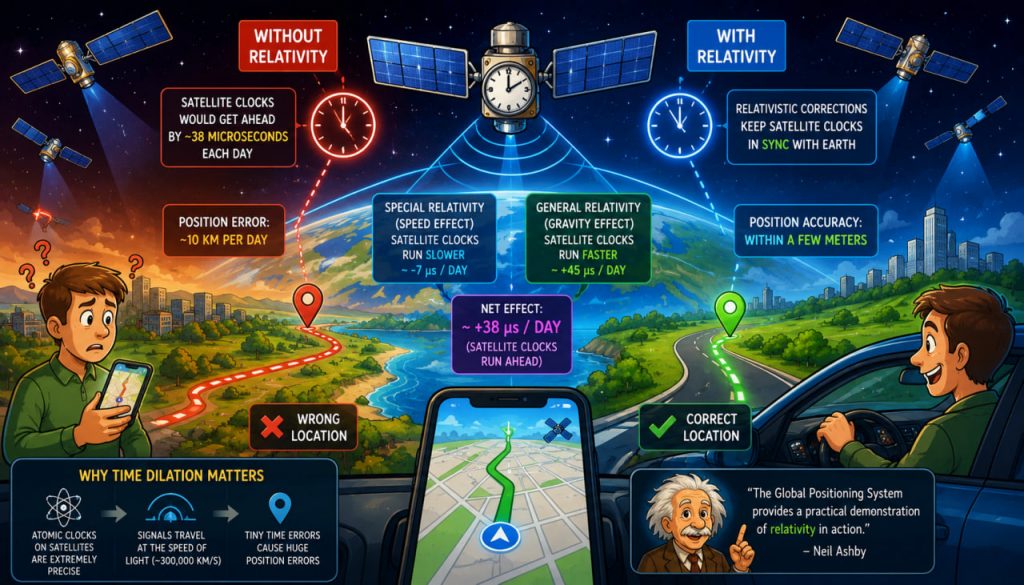
In fact, if engineers ignored Einstein’s equations, GPS errors would grow by approximately:
- 10 kilometers (6 miles) per day
making modern navigation practically useless.
This remarkable fact represents one of the clearest examples of how abstract theoretical physics directly affects everyday life.
The GPS system serves as a real-world demonstration that:
- Time does not flow equally everywhere.
- Motion and gravity influence the passage of time.
- Einstein’s predictions accurately describe reality.
Understanding why GPS requires relativity reveals one of the most fascinating intersections between:
- Physics
- Space technology
- Engineering
- Everyday life
What Is GPS?
The Global Positioning System (GPS) consists of:
- A network of satellites orbiting Earth
- Ground control stations
- User receivers
GPS satellites continuously broadcast:
- Their position
- Precise timestamps
Your phone calculates location by measuring:
- How long signals take to travel from multiple satellites
Since radio waves move at:
- The speed of light
even tiny timing errors create significant position errors.
For GPS to work accurately, clocks must be extraordinarily precise.
GPS Depends on Atomic Clocks
Each GPS satellite carries:
- Atomic clocks
These clocks are among the most accurate timekeeping devices ever built.
They can measure time with errors of only:
- Billionths of a second
This level of precision is necessary because:
Light travels about 300 meters in just one microsecond.
A very small clock error can therefore produce large navigation mistakes.
Einstein Changed Our Understanding of Time
Before Einstein, scientists generally believed:
- Time flowed identically everywhere
Einstein’s work revealed something revolutionary:
Time is not absolute.
Instead:
- Motion affects time
- Gravity affects time
Different observers may experience time passing at slightly different rates.
These effects are normally tiny in everyday life but become important for:
- Satellites
- Spacecraft
- High-speed systems
Special Relativity Slows Satellite Clocks
Einstein’s:
- Special Theory of Relativity
predicts that moving clocks run slower than stationary clocks.
GPS satellites travel at approximately:
- 14,000 km/h (8,700 mph)
Because of this high speed:
Satellite clocks lose about 7 microseconds per day compared to clocks on Earth.
Although this sounds insignificant, GPS requires extreme precision.
General Relativity Speeds Satellite Clocks Up
Einstein’s:
- General Theory of Relativity
introduces another effect.
Gravity influences the passage of time.
Stronger gravity causes:
- Time to pass more slowly
We experience stronger gravity on Earth’s surface than satellites do in orbit.
As a result:
Satellite clocks actually run faster than Earth clocks by about 45 microseconds per day.
This effect is larger than the slowing effect caused by motion.
The Two Effects Combine
The final result comes from combining:
- Special Relativity: -7 microseconds/day
- General Relativity: +45 microseconds/day
The net difference becomes:
- +38 microseconds per day
This means GPS satellite clocks gain approximately:
- 38 millionths of a second every day
compared to clocks on Earth.
Why 38 Microseconds Matter
At first glance:
- 38 microseconds sounds tiny
However, GPS measures distances using:
- Light-speed signals
A timing error of only:
- One microsecond
can create position errors of hundreds of meters.
A daily error of:
- 38 microseconds
would rapidly accumulate into navigation mistakes of:
- Around 10 kilometers per day
Without correction, GPS would quickly become unusable.
Engineers Correct the Clocks
To solve this problem, engineers deliberately adjust satellite clocks.
Before launch:
- GPS clocks are calibrated differently
so that once in orbit they tick at the correct rate relative to Earth.
Additional corrections are continuously applied through:
- Ground stations
- Satellite control systems
- Relativistic calculations
These adjustments ensure GPS remains accurate.
GPS Is a Daily Test of Relativity
One remarkable fact is that GPS effectively performs a constant experiment testing Einstein’s theories.
Every time someone uses:
- A smartphone map
- A navigation device
- A ride-sharing app
relativity corrections are helping calculate the position.
If Einstein’s equations were wrong:
- GPS would fail.
The system works precisely because relativity matches reality.
Other Satellite Systems Use Relativity Too
GPS is not unique.
Other navigation systems also rely on relativistic corrections, including:
- GLONASS
- Galileo
- BeiDou
All modern global navigation systems incorporate:
- Einstein’s physics
into their design.
Time Really Changes With Height
One surprising implication of relativity is that:
Time passes slightly faster at higher elevations.
People living on mountains experience time differently from people at sea level.
The difference is extremely small but measurable using:
- Atomic clocks
Scientists have experimentally confirmed this effect many times.
Relativity Was Once Considered Pure Theory
When Einstein developed relativity in:
- 1905
- 1915
many people viewed it as highly abstract theoretical physics.
No one imagined that one day billions of people would depend on those equations simply to:
- Find restaurants
- Navigate roads
- Track deliveries
- Use smartphones
This demonstrates how fundamental science can eventually transform technology.
Expert Opinion on GPS and Relativity
Physicist Neil Ashby, one of the leading experts on GPS relativity, explained:
“The Global Positioning System provides a practical demonstration of relativity in action.”
His work helped establish the relativistic corrections that modern GPS systems use today.
Why GPS Proves Einstein Was Right
The GPS system stands as one of the strongest real-world confirmations of:
- Special Relativity
- General Relativity
Every day, satellites orbiting Earth demonstrate that:
- Time is not universal
- Motion changes the flow of time
- Gravity changes the flow of time
Without accounting for these effects:
- Navigation would fail
- Aircraft guidance would suffer
- Smartphone maps would drift rapidly
What began as revolutionary theoretical physics over a century ago now quietly guides billions of people across the planet.
GPS reminds us that some of the strangest ideas in science eventually become essential tools of everyday civilization.
Interesting Facts
- GPS satellites orbit about 20,200 kilometers above Earth.
- Satellite clocks gain about 38 microseconds per day relative to Earth clocks.
- GPS errors would grow by roughly 10 kilometers per day without relativity corrections.
- Atomic clocks can lose less than a second over millions of years.
- Every smartphone navigation app relies indirectly on Einstein’s theories.
Glossary
- GPS — Global Positioning System used for navigation and location tracking.
- Atomic Clock — Extremely precise clock based on atomic vibrations.
- Special Relativity — Einstein’s theory describing physics at high speeds.
- General Relativity — Einstein’s theory describing gravity as spacetime curvature.
- Time Dilation — The phenomenon where time passes at different rates depending on speed or gravity.