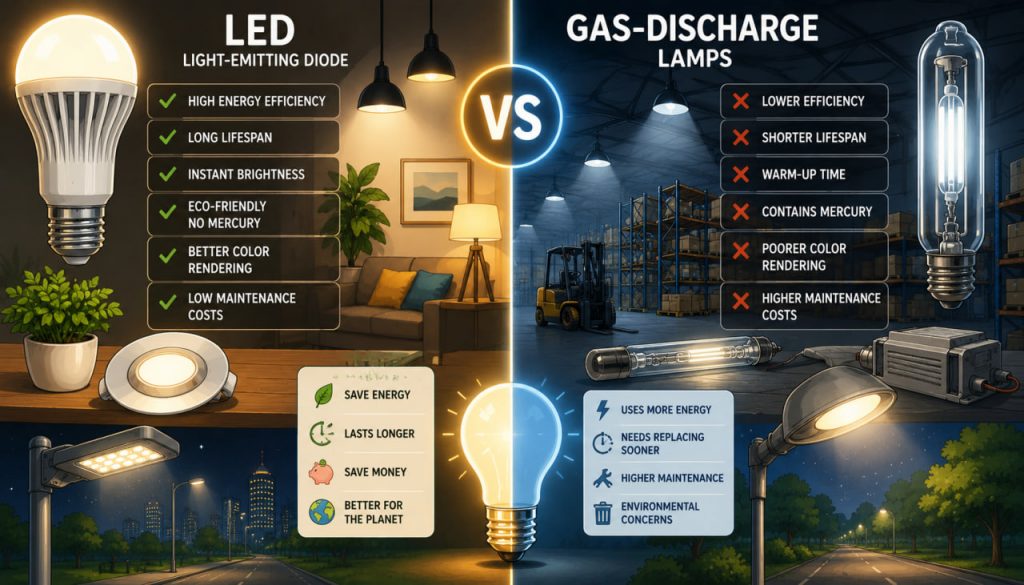
Lighting is something most people use every day without thinking much about the technology behind it. Yet the type of lamp you choose affects:
- Electricity consumption
- Lifespan
- Brightness
- Maintenance costs
- Environmental impact
For decades, gas-discharge lamps dominated many applications, including:
- Street lighting
- Industrial facilities
- Warehouses
- Stadiums
However, the rise of:
- Light-Emitting Diodes (LEDs)
has transformed the lighting industry.
Today, LEDs are replacing many older technologies because they offer:
- Higher efficiency
- Longer lifespan
- Better control
- Lower operating costs
Still, gas-discharge lamps remain in use for certain specialized applications.
Understanding the differences between these technologies helps consumers and businesses make informed decisions about:
- Energy savings
- Lighting quality
- Long-term costs
What Are LED Lamps?
LED stands for:
- Light-Emitting Diode
An LED produces light when electricity passes through a semiconductor material.
Unlike traditional lamps, LEDs do not rely on:
- Heated filaments
- Gas-filled tubes
Instead, they generate light directly through:
- Electronic processes
This makes LEDs extremely:
- Efficient
- Durable
- Compact
Modern LEDs are now used in:
- Homes
- Offices
- Vehicles
- Streetlights
- Smartphones
- Television screens
What Are Gas-Discharge Lamps?
Gas-discharge lamps generate light by sending electricity through:
- Ionized gas
The electric current excites atoms inside the lamp, producing light.
Common examples include:
- Fluorescent lamps
- Neon lamps
- Mercury-vapor lamps
- Metal-halide lamps
- Sodium-vapor lamps
For many decades these lamps offered better efficiency than:
- Traditional incandescent bulbs
and became widely adopted for large-scale lighting.
How LED Technology Works
LEDs use semiconductor materials that convert electrical energy directly into:
- Visible light
This process produces relatively little:
- Waste heat
compared to older lighting technologies.
Because fewer energy losses occur, LEDs can achieve very high:
- Luminous efficiency
while consuming less electricity.
How Gas-Discharge Lamps Work
Inside a gas-discharge lamp:
- Electricity excites gas atoms
These atoms emit:
- Ultraviolet light
- Visible light
Depending on the lamp design, special coatings may convert ultraviolet radiation into:
- Visible illumination
This process is efficient but generally more complex than LED operation.
Energy Efficiency Comparison
One of the biggest advantages of LEDs is:
- Energy efficiency
Modern LEDs often convert a much larger percentage of electricity into useful light.
Compared with many gas-discharge lamps, LEDs may:
- Consume less power
- Reduce electricity bills
- Lower operating costs
This advantage becomes especially important in:
- Large buildings
- Industrial facilities
- Municipal lighting systems
Lifespan Differences
LED lamps are famous for their:
- Long operational life
Many quality LEDs can operate for:
- 25,000 to 50,000 hours
or more
Some industrial models exceed:
- 100,000 hours
Gas-discharge lamps typically have shorter lifespans and often require:
- More frequent replacement
- Ballast maintenance
- Additional servicing
This increases long-term costs.
Instant Brightness
LED lamps reach full brightness:
- Almost instantly
Gas-discharge lamps often require:
- Warm-up periods
Some sodium and metal-halide lamps may need several minutes to achieve:
- Maximum brightness
This makes LEDs more practical for:
- Homes
- Offices
- Motion-activated systems
Color Quality and Comfort
Modern LED technology offers excellent:
- Color rendering
- Adjustable color temperatures
Users can choose:
- Warm white light
- Neutral white light
- Cool daylight tones
Many gas-discharge lamps produce less natural color reproduction.
This is particularly noticeable in:
- Retail stores
- Photography
- Interior design
where color accuracy matters.
Environmental Considerations
Many gas-discharge lamps contain:
- Mercury
Mercury is toxic and requires:
- Special disposal procedures
Improper disposal may create environmental risks.
LEDs generally contain:
- No mercury
making recycling and disposal safer.
This environmental advantage has encouraged governments to support:
- LED adoption
worldwide.
Heat Production
All lighting systems generate some heat.
However, LEDs generally produce:
- Less wasted heat
than many older technologies.
Reduced heat generation may help:
- Improve energy efficiency
- Lower cooling costs
- Extend fixture life
especially in large facilities.
Why Streetlights Are Becoming LED-Based
Many cities have replaced traditional:
- Sodium-vapor lamps
- Mercury-vapor lamps
with LED systems.
The reasons include:
- Lower energy consumption
- Reduced maintenance
- Better visibility
- Longer lifespan
Municipalities often save millions of dollars through:
- LED conversion programs
over time.
Are Gas-Discharge Lamps Still Useful?
Despite the growth of LEDs, gas-discharge lamps still appear in:
- Certain industrial applications
- Specialized lighting systems
- Scientific equipment
Some high-intensity discharge lamps provide:
- Extremely powerful illumination
for specific purposes.
However, the number of applications favoring LEDs continues to grow.
Smart Lighting and LEDs
LED technology integrates easily with:
- Smart home systems
- Sensors
- Automation platforms
Modern LED systems can:
- Change brightness
- Change color
- Respond to motion
- Operate remotely
These capabilities are difficult or impractical for many gas-discharge systems.
Cost Considerations
Initially, LED lamps often cost more than older technologies.
However, lower:
- Electricity use
- Maintenance requirements
- Replacement frequency
usually result in lower total ownership costs.
Over several years, LEDs frequently become:
- More economical
despite higher upfront prices.
Expert Opinion on Modern Lighting
Lighting engineer Roland Haitz, known for studying LED development, observed that improvements in LED technology were progressing at remarkable rates, similar to technological growth trends seen in electronics.
His work helped demonstrate why LEDs would eventually become dominant across many lighting sectors.
Which Technology Should You Choose?
For most modern applications, LEDs provide advantages in:
- Efficiency
- Lifespan
- Environmental impact
- Maintenance
- Light quality
Gas-discharge lamps may still serve specialized purposes, but for:
- Homes
- Offices
- Retail spaces
- Outdoor lighting
LED technology is usually the preferred choice.
As semiconductor technology continues advancing, LEDs are becoming:
- Brighter
- Cheaper
- More efficient
every year.
Why LED Lighting Represents the Future
The transition from gas-discharge lighting to LEDs represents one of the largest energy-efficiency improvements in modern infrastructure.
LEDs combine:
- Physics
- Electronics
- Materials science
to create lighting systems that are:
- Efficient
- Durable
- Environmentally friendly
For most consumers and businesses today, LEDs offer the best balance between:
- Performance
- Cost savings
- Sustainability
making them one of the most successful technological upgrades in modern everyday life.
Interesting Facts
- LEDs can last more than 50,000 hours.
- Many gas-discharge lamps contain mercury.
- LED streetlights are replacing sodium-vapor lamps worldwide.
- LEDs reach full brightness almost instantly.
- Modern LEDs are used in everything from smartphones to stadium lighting.
Glossary
- LED (Light-Emitting Diode) — Semiconductor device that produces light when electricity passes through it.
- Gas-Discharge Lamp — Lamp that generates light through electrically excited gas.
- Luminous Efficiency — Amount of visible light produced per unit of energy consumed.
- Mercury Vapor Lamp — Gas-discharge lamp that uses mercury to produce light.
- Color Rendering — Ability of a light source to accurately reveal colors.