Most waves in nature eventually:
- Spread out
- Lose their shape
- Dissipate their energy
A ripple on a pond gradually disappears. Sound waves weaken as they travel. Ocean waves eventually break apart.
However, there exists a special class of waves that behave very differently.
These unusual waves can:
- Travel long distances
- Maintain their shape
- Survive collisions with other waves
as if they were actual physical objects.
Scientists call these extraordinary phenomena:
- Solitons
Solitons are often described as:
- “Particle-like waves”
because they combine characteristics of both:
- Waves
- Particles
Since their discovery, solitons have become important in:
- Physics
- Oceanography
- Fiber-optic communications
- Plasma physics
- Quantum theory
Some researchers even believe soliton-like behavior may help explain phenomena ranging from:
- Rogue ocean waves
- Electrical signals
- Fundamental particle interactions
Understanding solitons reveals one of the strangest and most beautiful behaviors found in nature.
What Is a Soliton?
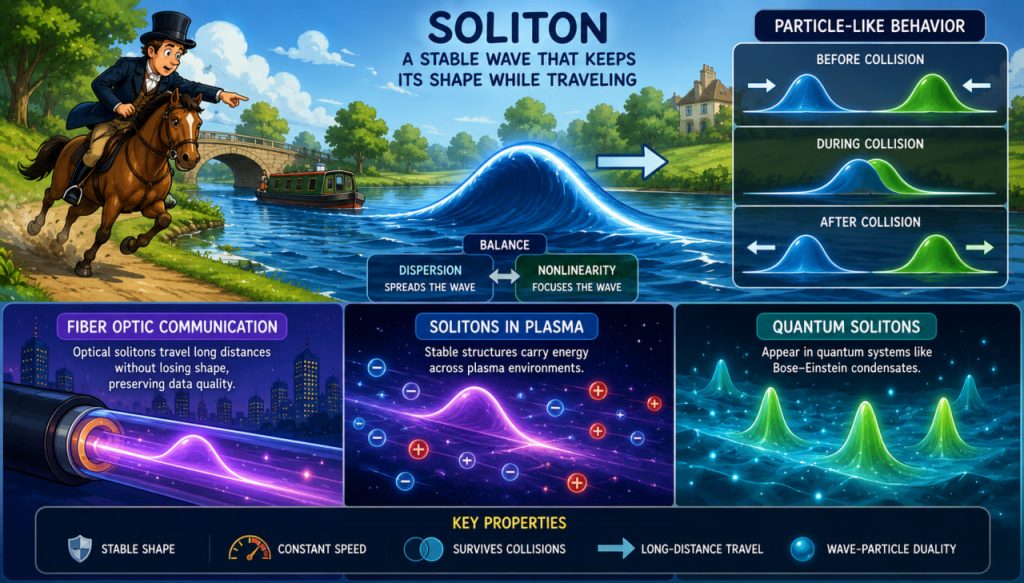
A soliton is a self-reinforcing wave that maintains its:
- Shape
- Speed
- Structure
while traveling through a medium.
Unlike ordinary waves, a soliton does not continuously spread out.
Instead, two competing effects balance each other perfectly:
- Dispersion
- Nonlinearity
This balance allows the wave to remain stable.
As a result, the soliton behaves almost like:
- A moving object
rather than a typical wave.
The First Soliton Discovery
The story of solitons began in:
- 1834
when Scottish engineer:
- John Scott Russell
observed an unusual wave while riding alongside a canal.
After a boat stopped suddenly, Russell noticed a single water wave continue traveling without losing its shape.
He later described it as:
“A large solitary elevation.”
Russell reportedly followed the wave on horseback for several kilometers.
This became the first recorded observation of a:
- Solitary wave
which later inspired the concept of solitons.
Why Ordinary Waves Disperse
Most waves gradually spread out because different parts of the wave travel at:
- Different speeds
This phenomenon is called:
- Dispersion
Dispersion causes waves to:
- Broaden
- Weaken
- Lose their original form
For example:
- Water ripples spread
- Light pulses blur
- Sound waves fade
over time.
The Secret Behind Solitons
Solitons survive because two opposing effects cancel each other.
Dispersion tries to:
- Spread the wave
Nonlinearity tries to:
- Compress the wave
When these forces balance perfectly:
A stable soliton forms.
The result is a wave that can travel enormous distances while maintaining its structure.
Solitons Behave Like Particles
One of the most fascinating properties of solitons is that they can:
- Collide
- Interact
- Separate again
while retaining their original form.
Ordinary waves usually:
- Merge
- Distort
- Disappear
after interactions.
Solitons often emerge from collisions looking almost unchanged.
This behavior resembles:
- Particle interactions
which is why physicists became so interested in them.
Solitons in Water
Water remains one of the easiest places to observe solitons.
Examples include:
- Canal waves
- Tsunami-like solitary waves
- Internal ocean waves
Some ocean solitons can travel:
- Hundreds of kilometers
while maintaining remarkable stability.
Satellites have even photographed enormous underwater solitons moving through oceans.
Solitons and Rogue Waves
Solitons are sometimes connected to:
- Rogue waves
also known as:
- Freak waves
- Monster waves
These rare ocean waves can become dramatically larger than surrounding waves.
Some theoretical models suggest nonlinear wave interactions similar to soliton physics may contribute to their formation.
However, rogue waves remain an active area of research.
Solitons in Fiber Optics
One of the most practical applications of solitons occurs in:
- Optical fiber communication
Normally, light pulses spread while traveling through fiber-optic cables.
This spreading limits:
- Data transmission quality
Solitons solve the problem.
Optical solitons maintain their shape across:
- Extremely long distances
making them useful for:
- Telecommunications
- Internet infrastructure
- High-speed data networks
Solitons in Plasma
Plasma physicists observe solitons in:
- Ionized gases
- Space plasmas
- Laboratory experiments
These structures can carry energy across plasma environments while remaining stable.
Similar phenomena appear in:
- The Sun
- Earth’s magnetosphere
- Interstellar space
Quantum Solitons
Modern physics also studies:
- Quantum solitons
which appear in certain quantum systems.
Researchers investigate whether soliton-like structures could play roles in:
- Bose-Einstein condensates
- Superfluids
- Quantum field theories
These studies connect solitons to some of the deepest questions in modern physics.
Solitons and Particle Physics
Some theoretical physicists have proposed that certain fundamental particles might be described using:
- Soliton-like mathematical structures
In these models:
- Particles emerge as stable wave configurations
rather than simple point objects.
Although not part of the standard explanation of particle physics, these ideas remain influential in theoretical research.
Solitons Appear Throughout Nature
One reason scientists admire solitons is their universality.
Similar mathematical structures appear in:
- Water waves
- Light waves
- Electrical signals
- Plasma dynamics
- Biological systems
This suggests that solitons represent a fundamental pattern found throughout nature.
Why Scientists Love Solitons
Solitons combine:
- Simplicity
- Stability
- Mathematical elegance
Their equations often reveal deep connections between:
- Physics
- Mathematics
- Engineering
Few phenomena demonstrate so clearly how complex systems can produce remarkably stable structures.
Expert Opinion on Solitons
Mathematician Martin Kruskal, one of the pioneers of modern soliton theory, helped demonstrate that solitons are not merely unusual waves but represent a distinct class of stable nonlinear phenomena.
His work transformed solitons from a curiosity into one of the most important concepts in modern wave physics.
Why Solitons Matter
Solitons challenge our intuition about how waves should behave.
Instead of:
- Dispersing
- Fading
- Losing shape
they remain:
- Stable
- Coherent
- Long-lived
Their existence demonstrates that nature sometimes creates structures that exist somewhere between:
- Waves
- Particles
Today, solitons help power:
- Global communications
- Scientific research
- Advanced physics experiments
while continuing to inspire new discoveries about the hidden mathematical order of the universe.
They are a reminder that even something as familiar as a wave can possess extraordinary properties when the laws of nature align in just the right way.
Interesting Facts
- The first soliton was observed in a canal in 1834.
- John Scott Russell reportedly chased the wave on horseback.
- Solitons can survive collisions and continue traveling.
- Fiber-optic communications use soliton principles to preserve signals.
- Giant underwater solitons have been observed from space.
Glossary
- Soliton — A stable self-reinforcing wave that maintains its shape while traveling.
- Dispersion — The tendency of waves to spread out over time.
- Nonlinearity — Behavior where outputs are not directly proportional to inputs.
- Fiber Optics — Technology that transmits information using light through glass fibers.
- Plasma — Ionized gas containing free electrons and charged particles.