Few scientific arguments have had a greater impact on modern physics than the famous debate between:
- Albert Einstein
- Boris Podolsky
- Nathan Rosen
In 1935, these three physicists published a paper that challenged one of the most successful scientific theories ever developed:
- Quantum Mechanics
Their goal was simple:
They wanted to show that quantum theory was incomplete.
Instead, their argument unintentionally helped inspire one of the strangest and most important discoveries in science:
- Quantum Entanglement
Today, entanglement lies at the heart of:
- Quantum computing
- Quantum cryptography
- Quantum teleportation research
- Modern quantum information science
Ironically, Einstein hoped to expose a weakness in quantum mechanics, but the debate eventually strengthened confidence in the theory.
The Einstein–Podolsky–Rosen paradox, usually called:
- The EPR Paradox
remains one of the most fascinating stories in the history of physics.
The Quantum Revolution
During the early twentieth century, physicists discovered that nature behaves very differently at microscopic scales.
Quantum mechanics successfully explained:
- Atoms
- Electrons
- Light
- Chemical reactions
The theory produced incredibly accurate predictions.
However, many scientists felt uncomfortable with its implications.
Unlike classical physics, quantum mechanics often describes reality in terms of:
- Probabilities
- Uncertainty
- Wave functions
rather than definite outcomes.
Einstein’s Discomfort with Quantum Theory
Albert Einstein contributed significantly to the development of quantum physics.
Yet he never fully accepted some of its conclusions.
Einstein believed nature should possess:
- Objective reality
- Definite properties
- Deterministic laws
He disliked the idea that particles might not possess precise properties until:
- Measurement occurs
This led to one of his most famous statements:
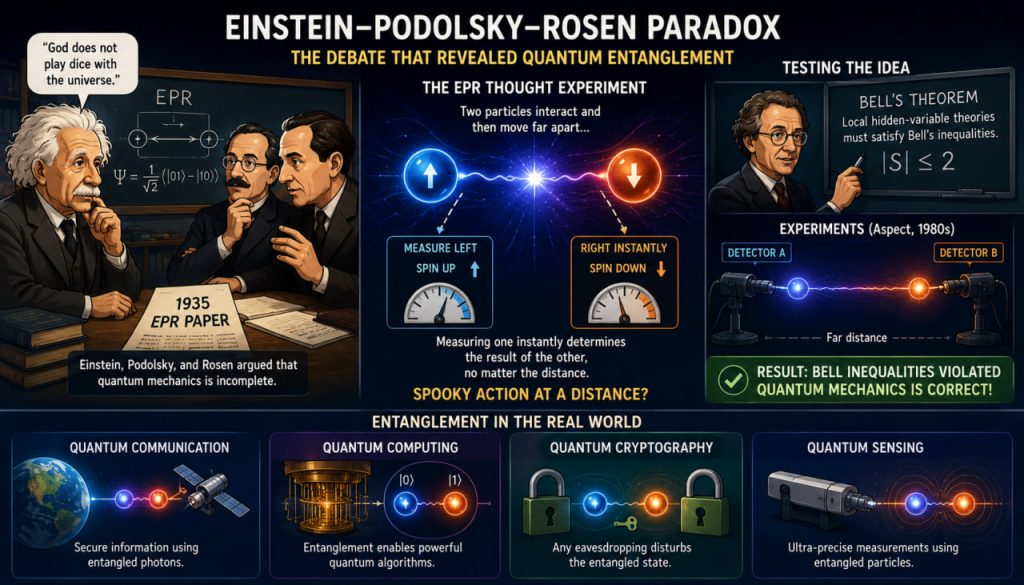
“God does not play dice with the universe.”
The Birth of the EPR Paradox
In 1935, Einstein, Podolsky, and Rosen proposed a thought experiment.
They imagined two particles interacting and then moving far apart.
According to quantum mechanics:
- The particles remain connected through a shared quantum state.
Measuring one particle immediately determines information about the other.
This seemed deeply troubling.
What Was the Problem?
Suppose two particles are created together.
After separating by a great distance, one particle is measured.
Quantum mechanics predicts that:
- The state of the second particle becomes known instantly.
This appears to happen regardless of the distance between them.
The EPR team argued that this suggested one of two possibilities:
- Quantum mechanics is incomplete.
- Information somehow travels faster than light.
Einstein strongly disliked the second possibility.
“Spooky Action at a Distance”
Einstein famously referred to this apparent connection as:
“Spooky action at a distance.”
He believed physical objects should not instantly influence each other across vast distances.
According to:
- Special Relativity
nothing should travel faster than light.
The EPR paradox therefore seemed to reveal a conflict between:
- Quantum mechanics
- Relativity
Hidden Variables
Einstein suspected that quantum theory was missing something.
He proposed that particles might possess hidden properties called:
- Hidden variables
These variables would determine outcomes in advance.
Under this view:
- Quantum randomness is only apparent.
Reality would remain fundamentally deterministic.
The EPR paper argued that a more complete theory should include these hidden variables.
Niels Bohr’s Response
Physicist Niels Bohr strongly disagreed.
Bohr argued that the EPR reasoning misunderstood the nature of quantum measurements.
According to the Copenhagen interpretation:
- Quantum properties do not necessarily exist in a definite form before measurement.
Bohr maintained that quantum mechanics was already complete.
The debate between Einstein and Bohr became one of the most famous intellectual disputes in science.
Entanglement Emerges
For many years, the EPR paradox remained purely philosophical.
Then physicists began studying the strange connection between particles more closely.
The phenomenon became known as:
- Quantum Entanglement
Entangled particles share a quantum state so deeply that they cannot be described independently.
Instead, they behave as parts of a larger quantum system.
John Bell Changes Everything
A major breakthrough occurred in:
- 1964
when physicist John Stewart Bell developed:
- Bell’s Theorem
Bell discovered a way to experimentally test whether hidden variables could explain quantum behavior.
This transformed the debate from philosophy into:
- Experimental science
for the first time.
Bell’s Inequality
Bell showed that any hidden-variable theory must satisfy certain mathematical limits.
Quantum mechanics predicts situations where these limits can be violated.
Therefore:
- Experiments could distinguish between the two possibilities.
This was a revolutionary insight.
Experiments Test Einstein’s Idea
Beginning in the 1970s and continuing through the 1980s, physicists performed increasingly sophisticated experiments.
One of the most famous series was conducted by:
Alain Aspect
The results consistently supported:
- Quantum mechanics
and violated Bell’s inequalities.
These findings strongly suggested that:
- Local hidden-variable explanations do not describe reality.
Einstein Was Wrong—And Right
The experiments indicated that Einstein’s proposed solution was incorrect.
Hidden variables could not explain the observed results.
However, Einstein correctly identified something extraordinary:
- Quantum mechanics predicts genuinely strange behavior.
The phenomenon he questioned turned out to be real.
Entanglement Is Now a Real Technology
Today quantum entanglement is no longer merely theoretical.
Researchers use it in:
- Quantum communication
- Quantum encryption
- Quantum sensing
- Quantum computing
Some experimental quantum networks already transmit entangled states across:
- Hundreds of kilometers
and even between:
- Ground stations and satellites
Does Entanglement Violate Relativity?
Surprisingly:
- No
Entanglement creates correlations between particles, but it does not allow usable information to travel faster than light.
Therefore:
- Relativity remains intact.
This subtle distinction remains one of the most difficult concepts in modern physics.
The 2022 Nobel Prize
The importance of entanglement was recognized when the:
- 2022 Nobel Prize in Physics
was awarded to:
- Alain Aspect
- John Clauser
- Anton Zeilinger
for groundbreaking experiments involving entangled quantum states.
Their work confirmed predictions that originated from the EPR debate.
Expert Opinion
Physicist Anton Zeilinger summarized the significance of entanglement:
“Entanglement is not one but the characteristic trait of quantum mechanics.”
Many physicists now view entanglement as one of the most fundamental features of reality.
Why the EPR Paradox Matters
The Einstein–Podolsky–Rosen paradox began as an attempt to challenge quantum mechanics.
Instead, it opened the door to one of the greatest discoveries in modern science.
The debate revealed that reality is far stranger than classical intuition suggests.
Today, quantum entanglement influences:
- Fundamental physics
- Information technology
- Cybersecurity
- Future computing systems
The EPR paradox reminds us that scientific progress often emerges from disagreement.
A challenge intended to expose a flaw ultimately helped uncover one of nature’s deepest secrets.
Interesting Facts
- The EPR paper was published in 1935.
- Einstein never accepted the standard interpretation of quantum mechanics.
- Bell’s Theorem transformed the debate into an experimental question.
- Quantum entanglement has been demonstrated over hundreds of kilometers.
- The 2022 Nobel Prize in Physics honored key entanglement experiments.
Glossary
- EPR Paradox — Thought experiment created by Einstein, Podolsky, and Rosen to challenge quantum mechanics.
- Quantum Entanglement — A quantum connection linking particles regardless of distance.
- Hidden Variables — Hypothetical properties that would determine outcomes in advance.
- Bell’s Theorem — Mathematical framework testing hidden-variable theories.
- Quantum State — Mathematical description of a quantum system.