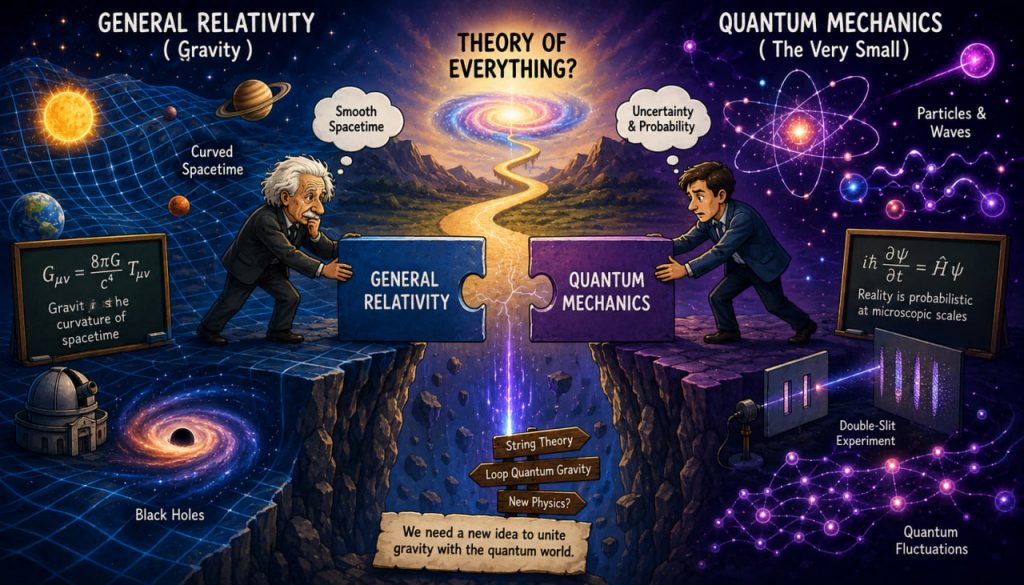
Modern physics is built upon two extraordinarily successful theories.
The first is:
- Quantum Mechanics
which describes the behavior of:
- Atoms
- Electrons
- Photons
- Subatomic particles
The second is:
- General Relativity
developed by Albert Einstein to explain:
- Gravity
- Space
- Time
- The structure of the universe
Both theories have passed countless experimental tests and are among the greatest achievements in scientific history.
Yet there is a major problem:
The two theories do not work well together.
When physicists try to combine gravity with quantum mechanics, the mathematics often breaks down.
This conflict has inspired one of the most ambitious goals in science:
- The Theory of Everything
a single framework capable of explaining all fundamental forces and particles in the universe.
Finding such a theory would represent one of humanity’s greatest intellectual achievements.
What Is a Theory of Everything?
A Theory of Everything (TOE) is a hypothetical framework that would unify:
- Gravity
- Electromagnetism
- The Strong Nuclear Force
- The Weak Nuclear Force
into one consistent description of nature.
Physicists dream of a theory that could explain:
- Matter
- Energy
- Space
- Time
using a single set of principles.
Such a theory would help answer some of the deepest questions about:
- The origin of the universe
- Black holes
- Quantum reality
- The fundamental structure of existence
The Success of Quantum Mechanics
Quantum mechanics describes the microscopic world with astonishing accuracy.
It explains:
- Chemical reactions
- Electronics
- Lasers
- Semiconductors
- Atomic behavior
Virtually every modern technology involving computers or electronics depends on quantum physics.
The theory has produced some of the most precise predictions ever tested in science.
The Success of General Relativity
Einstein’s General Relativity describes gravity as:
- The curvature of spacetime
Massive objects such as:
- Planets
- Stars
- Black holes
warp spacetime around them.
This curvature determines how objects move.
General Relativity successfully explains:
- Planetary orbits
- Gravitational lensing
- Black holes
- GPS satellite corrections
- Cosmic expansion
Why the Two Theories Conflict
The trouble begins when scientists attempt to apply both theories simultaneously.
Quantum mechanics assumes reality contains:
- Probability
- Uncertainty
- Quantum fluctuations
General Relativity treats spacetime as:
- Smooth
- Continuous
- Geometric
At ordinary scales this difference is manageable.
However, under extreme conditions such as:
- Black hole centers
- The Big Bang
both theories become important at the same time.
This is where the mathematics stops behaving properly.
The Problem with Quantum Gravity
Physicists believe gravity should also have a quantum description.
Just as electromagnetism has:
- Photons
gravity would theoretically involve:
- Gravitons
These hypothetical particles would carry gravitational interactions.
Unfortunately, attempts to quantize gravity often generate:
- Infinite quantities
- Unsolvable equations
The standard techniques that work for other forces fail for gravity.
Black Holes Reveal the Conflict
Black holes provide one of the clearest examples of the problem.
General Relativity predicts:
- Singularities
points where density becomes infinite.
Quantum mechanics strongly suggests that infinite physical quantities should not exist.
At the center of a black hole:
- Both theories demand attention
yet they produce incompatible descriptions.
This indicates that something important is missing from our understanding.
The Big Bang Creates Another Challenge
The earliest moments of the universe present a similar problem.
Near the Big Bang:
- Matter was extremely dense
- Temperatures were enormous
- Quantum effects were dominant
General Relativity predicts a singular beginning.
Quantum physics suggests the situation should be more complicated.
A Theory of Everything might explain what actually happened at the birth of the universe.
String Theory: One Possible Solution
One leading candidate for a Theory of Everything is:
- String Theory
Instead of treating particles as points, string theory proposes that fundamental objects are:
- Tiny vibrating strings
Different vibrations produce different particles.
String theory naturally includes:
- Gravity
- Quantum mechanics
within a single framework.
This has made it one of the most influential ideas in theoretical physics.
Extra Dimensions
String theory predicts the existence of:
- Additional spatial dimensions
beyond the familiar three dimensions of everyday life.
These extra dimensions may be:
- Extremely small
- Hidden from observation
Although intriguing, direct experimental evidence remains unavailable.
Loop Quantum Gravity
Another approach is:
- Loop Quantum Gravity
This theory attempts to quantize spacetime itself.
Instead of being perfectly smooth, spacetime may consist of:
- Tiny discrete units
at incredibly small scales.
Loop Quantum Gravity does not require extra dimensions and takes a different route toward quantum gravity.
Why the Search Is So Difficult
Testing theories of quantum gravity is extremely challenging.
Relevant effects occur near:
- The Planck Scale
where distances are roughly:
- 10⁻³⁵ meters
far smaller than anything current technology can directly probe.
Building experiments capable of reaching these scales remains beyond present engineering capabilities.
The Standard Model Is Incomplete
Physicists already know current theories are incomplete.
The Standard Model cannot explain:
- Dark Matter
- Dark Energy
- Gravity
- Neutrino masses completely
A successful Theory of Everything would ideally account for these mysteries as well.
The Dream of Unification
Physics has a long history of unification.
Scientists previously discovered that:
- Electricity and magnetism are aspects of one force.
Later, physicists unified:
- Electromagnetism
- The Weak Nuclear Force
Many researchers hope gravity may eventually join this pattern.
Expert Opinion on Unification
Physicist Stephen Hawking described the search for a unified theory as:
“The ultimate triumph of human reason.”
For decades, Hawking viewed a Theory of Everything as one of science’s greatest goals.
Could a Theory of Everything Explain Everything?
Despite its name, a Theory of Everything would not literally explain every phenomenon.
It would describe:
- Fundamental physical laws
but complex systems such as:
- Weather
- Biology
- Human behavior
would still require their own scientific explanations.
The theory would provide the deepest known foundation upon which other sciences are built.
Why Gravity Refuses to Cooperate
Gravity is unique among the fundamental forces.
Compared to the others, it is:
- Extremely weak
- Geometric in nature
- Tied directly to spacetime itself
This special role makes gravity extraordinarily difficult to combine with quantum mechanics.
The conflict remains one of the greatest unsolved problems in science.
Why the Theory of Everything Matters
The search for a Theory of Everything is more than a mathematical challenge.
It represents humanity’s attempt to answer profound questions:
- Why does the universe exist?
- What happened before the Big Bang?
- What is spacetime made of?
- How do gravity and quantum physics coexist?
Although physicists have not yet found the final answer, the quest continues to drive some of the most exciting research in modern science.
Whether the solution emerges from:
- String Theory
- Loop Quantum Gravity
- A completely new idea
the discovery could transform our understanding of reality more dramatically than any scientific breakthrough since Einstein.
Interesting Facts
- Gravity is about 10³⁶ times weaker than electromagnetism.
- Black holes are natural laboratories for quantum gravity.
- String theory may require up to 11 dimensions.
- The Planck length is approximately 100 billion billion times smaller than a proton.
- No experimentally confirmed Theory of Everything currently exists.
Glossary
- Theory of Everything (TOE) — A proposed framework unifying all fundamental forces of nature.
- Quantum Mechanics — The physics of atoms and subatomic particles.
- General Relativity — Einstein’s theory describing gravity through spacetime curvature.
- Graviton — Hypothetical quantum particle that would carry gravity.
- Planck Scale — Extremely small scale where quantum gravity effects are expected to become important.