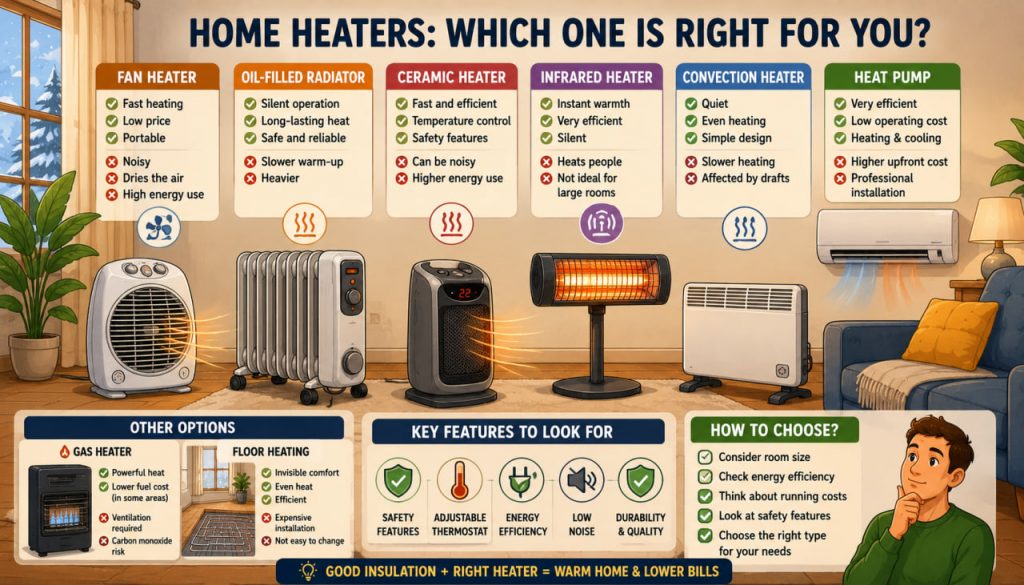
When temperatures drop, a reliable home heater becomes one of the most important household appliances. Modern consumers can choose from many different heating technologies, each with its own advantages and disadvantages.
The ideal heater depends on:
- Room size
- Climate
- Energy costs
- Safety requirements
- Heating speed
- Noise level
A heater that works perfectly in a small apartment may be unsuitable for a large house. Likewise, the cheapest heater to buy is not always the most economical to operate.
Understanding the main types of home heaters helps homeowners make smarter decisions while balancing:
- Comfort
- Efficiency
- Safety
- Cost
Why Choosing the Right Heater Matters
Heating often represents one of the largest energy expenses in a household.
An inefficient heater can lead to:
- High electricity bills
- Uneven heating
- Poor comfort
- Increased fire risk
Meanwhile, a well-chosen heater can provide:
- Stable temperatures
- Lower operating costs
- Improved energy efficiency
The goal is not simply producing heat but doing so safely and economically.
Electric Fan Heaters
Fan heaters are among the most common portable heating devices.
They work by:
- Heating an internal element
- Blowing warm air into the room
Advantages include:
- Fast heating
- Low purchase price
- Compact size
- Easy portability
However, fan heaters also have drawbacks:
- Higher electricity consumption
- Noise from the fan
- Air drying effects
They are best suited for:
- Small rooms
- Temporary heating
rather than continuous use.
Oil-Filled Radiators
Oil-filled radiators remain popular because they provide:
- Gentle heat
- Silent operation
- Long-lasting warmth
Inside the unit, electrical elements heat oil, which then transfers heat to the surrounding air.
Advantages:
- Quiet operation
- Stable temperatures
- No fan noise
- Good safety profile
Disadvantages:
- Slower warm-up time
- Heavier construction
They work particularly well in:
- Bedrooms
- Living rooms
- Home offices
Ceramic Heaters
Ceramic heaters use:
- Ceramic heating elements
combined with fans.
Compared with traditional fan heaters, they often offer:
- Improved efficiency
- Better temperature control
- Faster heating
Many modern ceramic models include:
- Thermostats
- Safety shutoffs
- Oscillation functions
These heaters are popular for:
- Medium-sized rooms
- Apartments
- Home offices
Infrared Heaters
Infrared heaters work differently from conventional heaters.
Instead of heating air directly, they emit:
- Infrared radiation
which warms:
- People
- Furniture
- Surfaces
Advantages:
- Instant warmth
- High efficiency
- Silent operation
Disadvantages:
- Uneven room heating
- Limited coverage area
Infrared heaters are ideal for:
- Personal heating
- Patios
- Workspaces
Convection Heaters
Convection heaters warm air that naturally circulates throughout the room.
Advantages:
- Quiet operation
- Even heating
- Simple design
Disadvantages:
- Slower heating speed
- Less effective in drafty spaces
These heaters are often used for:
- Continuous room heating
- Bedrooms
- Small homes
Heat Pumps: The Most Efficient Option
Heat pumps have become increasingly popular because of their exceptional efficiency.
Instead of generating heat directly, they:
- Move heat from one location to another
This allows them to produce:
- Several units of heat for each unit of electricity consumed
Advantages:
- Extremely efficient
- Lower operating costs
- Heating and cooling capability
Disadvantages:
- Higher installation costs
- More complex setup
For long-term energy savings, heat pumps are often considered one of the best options.
Gas Heaters
In some regions, gas heaters remain common.
Advantages:
- Powerful heating
- Lower fuel costs in some locations
Disadvantages:
- Ventilation requirements
- Carbon monoxide risks
- Installation complexity
Safety considerations make proper installation essential.
Safety Features to Look For
Modern heaters should include important safety systems such as:
- Overheat protection
- Tip-over shutoff
- Child safety features
- Temperature control
These features help reduce risks associated with:
- Fire
- Burns
- Electrical faults
Safety should always be a priority when choosing a heater.
Energy Efficiency Matters
The most powerful heater is not necessarily the best heater.
Efficient heating depends on:
- Insulation quality
- Room size
- Thermostat settings
- Heater technology
Reducing heat loss through:
- Windows
- Doors
- Walls
can often save more energy than upgrading the heater itself.
Noise Levels
Some heaters are nearly silent, while others produce noticeable noise.
Quiet options include:
- Oil-filled radiators
- Infrared heaters
- Convection heaters
Noisier options include:
- Fan heaters
- Some ceramic heaters
For bedrooms, noise level can be an important factor.
Which Heater Is Best for Small Rooms?
For small spaces, good options include:
- Ceramic heaters
- Oil-filled radiators
- Compact convection heaters
These provide effective heating without excessive energy consumption.
Which Heater Is Best for Large Rooms?
Larger areas often benefit from:
- Heat pumps
- Larger infrared systems
- Central heating systems
Portable heaters may struggle to efficiently heat very large spaces.
Expert Opinion on Home Heating
Energy efficiency experts generally recommend prioritizing:
- Proper insulation
- Thermostat control
- Efficient heating technologies
before simply increasing heating power.
A well-insulated room often requires significantly less energy regardless of heater type.
Which Heater Should You Choose?
For most households:
Oil-filled radiators and ceramic heaters provide an excellent balance of safety, comfort, and affordability.
If maximum efficiency is the goal:
Heat pumps are usually the best long-term solution.
For personal heating:
Infrared heaters offer fast and efficient warmth.
Ultimately, the ideal heater depends on:
- Budget
- Room size
- Climate
- Energy prices
Choosing the right technology can improve comfort while reducing energy costs throughout the colder months.
Interesting Facts
- Heat pumps can deliver several times more heat energy than the electricity they consume.
- Infrared heaters warm objects directly rather than heating air.
- Oil-filled radiators do not burn oil; the oil remains sealed inside.
- Proper insulation often saves more energy than purchasing a larger heater.
- Modern heaters commonly include automatic tip-over protection.
Glossary
- Heat Pump — System that transfers heat rather than generating it directly.
- Infrared Radiation — Heat energy that warms surfaces and people directly.
- Convection — Heat transfer through the movement of air.
- Thermostat — Device that automatically regulates temperature.
- Ceramic Heater — Electric heater using ceramic heating elements for efficient warmth.