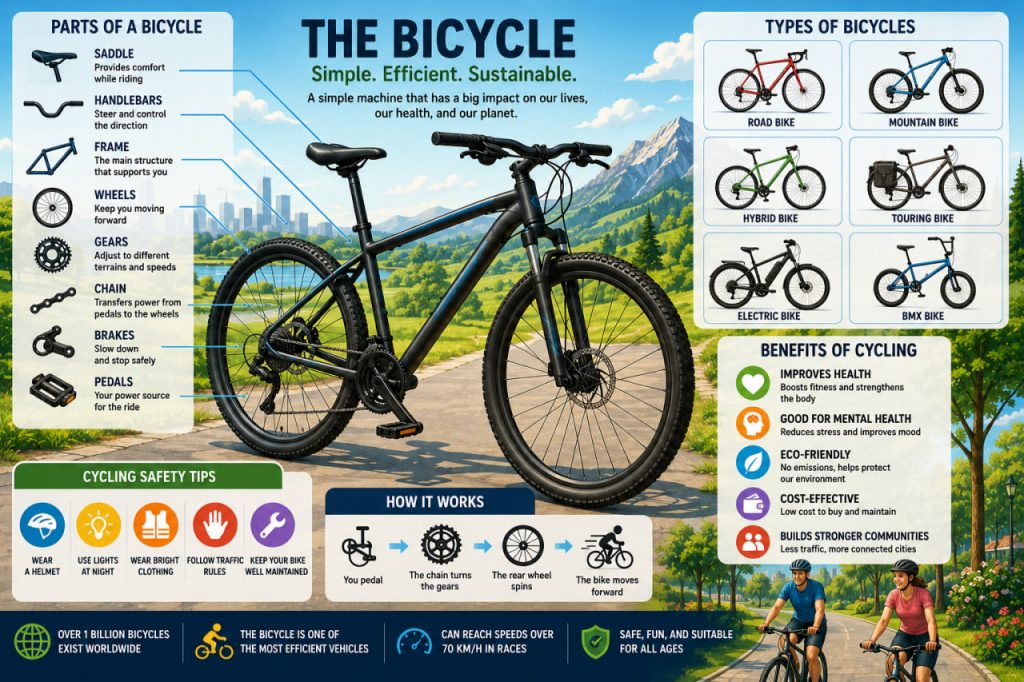
Few inventions have had such a profound impact on transportation, health, recreation, and society as the bicycle. Simple, efficient, and environmentally friendly, the bicycle remains one of the most widely used machines in the world.
More than a century after its invention, bicycles are still used for:
- Transportation
- Exercise
- Sport
- Tourism
- Recreation
Modern bicycles combine:
- Physics
- Engineering
- Human power
to create a remarkably efficient mode of travel.
In many ways, the bicycle represents the perfect partnership between:
- Human muscles
- Mechanical design
- Energy efficiency
Understanding how bicycles work and why they remain so popular reveals the genius behind one of history’s greatest inventions.
What Is a Bicycle?
A bicycle is a human-powered vehicle with:
- Two wheels
- A frame
- Handlebars
- Pedals
- A drivetrain
The rider transfers energy through:
- Pedaling
which rotates the wheels and propels the bicycle forward.
Although modern bicycles may appear simple, they are the result of centuries of technological development and refinement.
A Brief History of the Bicycle
The earliest bicycle-like machines appeared in the early 1800s.
One important predecessor was:
- The Draisine
invented by German inventor:
Karl Drais
in 1817.
This vehicle had:
- Two wheels
- Steering
but no pedals.
Over the following decades, inventors added:
- Pedals
- Chains
- Pneumatic tires
Eventually leading to the modern bicycle design that remains recognizable today.
How a Bicycle Works
A bicycle operates through a surprisingly elegant combination of mechanical principles.
When the rider pushes the pedals:
- The chain rotates the rear wheel
The rotating wheel creates forward motion.
Key components include:
- Pedals
- Crankset
- Chain
- Gears
- Wheels
Together they efficiently transfer human energy into movement.
Why Bicycles Are So Efficient
The bicycle is often considered one of the most energy-efficient transportation systems ever created.
Compared with:
- Walking
- Running
- Automobiles
bicycles allow humans to travel farther using less energy.
This efficiency results from:
- Rolling wheels
- Lightweight design
- Mechanical leverage
The bicycle dramatically reduces the energy required to move across distances.
The Physics of Balance
One of the most fascinating aspects of cycling is balance.
Many people assume bicycles remain upright solely because of:
- Spinning wheels
In reality, bicycle stability results from several factors, including:
- Steering geometry
- Rider adjustments
- Gyroscopic effects
The rider constantly makes tiny corrections that help maintain balance.
This process becomes largely automatic with experience.
Gears Make Riding Easier
Modern bicycles often include:
- Multiple gears
Gears allow riders to adjust mechanical advantage depending on:
- Terrain
- Speed
- Effort level
Lower gears help with:
- Hills
- Acceleration
Higher gears help with:
- Fast travel
- Flat roads
This flexibility greatly improves efficiency and comfort.
Health Benefits of Cycling
Cycling is one of the most popular forms of exercise worldwide.
Regular cycling may help improve:
- Cardiovascular fitness
- Muscle endurance
- Balance
- Coordination
- Mental well-being
Because cycling is a low-impact activity, it places less stress on joints compared with:
- Running
making it suitable for many age groups.
Cycling and Mental Health
Research suggests that physical activity, including cycling, may contribute to:
- Reduced stress
- Improved mood
- Better mental health
Outdoor cycling can provide additional benefits through exposure to:
- Nature
- Fresh air
- Sunlight
Many cyclists report that riding helps them:
- Relax
- Focus
- Clear their minds
Bicycles and the Environment
Unlike cars and motorcycles, bicycles produce:
- No direct emissions
They require:
- No fuel
- Minimal resources
- Little space
As cities seek ways to reduce:
- Traffic congestion
- Air pollution
- Carbon emissions
cycling is increasingly promoted as a sustainable transportation solution.
Bicycles in Cities
Many cities now invest heavily in:
- Bike lanes
- Bicycle-sharing programs
- Cycling infrastructure
Urban planners recognize that bicycles can help reduce:
- Traffic jams
- Parking demand
- Transportation costs
In some cities, bicycles have become an essential part of daily commuting.
Different Types of Bicycles
Modern bicycles come in many specialized designs.
Popular categories include:
- Road bikes
- Mountain bikes
- Hybrid bikes
- Touring bikes
- Electric bikes
- BMX bikes
Each type is optimized for specific riding conditions and purposes.
The Rise of Electric Bicycles
Electric bicycles, or:
- E-bikes
have become increasingly popular.
They use small electric motors to assist pedaling.
Advantages include:
- Easier hill climbing
- Longer travel distances
- Reduced physical effort
E-bikes are helping more people use bicycles for:
- Transportation
- Recreation
- Commuting
Bicycle Racing
Cycling is also a major international sport.
Events such as:
Tour de France
attract millions of spectators worldwide.
Professional cyclists demonstrate extraordinary:
- Endurance
- Strategy
- Athletic performance
through races covering hundreds or even thousands of kilometers.
Safety Matters
While cycling offers many benefits, safety remains important.
Recommended safety measures include:
- Wearing helmets
- Using lights
- Following traffic rules
- Maintaining the bicycle properly
Good visibility and responsible riding significantly reduce accident risks.
Expert Opinion on Cycling
Transportation researcher and cycling advocate
John Pucher
has emphasized that increased cycling can improve both public health and urban sustainability.
His work highlights how bicycles provide benefits not only for individuals but also for communities.
Why the Bicycle Remains a Timeless Invention
The bicycle has survived for more than a century because it solves multiple problems simultaneously.
It provides:
- Transportation
- Exercise
- Recreation
- Environmental benefits
while requiring remarkably little energy.
Its design is elegant, efficient, and accessible.
Few inventions combine:
- Simplicity
- Practicality
- Sustainability
as successfully as the bicycle.
In an age of advanced technology and complex machines, the bicycle remains a powerful reminder that sometimes the most effective solutions are also the simplest.
Interesting Facts
- The bicycle is often considered the most energy-efficient vehicle ever invented.
- More than one billion bicycles exist worldwide.
- The first bicycles had no pedals.
- Professional cyclists can exceed speeds of 70 km/h during races.
- Modern bicycles are used for transportation, sport, tourism, and fitness.
Glossary
- Drivetrain — The system that transfers pedal power to the wheels.
- Gear Ratio — Relationship between pedal rotation and wheel rotation.
- Gyroscopic Effect — Physical phenomenon related to rotating wheels.
- E-Bike — Bicycle equipped with an electric motor for assistance.
- Cardiovascular Fitness — Health and efficiency of the heart and circulatory system.