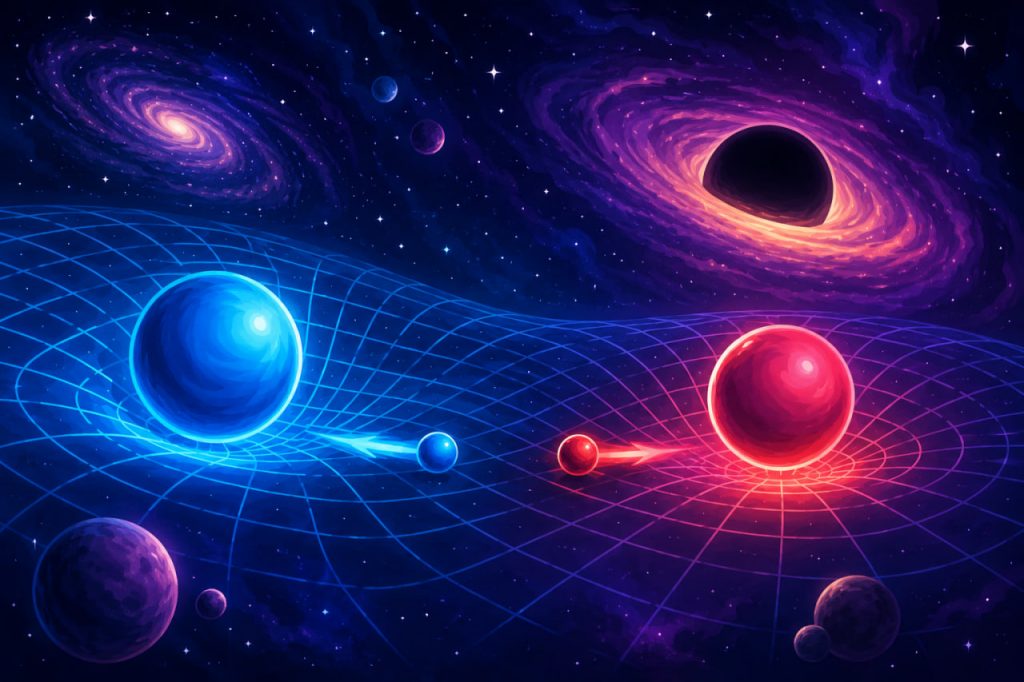
Among the strangest ideas in modern physics is the concept of exotic matter—a hypothetical form of matter that behaves in ways completely unlike anything we encounter in everyday life.
Ordinary matter has:
- Positive mass
- Positive energy density
- Normal gravitational behavior
Exotic matter, in some theoretical models, may possess:
- Negative mass
- Negative energy density
- Unusual gravitational properties
If such matter exists, it could potentially make possible some of the most extraordinary concepts ever proposed by physicists, including:
- Wormholes
- Warp drives
- Time machines
- Antigravity-like effects
At present, exotic matter remains largely theoretical. However, the mathematics of modern physics continues to suggest that nature may allow phenomena far stranger than our everyday experience.
Understanding exotic matter takes us to the frontier where:
- Quantum mechanics
- Relativity
- Cosmology
meet some of the biggest mysteries of the universe.
What Is Exotic Matter?
The term “exotic matter” does not refer to a specific known substance.
Instead, it generally describes hypothetical forms of matter that possess unusual physical properties.
Depending on the theory, exotic matter may exhibit:
- Negative mass
- Negative energy density
- Negative pressure
These properties differ dramatically from those of ordinary matter.
Because of this, exotic matter could potentially influence gravity in unusual ways.
What Is Negative Mass?
In everyday physics, mass is always positive.
Positive mass behaves predictably:
- Push it forward, and it accelerates forward.
- Gravity attracts it toward other masses.
Negative mass would behave very differently.
In simple theoretical models:
- Push negative mass forward, and it may accelerate backward.
This bizarre behavior challenges our intuition and leads to unusual physical consequences.
How Would Negative Mass Behave?
Imagine placing:
- Positive mass
- Negative mass
near each other.
Some theoretical calculations suggest a strange phenomenon:
- Positive mass chases negative mass.
- Negative mass moves away.
- Both objects accelerate continuously.
This hypothetical behavior is sometimes called:
- Runaway motion
It is one of the reasons negative mass fascinates physicists.
Einstein’s Gravity and Exotic Matter
According to Einstein’s General Relativity:
- Mass and energy curve spacetime.
Ordinary matter creates attractive gravity.
Exotic matter could potentially produce:
- Repulsive gravitational effects
under certain conditions.
This possibility makes exotic matter important in theoretical studies of:
- Wormholes
- Warp bubbles
- Cosmological models
Wormholes and Exotic Matter
One of the most famous applications of exotic matter involves:
- Wormholes
A wormhole is a hypothetical shortcut connecting distant regions of spacetime.
The problem is that wormholes tend to collapse almost instantly.
Theoretical calculations suggest that exotic matter with:
- Negative energy density
might stabilize a wormhole and hold it open.
Without exotic matter, traversable wormholes appear impossible under current models.
Could Warp Drives Require Exotic Matter?
In 1994, physicist
Miguel Alcubierre
proposed a theoretical warp-drive solution within Einstein’s equations.
The idea involved:
- Compressing spacetime ahead of a spacecraft
- Expanding spacetime behind it
This could effectively allow faster-than-light travel without violating relativity locally.
However, the original design required enormous amounts of:
- Negative energy
making exotic matter a crucial ingredient.
Quantum Physics and Negative Energy
Interestingly, quantum mechanics does allow certain situations involving:
- Negative energy densities
One famous example is:
- The Casimir Effect
In this phenomenon, two closely spaced metal plates alter quantum vacuum fluctuations.
The result is a tiny measurable force that can be described using regions of reduced vacuum energy.
Although not equivalent to large quantities of exotic matter, it demonstrates that nature may permit negative energy under specific conditions.
Is Exotic Matter the Same as Antimatter?
No.
This is a common misconception.
Antimatter consists of particles with:
- Opposite electric charges
compared to ordinary matter.
However, antimatter still possesses:
- Positive mass
- Positive energy
and responds to gravity much like normal matter.
Exotic matter and antimatter are entirely different concepts.
Dark Energy and Exotic Matter
Some cosmologists speculate about possible connections between exotic matter and:
- Dark Energy
Dark energy appears responsible for the accelerated expansion of the universe.
Although dark energy exhibits unusual properties, scientists do not currently consider it proven exotic matter.
The relationship remains uncertain.
Has Negative Mass Ever Been Found?
To date:
No confirmed example of naturally occurring negative mass has been discovered.
Despite extensive scientific investigation:
- No stable negative-mass particles are known.
- No exotic matter deposits have been observed.
- No laboratory has produced macroscopic negative mass.
At present, exotic matter remains hypothetical.
Strange Laboratory Experiments
In recent years, physicists have created systems that mimic some behaviors associated with negative mass.
For example:
- Ultracold atomic gases
- Bose-Einstein condensates
can sometimes display effective negative-mass behavior under specific experimental conditions.
However:
- These are not true negative-mass objects.
They simply reproduce certain mathematical characteristics of negative mass.
Why Physicists Take Exotic Matter Seriously
Even though exotic matter has never been directly observed, physicists continue studying it because:
- Einstein’s equations allow unusual solutions.
- Quantum theory permits negative-energy effects.
- Cosmology reveals unexpected phenomena.
Many breakthroughs in physics began as strange theoretical ideas long before experimental confirmation became possible.
Expert Opinion on Exotic Matter
Physicist
Kip Thorne
has extensively studied wormholes and spacetime geometry.
His work demonstrated that traversable wormholes would require forms of matter possessing unusual energy properties not found in ordinary matter.
These studies helped establish exotic matter as a serious topic within theoretical physics.
Could Exotic Matter Change the Future?
If exotic matter were ever discovered, it could revolutionize our understanding of:
- Gravity
- Space travel
- Cosmology
- Fundamental physics
It might provide insights into:
- Faster interstellar travel
- Black holes
- The structure of spacetime itself
However, current evidence remains insufficient to confirm its existence.
Why Exotic Matter Matters
Exotic matter occupies a fascinating position between:
- Established physics
- Scientific speculation
It emerges naturally from some of the equations describing spacetime, yet it has never been directly observed.
Whether exotic matter ultimately proves real or not, its study continues to push the boundaries of our understanding.
The search forces physicists to ask profound questions:
- What is mass?
- What is gravity?
- Can spacetime be engineered?
- Are wormholes possible?
Until those questions are answered, exotic matter remains one of the most intriguing mysteries in modern theoretical physics.
Interesting Facts
- Negative mass has never been directly observed.
- Traversable wormholes would likely require exotic matter.
- The Alcubierre warp drive depends on negative energy.
- The Casimir Effect demonstrates measurable vacuum-energy phenomena.
- Some laboratory systems can imitate certain negative-mass behaviors.
Glossary
- Exotic Matter — Hypothetical matter with unusual properties such as negative energy density.
- Negative Mass — A theoretical form of mass that would behave opposite to ordinary mass.
- Wormhole — Hypothetical shortcut through spacetime connecting distant locations.
- Casimir Effect — Quantum phenomenon producing a tiny force between closely spaced metal plates.
- Warp Drive — Hypothetical method of faster-than-light travel using spacetime manipulation.