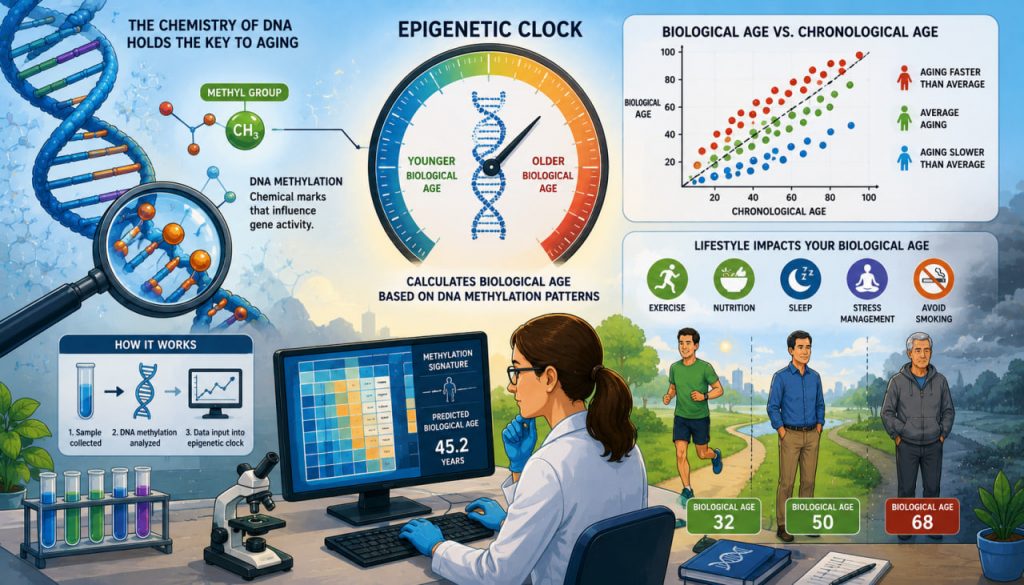
Most people know their chronological age—the number of years that have passed since their birth. However, scientists have increasingly discovered that chronological age does not always match biological age. Two people born on the same day can have remarkably different levels of health, disease risk, and life expectancy.
This realization has led researchers to search for reliable ways to measure how old the body truly is. One of the most promising tools to emerge from this effort is the epigenetic clock. By analyzing chemical markers attached to DNA, scientists can estimate biological age with astonishing accuracy and gain insights into how quickly a person is aging.
Some modern epigenetic clocks are so precise that they can predict age within a few years and, under certain laboratory conditions, detect changes that occur over relatively short periods. These discoveries are transforming aging research and may eventually help doctors monitor health in entirely new ways.
What Is Biological Age?
Biological age refers to the condition of the body’s cells, tissues, and organs rather than the number of years a person has lived.
Two individuals may both be 50 years old chronologically, but one may have the biological characteristics of a typical 40-year-old while the other resembles someone much older.
Biological age is influenced by:
- Genetics
- Nutrition
- Physical activity
- Stress
- Sleep quality
- Environmental exposures
- Disease history
Because these factors vary between individuals, biological aging progresses at different rates.
Biological age often provides a better picture of overall health than chronological age alone.
What Is Epigenetics?
To understand epigenetic clocks, it is first necessary to understand epigenetics.
Epigenetics refers to chemical modifications that influence how genes are used without changing the DNA sequence itself.
DNA can be thought of as the body’s instruction manual. Epigenetic markers act more like notes written in the margins, telling cells which instructions should be used more frequently and which should be ignored.
One of the most important epigenetic modifications is DNA methylation.
DNA methylation occurs when small chemical groups called methyl groups attach to specific locations on DNA.
These modifications help regulate gene activity throughout life.
How Aging Changes DNA Chemistry
As people age, predictable changes occur in DNA methylation patterns.
Some methylation sites gain additional chemical markers, while others lose them.
Remarkably, these changes occur in highly consistent ways across large populations.
Scientists discovered that by examining specific methylation sites throughout the genome, they could estimate a person’s age with impressive accuracy.
This finding led to the development of epigenetic clocks.
How Epigenetic Clocks Work
An epigenetic clock is a mathematical model that analyzes DNA methylation patterns to estimate biological age.
Researchers examine hundreds or thousands of methylation sites and compare them with patterns observed in large datasets.
The resulting calculation produces an estimate of biological age.
If the calculated age is:
- Younger than chronological age, aging may be occurring more slowly.
- Older than chronological age, aging may be accelerated.
This difference is often called age acceleration.
Scientists are particularly interested in understanding why some people experience faster biological aging than others.
The Horvath Clock Revolution
One of the most influential breakthroughs occurred in 2013 when Steve Horvath developed one of the first highly accurate epigenetic clocks.
The Horvath Clock analyzed methylation patterns across multiple tissues and demonstrated that biological age could be estimated with remarkable precision.
The discovery transformed aging research.
For the first time, scientists had a practical biomarker that could measure biological aging rather than simply counting years.
Today, numerous epigenetic clocks have been developed, each optimized for different research goals.
Can Lifestyle Affect Epigenetic Age?
Research suggests that biological age is not completely fixed.
Studies have linked several factors to slower epigenetic aging:
- Regular exercise
- Healthy body weight
- Balanced nutrition
- Adequate sleep
- Avoiding smoking
- Managing chronic stress
Conversely, factors associated with accelerated epigenetic aging include:
- Smoking
- Obesity
- Chronic inflammation
- Exposure to pollution
- Long-term psychological stress
These findings support the idea that daily habits can influence how quickly the body ages at a molecular level.
Can Biological Age Be Reversed?
One of the most exciting questions in longevity science is whether epigenetic age can be reduced.
Several studies have reported small decreases in epigenetic age following interventions involving:
- Dietary changes
- Exercise programs
- Improved sleep
- Certain experimental therapies
However, researchers remain cautious.
While some results are encouraging, it is not yet clear whether lowering epigenetic age directly translates into longer lifespan or improved long-term health.
More research is needed before definitive conclusions can be drawn.
Expert Perspective
Geneticist Steve Horvath has described epigenetic clocks as among the most powerful tools available for studying human aging.
His work demonstrated that aging leaves measurable signatures in DNA chemistry and that these signatures can be quantified.
“The epigenetic clock captures biological aging processes that occur throughout the body.”
This insight has opened entirely new areas of research focused on understanding and potentially modifying the aging process.
Medical Applications of Epigenetic Clocks
Although still primarily research tools, epigenetic clocks have numerous potential applications.
Scientists are investigating their use in:
- Longevity research
- Disease risk assessment
- Preventive medicine
- Drug development
- Personalized healthcare
Researchers may eventually use biological age measurements to evaluate whether treatments genuinely slow aging rather than simply treating age-related diseases.
This could dramatically change how medicine approaches aging in the future.
Limitations and Challenges
Despite their promise, epigenetic clocks are not perfect.
Several challenges remain:
- Different clocks may produce different results.
- Biological age is influenced by many factors beyond methylation.
- Long-term predictive accuracy continues to be studied.
- Individual results can vary.
Scientists generally view epigenetic clocks as powerful biomarkers rather than definitive measures of health or lifespan.
The Future of Aging Research
Many researchers believe epigenetic clocks represent one of the most important developments in modern longevity science.
By providing measurable indicators of biological aging, these tools allow scientists to test interventions more rapidly than ever before.
Instead of waiting decades to determine whether a treatment extends lifespan, researchers can monitor changes in biological age over shorter periods.
This capability may accelerate discoveries aimed at improving human health and extending healthy years of life.
Conclusion
Epigenetic clocks have revolutionized the study of aging by revealing that the chemistry of DNA contains detailed information about biological age. Through the analysis of DNA methylation patterns, scientists can estimate how quickly an individual is aging and investigate the factors that influence longevity.
While many questions remain unanswered, epigenetic clocks are already transforming aging research and bringing scientists closer to understanding one of biology’s greatest mysteries: why we age and whether the process can be slowed, modified, or perhaps someday partially reversed.
Interesting Facts
- DNA methylation patterns can predict age with remarkable accuracy across many tissues.
- The first widely recognized epigenetic clock was introduced in 2013.
- Identical twins can develop different epigenetic ages despite sharing nearly identical DNA.
- Smoking is consistently associated with accelerated epigenetic aging.
- Some experimental studies have reported modest reductions in measured biological age after lifestyle interventions.
- Researchers are developing next-generation epigenetic clocks designed to predict disease risk and lifespan more accurately.
Glossary
- Epigenetics — The study of chemical modifications that influence gene activity without altering DNA sequences.
- DNA Methylation — The attachment of methyl groups to DNA that can affect gene expression.
- Biological Age — A measure of how old the body’s cells and tissues appear based on biological markers.
- Chronological Age — The number of years a person has lived since birth.
- Biomarker — A measurable biological characteristic used to assess health or biological processes.
- Age Acceleration — A condition in which biological age exceeds chronological age.