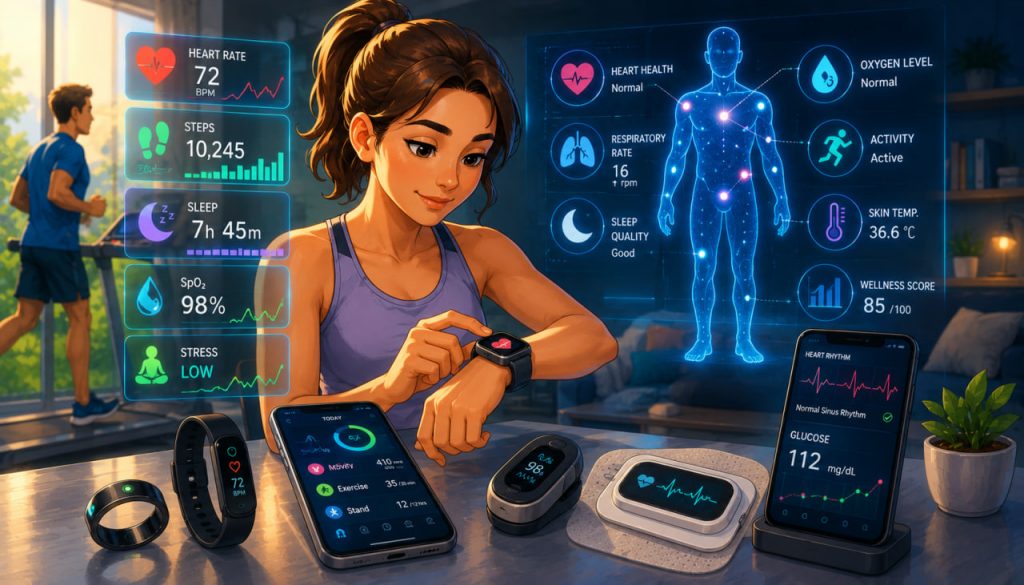
Wearable health monitoring devices have moved far beyond simple step counters. Smartwatches, fitness bands, rings, medical patches, continuous glucose monitors, and sensor-equipped clothing can now collect health information throughout the day and night.
These devices may track movement, heart rate, sleep, blood oxygen estimates, skin temperature, heart rhythm, glucose levels, and other signals. Some are consumer wellness products, while others are regulated medical devices designed for specific clinical purposes.
Wearables are most valuable when they reveal meaningful trends, support healthy behavior, or help manage a diagnosed condition—not when every measurement is treated as a definitive medical result.
What Are Wearable Health Devices?
A wearable health device is an electronic product designed to be worn on or attached to the body while collecting physiological or behavioral information.
The U.S. Food and Drug Administration includes smartwatches, rings, patches, and bands among sensor-based digital health technologies that may monitor health parameters continuously or through occasional measurements outside traditional clinical settings.
Common categories include:
- Smartwatches and fitness trackers
- Smart rings
- Chest straps
- Adhesive cardiac patches
- Continuous glucose monitors
- Wearable electrocardiogram devices
- Smart clothing
- Sleep-monitoring headbands
- Fall-detection systems
- Rehabilitation and movement sensors
Not every wearable is a medical device. A watch that estimates fitness trends may be marketed as a wellness product, while a device intended to diagnose or monitor a medical condition may require regulatory review.
What Can Wearables Measure?
Most wrist-worn devices combine several sensors.
An accelerometer measures movement and helps estimate steps, activity, posture, and sleep patterns. A gyroscope detects rotation and orientation.
Many devices use photoplethysmography, or PPG. Green or infrared light shines into the skin, and a sensor detects changes in reflected light associated with blood flow. Algorithms use this signal to estimate heart rate and related measurements.
Depending on the device, wearables may monitor:
- Heart rate
- Step count
- Distance travelled
- Exercise intensity
- Sleep duration
- Breathing rate
- Skin temperature
- Blood oxygen saturation estimates
- Heart-rate variability
- Electrocardiogram signals
- Falls and sudden movement
- Glucose concentration
Flexible sensors can also measure pulse, respiration, temperature, movement, and pressure-related changes while being incorporated into patches or clothing.
A wearable usually estimates health measurements indirectly. Its number may not be equivalent to a reading from clinical equipment.
Heart Rate and Rhythm Monitoring
Heart monitoring is one of the most useful wearable applications.
A smartwatch can record heart rate during rest and exercise, helping users notice changes in fitness, recovery, or possible illness. Some devices can also record a single-lead electrocardiogram when the user touches a sensor.
Wearable algorithms may identify an irregular pulse pattern that could be associated with atrial fibrillation. This condition increases the risk of stroke and may produce no obvious symptoms.
Research involving large wearable populations has shown that automated systems can identify irregular rhythms and prompt users to seek further assessment.
However, an alert is not a confirmed diagnosis. Movement, poor skin contact, electrical interference, and other rhythm abnormalities can create misleading results.
A normal wearable reading also cannot exclude every heart condition. Chest pain, fainting, severe breathlessness, weakness on one side, or other urgent symptoms require medical care regardless of what the watch displays.
Sleep Tracking
Wearables estimate sleep primarily through movement, heart rate, and sometimes skin temperature or oxygen-related signals.
They can be useful for tracking:
- Bedtime consistency
- Approximate sleep duration
- Nighttime awakenings
- Resting heart-rate trends
- Changes after alcohol, travel, stress, or exercise
Sleep-stage labels such as light, deep, and rapid eye movement sleep are estimates generated by algorithms. A wrist device does not measure brain activity as directly as a clinical sleep study.
The greatest value often comes from observing patterns over weeks rather than focusing on one night’s score.
Constant checking can sometimes create anxiety about sleep. A person may feel exhausted because an app reports a poor score, even when they felt reasonably rested before viewing it.
Sleep data should support healthier routines, not become another source of pressure.
Blood Oxygen and Breathing Measurements
Some wearables estimate blood oxygen saturation using optical sensors.
These readings may help show trends during sleep, exercise, or high-altitude travel. However, wrist-based measurements can be affected by movement, cold skin, loose fit, tattoos, circulation, sensor position, and device design.
A consumer wearable should not replace a validated medical pulse oximeter when accurate oxygen measurement is clinically important.
Breathing-rate estimates can also reveal unusual changes, particularly when compared with a person’s normal baseline. Yet they cannot independently identify the cause, which might include exercise, stress, fever, respiratory illness, or measurement error.
Continuous Glucose Monitoring
Continuous glucose monitors use a small sensor placed under the skin to measure glucose in the fluid surrounding cells.
They are especially important for many people with diabetes because they display glucose trends throughout the day and can warn of dangerously high or low levels.
Unlike general fitness trackers, these systems have a direct role in disease management. They may help patients understand how meals, medication, exercise, stress, and sleep affect glucose.
Non-invasive watches that claim to measure blood glucose without penetrating the skin should be treated carefully. Reliable glucose monitoring is technically difficult, and unverified readings could lead to dangerous medication or dietary decisions.
Before using any glucose device for treatment decisions, confirm that it is authorized for that purpose and recommended by a qualified healthcare professional.
Blood Pressure Wearables
Wearable blood-pressure technology is developing rapidly, but significant limitations remain.
Traditional validated monitors use an inflatable upper-arm cuff. Many cuffless wearables estimate blood pressure indirectly using pulse-wave signals, timing measurements, optical sensors, and machine-learning algorithms.
The American Heart Association explains that cuffless devices often estimate changes relative to a calibration value rather than directly measuring pressure in the same way as a conventional cuff.
Its 2025 scientific statement concluded that these technologies are promising but require better validation before many can be safely relied upon for clinical or home monitoring.
People managing hypertension should continue using a properly validated upper-arm monitor unless their clinician recommends a specific alternative.
Fall Detection and Safety Features
Some smartwatches and dedicated wearables can detect sudden impacts followed by a lack of movement.
They may sound an alarm, ask whether the wearer is safe, and contact an emergency service or chosen relative when there is no response.
These systems can be valuable for older adults, people with epilepsy, those recovering from surgery, and individuals at risk of fainting or falling.
However, false alarms and missed falls are possible. Battery failure, poor connectivity, incorrect settings, or not wearing the device can prevent an alert.
A wearable safety feature should supplement other protections such as accessible phones, safe home design, medication review, mobility support, and regular contact with family or caregivers.
How Wearables Support Doctors and Remote Care
Wearables can collect information during ordinary life rather than only during a brief clinic visit.
This may help healthcare professionals monitor recovery, rehabilitation, heart failure, physical activity, medication response, or symptoms that appear unpredictably.
The FDA is studying digital health technologies in drug development and remote patient monitoring, including systems that combine biosensor information with patient-reported symptoms and medication adherence.
NIH researchers have also used commercial smartwatches to create continuous streams of personal health data over many months.
The challenge is turning enormous quantities of information into useful clinical decisions. Doctors cannot realistically inspect every heartbeat, step, or sleep estimate from every patient.
Effective systems must highlight meaningful changes without overwhelming professionals with unnecessary alerts.
Accuracy and Common Sources of Error
Wearable accuracy depends on the device, sensor, software, measurement, and situation.
Common causes of error include:
- Loose or incorrect positioning
- Movement during measurement
- Sweat or water
- Cold skin
- Poor circulation
- Tattoos or dense body hair
- Low battery
- Outdated software
- Irregular heart rhythms
- Changes in device calibration
Step counting may be accurate during ordinary walking but less reliable when pushing a stroller, carrying objects, or moving the arms without walking.
Heart-rate monitoring may perform well at rest but become less accurate during rapid movement or certain exercises.
A device may also be technically consistent while its interpretation remains uncertain. For example, a higher nighttime temperature may reflect illness, the menstrual cycle, room temperature, alcohol, or another factor.
Privacy and Data Security
Wearables can collect highly personal information about movement, sleep, location, heart patterns, reproductive health, and daily routines.
Before choosing a device, review:
- What information is collected
- Whether location tracking can be disabled
- Where the data are stored
- Whether data are shared with advertisers or partners
- How long information is retained
- Whether deletion is possible
- Whether two-factor authentication is available
- How health information can be exported
Medical privacy laws may not cover every consumer fitness application in the same way they cover hospital records.
A convenient health dashboard may also become a detailed record of your private behavior.
Expert Perspective
The FDA treats digital health as a broad field that includes mobile health, wearable devices, telemedicine, health-information technology, and personalized medicine. Its regulatory work focuses on encouraging useful innovation while ensuring that medical claims are supported by appropriate evidence.
The World Health Organization is also developing guidance for using wearable devices to measure physical activity consistently across populations. Its expert meetings emphasize the need for common metrics, device standards, evaluation methods, and stronger evidence.
The expert message is straightforward: wearables can generate valuable health information, but usefulness depends on accuracy, validation, interpretation, accessibility, and connection to real healthcare.
How to Choose a Wearable Health Device
Begin with the problem you want to solve.
For general fitness, focus on comfort, battery life, activity tracking, and whether the device encourages sustainable habits.
For a medical purpose, ask:
- Is it authorized or validated for this use?
- Has it been tested in people like me?
- Does my doctor recommend it?
- Will the result change treatment?
- Can the data be shared in a useful format?
- What happens when an alert appears?
- Are there ongoing subscription costs?
- How is my information protected?
Do not choose a device simply because it offers the largest number of measurements. A smaller set of reliable features is usually more valuable than a dashboard filled with uncertain estimates.
Interesting Facts
- Wearables can collect thousands of measurements while a person follows an ordinary daily routine.
- A smartwatch electrocardiogram usually records only one electrical lead, while a clinical ECG commonly records twelve.
- Skin temperature is not identical to core body temperature.
- Heart-rate variability changes with sleep, stress, exercise, illness, and breathing.
- Smart rings may provide stable nighttime readings because they fit closely around a finger.
- Adhesive cardiac patches can monitor rhythm for days or weeks.
- Wearables are increasingly used in clinical research and remote trials.
- A device can receive software updates that change how it calculates health metrics.
- Continuous data can reveal trends that a single clinic measurement may miss.
- More data do not automatically produce better health decisions.
Glossary
- Wearable Health Device — An electronic product worn on the body that collects health, activity, or physiological information.
- Sensor — A component that detects a physical or biological signal.
- Accelerometer — A sensor that measures movement and acceleration.
- Gyroscope — A sensor that measures rotation and orientation.
- Photoplethysmography — An optical technique that estimates changes in blood flow using light.
- Electrocardiogram — A recording of the heart’s electrical activity.
- Atrial Fibrillation — An irregular heart rhythm associated with an increased risk of stroke.
- Heart-Rate Variability — Variation in time between consecutive heartbeats.
- Blood Oxygen Saturation — The percentage of hemoglobin carrying oxygen.
- Continuous Glucose Monitor — A sensor system that repeatedly estimates glucose levels in the fluid beneath the skin.
- Actigraphy — Measurement of movement over time to estimate activity and rest patterns.
- Remote Patient Monitoring — Collection and transmission of patient health information outside a clinical facility.
- Calibration — Adjustment of a device against a reference measurement.
- Clinical Validation — Evidence showing that a device performs adequately for its intended medical use.
- False Positive — An alert indicating a problem that is not actually present.
- False Negative — A result that fails to detect a real problem.