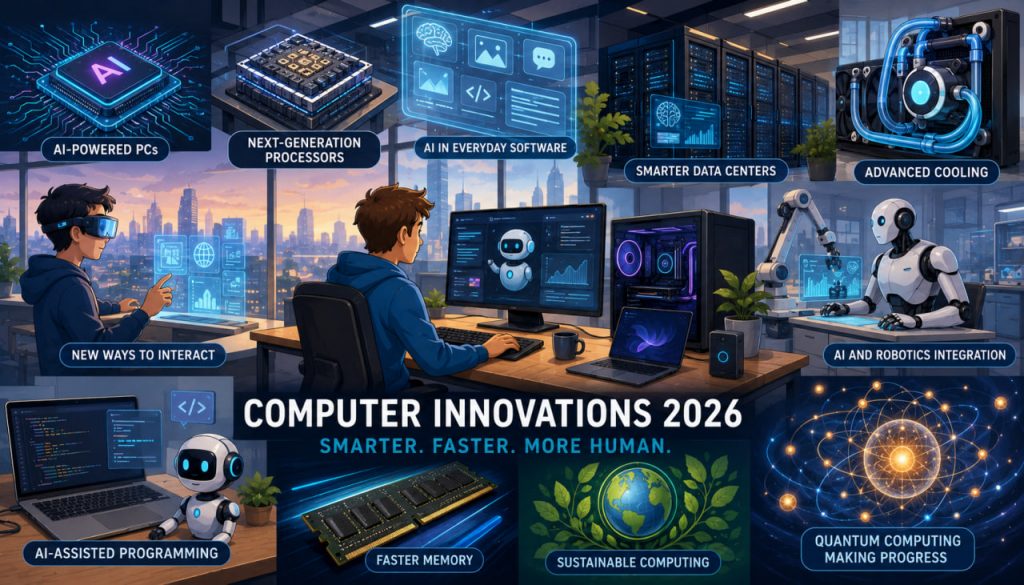
The year 2026 is becoming an exciting period for computer technology. Advances in artificial intelligence, processor design, memory systems, data centers, and human-computer interaction are transforming how computers operate and how people use them. While computers have become increasingly powerful over the past decades, recent innovations are focusing not only on raw performance but also on efficiency, intelligence, and adaptability.
From AI-powered personal computers to next-generation chips and emerging quantum technologies, the computing industry is entering a new phase of development. These innovations are expected to influence everything from home computing and gaming to scientific research and industrial automation.
The Rise of AI-Powered Personal Computers
One of the most significant trends of 2026 is the growing popularity of AI PCs.
Unlike traditional computers that rely heavily on cloud services, AI PCs contain specialized hardware designed to run artificial intelligence tasks locally.
These systems often include dedicated neural processing units (NPUs).
An NPU is a processor optimized specifically for AI calculations such as:
- Image generation
- Voice recognition
- Language processing
- Real-time translation
- Intelligent assistants
Running AI locally improves privacy, reduces latency, and decreases dependence on internet connectivity.
As software developers increasingly integrate AI features into applications, NPUs are becoming a major selling point for modern computers.
More Efficient Processors
Processor manufacturers continue to pursue performance gains while reducing power consumption.
Modern chip designs increasingly use heterogeneous architectures.
In these systems, different types of processor cores handle different workloads.
For example:
- Performance cores handle demanding tasks.
- Efficiency cores manage background operations.
This approach allows computers to deliver strong performance while maintaining lower energy consumption and improved battery life.
The strategy has become particularly important for laptops and mobile workstations.
Advanced Chip Manufacturing
Semiconductor fabrication continues to advance.
Manufacturers are producing increasingly dense chips containing billions of transistors.
Smaller manufacturing processes allow:
- Higher performance
- Lower power consumption
- Greater transistor density
- Improved thermal efficiency
Modern processors now contain astonishing levels of computational capability compared with systems from only a decade ago.
The continued refinement of chip manufacturing remains one of the primary drivers of technological progress.
Artificial Intelligence in Everyday Software
AI is no longer limited to research laboratories.
In 2026, AI features are increasingly integrated into everyday software.
Applications now offer:
- Intelligent writing assistance
- Automatic image editing
- Smart search capabilities
- Code generation
- Meeting summarization
Many programs can analyze user behavior and provide contextual recommendations.
This trend is making computers more capable of assisting users rather than simply responding to commands.
Faster Memory Technologies
Memory systems are also evolving rapidly.
Modern computers increasingly rely on:
- High-bandwidth memory
- Faster DDR memory standards
- Improved cache architectures
These technologies help processors access data more quickly.
As AI workloads become more demanding, memory performance is becoming almost as important as processor speed.
Researchers continue developing new approaches that reduce bottlenecks between processors and memory.
Data Centers Become More Intelligent
Many of the world’s most powerful computers reside in data centers.
In 2026, data centers are becoming increasingly automated through artificial intelligence.
AI systems help optimize:
- Energy usage
- Cooling systems
- Workload distribution
- Hardware maintenance
This is particularly important because modern AI models require enormous computational resources.
Improved efficiency reduces operating costs and environmental impact.
Liquid Cooling Expands Beyond Enthusiasts
Cooling technology is advancing alongside computing power.
Traditional air cooling remains common, but liquid cooling solutions are becoming increasingly widespread.
Modern systems use sophisticated cooling approaches to manage heat generated by powerful processors and graphics cards.
Benefits include:
- Lower operating temperatures
- Reduced noise
- Improved performance stability
- Better energy efficiency
Large-scale data centers are also adopting advanced liquid-cooling technologies to support high-density computing environments.
Quantum Computing Continues to Progress
Quantum computing remains one of the most intriguing areas of computer science.
Quantum computers use quantum bits, or qubits, which behave differently from traditional binary bits.
Unlike classical bits that represent either 0 or 1, qubits can exist in multiple states simultaneously.
Researchers continue making progress in:
- Error correction
- Qubit stability
- Quantum algorithms
- Scalable architectures
While quantum computers are not replacing personal computers anytime soon, they may eventually solve certain scientific and mathematical problems far more efficiently than classical machines.
AI-Assisted Programming
Software development is changing rapidly due to AI.
Modern programming tools can:
- Suggest code
- Detect bugs
- Generate documentation
- Explain complex functions
- Assist with debugging
These capabilities help developers work more efficiently.
Rather than replacing programmers, AI tools are increasingly acting as collaborative assistants that accelerate development workflows.
Sustainable Computing
Environmental concerns are influencing computer design more than ever before.
Manufacturers are focusing on:
- Energy-efficient processors
- Recyclable materials
- Reduced electronic waste
- Longer product lifespans
Sustainability has become a major consideration throughout the technology industry.
Future innovations are expected to balance performance gains with environmental responsibility.
Expert Perspective
Computer scientist Andrew Ng has repeatedly emphasized that artificial intelligence is becoming a foundational technology comparable to electricity in its transformative potential.
This observation reflects a broader industry trend.
“AI is the new electricity.”
Just as electricity transformed countless industries during the 20th century, AI is increasingly becoming integrated into nearly every aspect of computing.
Human-Computer Interaction Evolves
The way people interact with computers continues to change.
New technologies include:
- Voice-based interfaces
- AI assistants
- Gesture recognition
- Augmented reality applications
- Natural language interaction
Computers are becoming more capable of understanding human intentions and responding in intuitive ways.
This evolution may eventually make traditional keyboard-and-mouse interactions less dominant in certain applications.
Conclusion
Computer innovations in 2026 are being driven by a combination of artificial intelligence, advanced semiconductor technology, improved memory systems, sustainable engineering, and new approaches to human-computer interaction. Rather than focusing solely on faster hardware, the industry is increasingly creating systems that are smarter, more efficient, and better integrated into daily life.
As AI-powered computing continues to expand, future computers may become proactive assistants capable of helping users solve problems, create content, and manage information in ways that were once considered science fiction. The innovations emerging today are laying the foundation for the next generation of digital technology.
Interesting Facts
- Modern AI processors can perform trillions of operations per second.
- Today’s high-end chips contain tens of billions of transistors.
- Neural Processing Units are becoming standard components in many new computers.
- Some modern data centers use liquid cooling systems to improve efficiency.
- Quantum computers operate using principles of quantum mechanics rather than classical electronics.
- AI-assisted programming tools are now used by millions of software developers worldwide.
Glossary
- AI PC — A personal computer equipped with specialized hardware designed to accelerate artificial intelligence workloads.
- NPU (Neural Processing Unit) — A processor optimized specifically for AI calculations.
- Heterogeneous Architecture — A processor design that combines different types of computing cores for specific tasks.
- Transistor — A microscopic electronic component that forms the foundation of modern computer chips.
- Qubit — The basic unit of information in a quantum computer.
- Liquid Cooling — A cooling system that uses circulating liquid to remove heat from computer components.