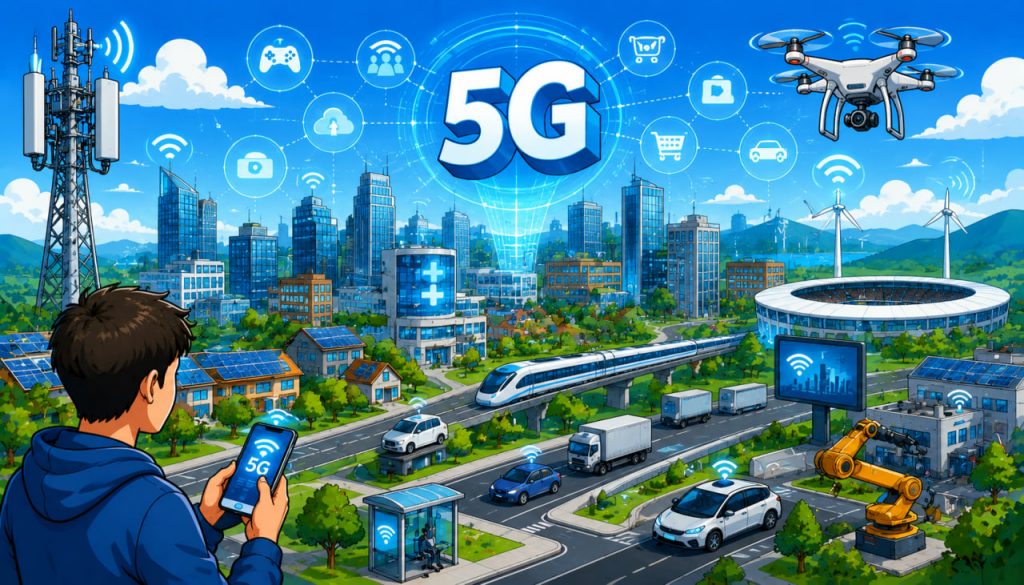
5G is the fifth generation of mobile communication technology. It is the successor to 4G LTE and was designed not only to make smartphones faster, but also to support a new digital infrastructure for cities, industry, transport, medicine, entertainment, and the Internet of Things.
For most people, 5G means faster mobile internet, smoother video calls, quicker downloads, and better performance in crowded places. But technically, 5G is much more than a speed upgrade. It is a new network architecture built to connect millions of devices, reduce delay, improve reliability, and support services that older networks were not designed to handle.
According to the International Telecommunication Union, 5G, formally known as IMT-2020, is built around three major usage scenarios: enhanced mobile broadband, ultra-reliable low-latency communications, and massive machine-type communications.
What Does 5G Mean?
The term 5G simply means “fifth generation.”
Each mobile generation introduced major improvements:
- 1G enabled analog voice calls.
- 2G introduced digital calls and text messages.
- 3G made mobile internet practical.
- 4G brought fast broadband, streaming, and app-based services.
- 5G adds higher capacity, lower latency, and support for massive device connectivity.
The goal of 5G is not just to connect people, but also to connect machines, sensors, vehicles, factories, hospitals, and smart infrastructure.
In simple terms, 5G is a faster, more flexible, and more powerful mobile network designed for a highly connected world.
How Fast Is 5G?
5G can be significantly faster than 4G, but real-world speed depends on many factors.
These include:
- Network coverage
- Frequency band
- Distance from the tower
- Number of users nearby
- Device quality
- Operator infrastructure
- Indoor or outdoor use
In ideal laboratory conditions, 5G can reach extremely high speeds. In everyday life, users usually experience more modest but still noticeable improvements compared with 4G.
The biggest advantage is not only peak speed, but higher capacity. This means 5G networks can handle more users and devices at the same time, especially in busy areas such as stadiums, airports, shopping centers, and city centers.
Low, Mid, and High-Band 5G
Not all 5G networks are the same.
5G uses different parts of the radio spectrum, usually grouped into three categories.
Low-band 5G
Low-band frequencies provide wide coverage and better penetration through walls.
They are useful for rural areas and broad national coverage, but speeds are usually closer to advanced 4G.
Mid-band 5G
Mid-band spectrum offers a balance between speed and coverage.
It is often considered the most practical and important layer for everyday 5G service because it can provide strong performance without requiring extremely dense tower placement.
High-band 5G
High-band 5G, often called millimeter wave, can deliver very high speeds and capacity.
However, it has a shorter range and is more easily blocked by buildings, trees, and even walls.
The FCC describes low-band spectrum as useful for wider coverage, while mid-band spectrum has become an important target for 5G because it offers a strong balance of performance and coverage.
What Is Latency and Why Does It Matter?
Latency is the delay between sending a command and receiving a response.
For example, when you tap a button in an online game or control a remote device, latency affects how quickly the system reacts.
4G networks already offer good performance for many everyday tasks. But 5G is designed to reduce latency further, making real-time applications more practical.
Low latency can be important for:
- Cloud gaming
- Augmented reality
- Remote medical tools
- Industrial automation
- Connected vehicles
- Smart traffic systems
Speed helps you download data faster. Low latency helps digital systems respond faster.
This distinction is one of the main reasons 5G matters beyond smartphones.
5G and the Internet of Things
The Internet of Things, or IoT, refers to everyday devices connected to the internet.
These may include:
- Smart meters
- Environmental sensors
- Security systems
- Agricultural sensors
- Industrial machines
- Medical devices
- Logistics trackers
5G is designed to support massive machine-type communications, meaning it can connect very large numbers of devices efficiently. This is especially important for smart cities, smart factories, and large-scale monitoring systems.
A future city may use thousands or millions of connected sensors to manage traffic, air quality, lighting, water systems, and public safety.
What Is Network Slicing?
One of the most important 5G concepts is network slicing.
Network slicing allows operators to create separate virtual networks on the same physical infrastructure. Each “slice” can be optimized for a different purpose.
For example:
- One slice may support emergency services.
- Another may support industrial robots.
- Another may provide high-speed video streaming.
- Another may connect low-power sensors.
The GSMA explains that network slicing allows 5G networks to support diverse services with specific performance requirements.
This flexibility is one of the reasons 5G is considered a platform for future digital services, not just a faster phone network.
Is 5G Safe?
5G has been the subject of many myths and conspiracy theories.
From a scientific perspective, 5G radio signals are a form of non-ionizing electromagnetic radiation. This means they do not have enough energy to break chemical bonds or damage DNA in the way ionizing radiation, such as X-rays or gamma rays, can.
Health authorities and telecommunications regulators set exposure limits for wireless networks.
As with earlier mobile technologies, 5G networks must operate within these safety limits.
There is no credible scientific evidence that properly regulated 5G networks cause the dramatic health effects often claimed in online misinformation.
However, infrastructure planning, transparency, and public communication remain important because people naturally want to understand technologies placed near homes, schools, and workplaces.
Expert Perspective
The International Telecommunication Union, the United Nations specialized agency for information and communication technologies, has played a central role in defining the technical vision for IMT-2020, commonly known as 5G.
Its framework identifies three core directions for 5G: enhanced mobile broadband, ultra-reliable low-latency communication, and massive machine-type communication.
“The future of 5G is not only faster phones, but networks capable of supporting very different digital services at the same time.”
This expert view is important because it explains why 5G is often discussed in connection with transport, industry, healthcare, smart cities, and automation.
Why 5G Matters for Everyday Users
For ordinary users, 5G can improve daily digital life in several ways.
Benefits include:
- Faster downloads
- Better video streaming
- More stable connections in crowded areas
- Lower lag in games and video calls
- Better hotspot performance
- Improved support for future apps
However, the difference between 4G and 5G may not always feel dramatic.
If you mainly browse websites, send messages, and watch standard video, good 4G may already feel sufficient.
The real value of 5G becomes clearer in data-heavy and latency-sensitive applications.
5G Standalone and 5G Advanced
Many early 5G networks were launched as non-standalone systems, meaning they still relied partly on existing 4G infrastructure.
5G Standalone uses a dedicated 5G core network, enabling more advanced features such as stronger network slicing, improved latency, and more flexible industrial services.
GSMA notes that 5G Standalone is important for unlocking the full potential of 5G, especially for low latency, network slicing, and massive IoT capabilities.
The next evolutionary step is often called 5G Advanced, which introduces further improvements in efficiency, positioning, automation, and performance.
Interesting Facts
- 5G is not one single speed; performance depends heavily on the frequency band and local network design.
- High-band 5G can be extremely fast but has limited range.
- Mid-band 5G is often considered the most balanced option for cities and suburbs.
- 5G can support not only phones, but also sensors, vehicles, factories, and smart infrastructure.
- Network slicing allows one physical network to behave like multiple specialized networks.
- Many early 5G networks still used parts of 4G infrastructure.
- The full potential of 5G becomes clearer with 5G Standalone networks.
Glossary
- 5G — The fifth generation of mobile network technology.
- Latency — The delay between sending data and receiving a response.
- Bandwidth — The amount of data a network can transmit in a given time.
- Spectrum — The range of radio frequencies used for wireless communication.
- Low-Band 5G — 5G using lower frequencies with wide coverage but moderate speeds.
- Mid-Band 5G — 5G using middle frequencies that balance speed and coverage.
- Millimeter Wave — High-frequency 5G spectrum that offers very high speeds over shorter distances.
- Internet of Things — A network of connected devices, sensors, and machines.
- Network Slicing — A 5G feature that creates virtual network sections for different services.
- 5G Standalone — A 5G network that uses a dedicated 5G core instead of relying on 4G infrastructure.