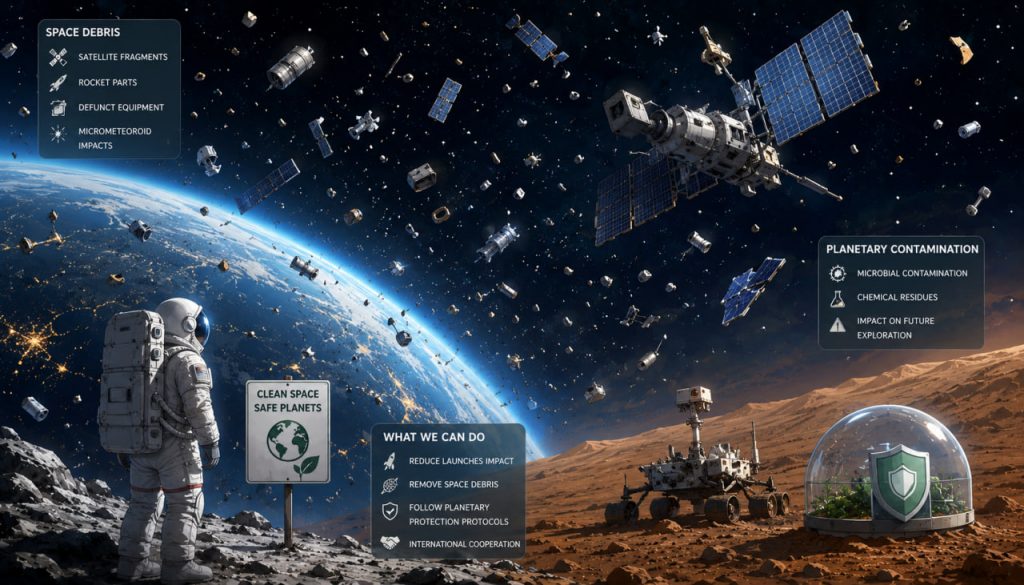
When people think about environmental protection, they usually imagine forests, oceans, rivers, air pollution, or climate change. However, human activity is no longer limited to Earth. Since the beginning of the Space Age in 1957, humanity has launched thousands of satellites, probes, rockets, and spacecraft into space. As a result, environmental concerns now extend far beyond our planet.
Today, scientists face two major ecological challenges in space: space debris orbiting Earth and the risk of contaminating other worlds with terrestrial microorganisms and human-made pollutants. These issues have become increasingly important as commercial spaceflight, satellite constellations, lunar missions, and future Mars expeditions continue to expand.
What Is Space Debris?
Space debris, often called “space junk,” refers to human-made objects in orbit that no longer serve any useful purpose.
Examples include:
- Defunct satellites
- Spent rocket stages
- Broken spacecraft components
- Paint flakes
- Fragments from collisions
- Debris from explosions in orbit
According to the European Space Agency (ESA), millions of debris objects currently orbit Earth, ranging from tiny fragments to large inactive satellites.
Even a small object can be dangerous because orbital speeds are extremely high, often exceeding 28,000 kilometers per hour (17,500 mph).
At such speeds, even a bolt or paint chip can cause serious damage to operational spacecraft.
How Did Space Debris Become a Problem?
The problem accumulated gradually over decades.
Early space missions focused primarily on exploration and technology development. Long-term orbital sustainability was rarely considered.
Several factors contributed to the growth of debris:
- Increasing satellite launches
- Abandoned spacecraft
- Rocket stage disposal
- Accidental collisions
- Anti-satellite weapon tests
- Explosions caused by leftover fuel
One of the most significant debris-generating events occurred in 2009 when the active satellite Iridium 33 collided with the inactive Russian satellite Cosmos 2251.
The collision produced thousands of trackable fragments and many smaller pieces that remain in orbit.
As satellite numbers continue to grow, collision risks increase.
The Kessler Syndrome: A Dangerous Scenario
Scientists worry about a phenomenon known as the Kessler Syndrome, proposed by NASA scientist Donald Kessler in 1978.
The theory suggests that orbital debris could eventually reach a critical density where collisions generate more debris, which then causes additional collisions.
This chain reaction could make certain orbital regions increasingly hazardous.
Potential consequences include:
- Damage to satellites
- Increased launch risks
- Higher mission costs
- Communication disruptions
- Navigation system interference
- Threats to human spaceflight
Preventing the Kessler Syndrome is one of the most important long-term goals of space sustainability efforts.
Why Space Debris Matters on Earth
Although debris exists in space, its effects can be felt on Earth.
Modern society depends heavily on satellites for:
- GPS navigation
- Weather forecasting
- Telecommunications
- Internet connectivity
- Scientific observation
- Disaster monitoring
- Military operations
A major debris-related accident could disrupt essential services that billions of people use daily.
The economic consequences could also be significant.
Space is increasingly becoming part of Earth’s critical infrastructure.
Cleaning Up Space Junk
Scientists, engineers, and space agencies are developing methods to reduce and remove orbital debris.
Proposed solutions include:
- Robotic capture systems
- Nets and harpoons
- Magnetic docking mechanisms
- Drag sails
- Laser-based tracking
- Controlled deorbiting technologies
Several experimental missions have already demonstrated active debris removal techniques.
However, cleaning up space remains technically difficult and expensive.
Unlike terrestrial waste management, orbital cleanup must occur in a harsh environment where objects travel at enormous speeds.
The most effective solution is preventing new debris while gradually removing the most dangerous existing objects.
Beyond Earth: The Problem of Planetary Contamination
Space ecology is not limited to Earth’s orbit.
Scientists are also concerned about contamination of other planets, moons, and celestial bodies.
This issue is known as planetary protection.
There are two main forms:
Forward Contamination
Forward contamination occurs when Earth organisms are transported to another world.
Potential sources include:
- Spacecraft surfaces
- Scientific instruments
- Human missions
- Microbial contamination during assembly
Even highly sterilized spacecraft may carry some microorganisms.
Scientists worry that terrestrial microbes could survive and interfere with the search for extraterrestrial life.
If Earth bacteria were discovered on Mars after being accidentally introduced there, future biological research could become far more complicated.
Back Contamination
Back contamination refers to the possibility that material returned from another celestial body could introduce unknown biological agents to Earth.
Although no evidence currently suggests dangerous extraterrestrial organisms exist, precautionary measures remain important.
Future missions returning samples from Mars may require strict containment procedures.
Planetary protection policies are designed to reduce these risks.
Why Mars Receives Special Attention
Mars is considered one of the most likely places in the Solar System to preserve evidence of past microbial life.
For this reason, contamination concerns are particularly strong.
Scientists want future discoveries to be scientifically reliable.
If Earth microbes establish themselves on Mars, distinguishing native Martian biology from terrestrial contamination could become extremely difficult.
Protecting Mars from contamination is partly about protecting the integrity of scientific research.
The same principles apply to icy moons such as Europa and Enceladus, which may contain subsurface oceans capable of supporting microbial life.
The Environmental Footprint of Space Exploration
Space missions also have direct environmental impacts.
Rocket launches require large amounts of energy and fuel.
Potential environmental concerns include:
- Greenhouse gas emissions
- Black carbon particles
- Chemical exhaust products
- Manufacturing impacts
- Resource extraction
- Infrastructure development
Compared with global transportation or industry, the current space sector remains relatively small.
However, increasing launch frequency means environmental impacts are receiving more attention from researchers and regulators.
Future space sustainability discussions will likely include both orbital pollution and launch-related environmental effects.
Expert Perspective
NASA’s Planetary Protection Office emphasizes the importance of preventing harmful biological contamination during space exploration.
Planetary protection policies are designed to preserve both scientific integrity and environmental responsibility beyond Earth.
“We explore space not only to discover new worlds, but also to preserve them for future generations of science.”
This principle reflects a growing understanding that exploration and conservation must go hand in hand.
Just as environmental stewardship became essential on Earth, responsible management of the space environment is becoming increasingly important.
Toward Sustainable Space Exploration
The future of space activity will require international cooperation.
Governments, private companies, researchers, and international organizations are increasingly working together to establish best practices.
Important goals include:
- Reducing orbital debris
- Improving satellite disposal
- Designing recyclable spacecraft
- Preventing unnecessary collisions
- Strengthening planetary protection standards
- Monitoring environmental impacts of launches
- Developing active debris-removal technologies
As humanity expands its presence beyond Earth, environmental responsibility must expand as well.
The challenges of the 21st century are no longer confined to forests, oceans, and cities. They now extend into orbit and across the Solar System.
The future of space exploration depends not only on reaching new worlds but also on protecting them.
Interesting Facts
- More than 36,000 tracked debris objects larger than 10 centimeters currently orbit Earth.
- Millions of smaller debris fragments are too small to track individually but can still damage spacecraft.
- A satellite collision can create thousands of new debris fragments almost instantly.
- Mars missions undergo extensive sterilization procedures to reduce contamination risks.
- Some spacecraft are intentionally directed into planetary atmospheres to burn up safely at the end of their missions.
- The International Space Station regularly performs avoidance maneuvers to reduce collision risks.
- Planetary protection policies have existed since the early days of space exploration.
Glossary
- Space Debris — Human-made objects in orbit that no longer serve a useful purpose.
- Kessler Syndrome — A theoretical chain reaction in which orbital collisions create increasing amounts of debris.
- Planetary Protection — Policies designed to prevent biological contamination between Earth and other celestial bodies.
- Forward Contamination — The transfer of Earth organisms to another planet or moon.
- Back Contamination — The introduction of extraterrestrial material to Earth.
- Low Earth Orbit (LEO) — The region of space extending roughly up to 2,000 kilometers above Earth.
- Deorbiting — The process of intentionally removing a spacecraft from orbit.
- Sterilization — Procedures used to eliminate microorganisms from spacecraft components.
- Orbital Sustainability — The long-term ability to safely use Earth’s orbital environment.
- Planetary Science — The scientific study of planets, moons, asteroids, and other bodies in the Solar System.