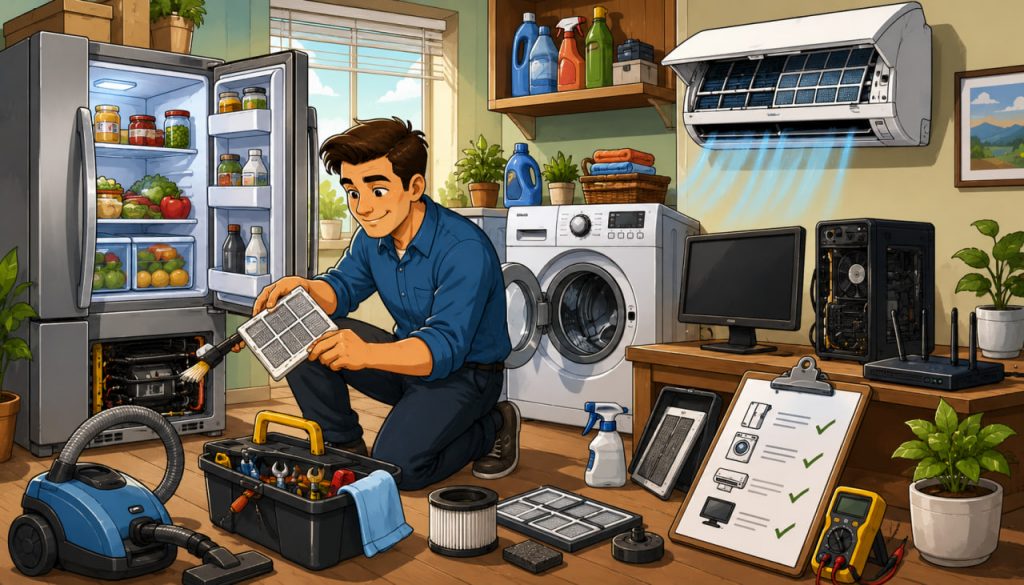
Modern homes depend heavily on appliances and electronic devices. Refrigerators preserve food, washing machines save time, air conditioners improve comfort, and computers support work and communication. Yet many homeowners pay little attention to maintenance until something breaks.
Proper care can significantly extend the lifespan of household equipment, reduce repair costs, improve energy efficiency, and prevent unexpected failures. In many cases, simple maintenance habits can add years to the life of an appliance.
This practical guide explains how to keep household equipment operating safely and efficiently while avoiding common mistakes that lead to premature breakdowns.
Why Preventive Maintenance Matters
Many household appliances fail not because of manufacturing defects but because of neglect.
Dust accumulation, poor ventilation, moisture, overloading, and lack of cleaning can gradually reduce performance and damage components.
Preventive maintenance offers several benefits:
- Longer equipment lifespan
- Lower repair expenses
- Improved energy efficiency
- Better safety
- Reduced risk of sudden failures
- Lower environmental impact
Replacing appliances less frequently also reduces electronic waste and conserves resources used in manufacturing.
A small investment of time often prevents expensive repairs later.
The Golden Rule: Follow the Manufacturer’s Instructions
Every appliance is designed differently.
Manufacturers provide maintenance schedules and recommendations based on extensive testing.
Unfortunately, instruction manuals are often ignored after installation.
Important information typically includes:
- Cleaning procedures
- Filter replacement intervals
- Operating limitations
- Ventilation requirements
- Safety precautions
Following these guidelines is one of the simplest ways to maximize reliability.
The user manual is often the most overlooked maintenance tool in the house.
Keeping Appliances Clean
Dust and dirt are among the most common causes of reduced efficiency.
Regular cleaning helps prevent overheating and mechanical stress.
Refrigerators
Pay attention to:
- Door seals
- Ventilation areas
- Condenser coils (if accessible)
Dirty condenser coils can force the compressor to work harder, increasing electricity consumption and wear.
Washing Machines
Regular maintenance includes:
- Cleaning detergent drawers
- Wiping door seals
- Running cleaning cycles
- Checking drain filters
Moisture left inside the machine can promote mold growth and unpleasant odors.
Dishwashers
Important maintenance tasks include:
- Cleaning filters
- Inspecting spray arms
- Removing food debris
- Checking drainage systems
Electronics
Computers, gaming consoles, and routers require occasional dust removal to maintain airflow.
Dust buildup is a major contributor to overheating.
Avoid Overloading Equipment
Many appliances are designed for specific operating limits.
Overloading can dramatically shorten their lifespan.
Examples include:
Washing Machines
Excessively heavy loads place stress on:
- Bearings
- Motors
- Suspension systems
Electrical Circuits
Too many devices connected to one outlet may increase overheating risks.
Refrigerators
Overpacking can block airflow and reduce cooling efficiency.
Operating within recommended limits reduces mechanical and electrical stress.
Protect Against Power Problems
Voltage fluctuations can damage sensitive electronics.
Modern homes contain numerous devices that depend on delicate electronic components.
Examples include:
- Televisions
- Computers
- Smart appliances
- Routers
- Home automation systems
Protection measures may include:
- Surge protectors
- Uninterruptible power supplies (UPS)
- Proper grounding systems
These devices can help reduce damage caused by power surges, lightning events, or unstable electrical networks.
Maintain Proper Ventilation
Many household appliances generate heat during operation.
Poor airflow can lead to overheating and premature failure.
Pay particular attention to:
- Refrigerators
- Freezers
- Air conditioners
- Computers
- Gaming systems
- Home servers
Do not block ventilation openings.
Avoid placing equipment tightly against walls unless specifically designed for such installation.
Heat is one of the most common enemies of electronic and mechanical equipment.
Replace Filters on Time
Many appliances rely on filters to maintain performance.
Common examples include:
- Air conditioners
- Vacuum cleaners
- Air purifiers
- Range hoods
- Water filtration systems
Dirty filters can:
- Restrict airflow
- Increase energy consumption
- Reduce effectiveness
- Place additional strain on motors
A simple filter replacement often restores performance immediately.
Monitor Moisture and Water Exposure
Water is essential for some appliances but dangerous for others.
Humidity can contribute to:
- Corrosion
- Mold growth
- Electrical damage
- Short circuits
Protect sensitive devices by:
- Keeping electronics away from leaks
- Maintaining proper ventilation
- Addressing water damage immediately
- Monitoring basement and utility room humidity
For appliances connected to water lines, periodic inspection of hoses and fittings is recommended.
Recognize Early Warning Signs
Most equipment provides warning signals before complete failure.
Common signs include:
- Unusual noises
- Excessive vibration
- Burning smells
- Reduced performance
- Overheating
- Error messages
- Water leaks
- Rising energy consumption
Ignoring these symptoms often leads to more extensive damage.
Small problems are usually cheaper and easier to fix than major failures.
Smart Technology and Predictive Maintenance
Modern appliances increasingly include self-diagnostic systems.
Smart devices can monitor:
- Energy use
- Operating temperature
- Maintenance schedules
- Filter condition
- Error codes
Some systems even send maintenance alerts directly to smartphones.
Predictive maintenance, already common in industry, is becoming more accessible in residential settings.
This technology helps identify potential issues before breakdowns occur.
Expert Perspective
Engineers specializing in reliability and maintenance often emphasize a simple principle:
“Most equipment failures are not sudden events—they are the final stage of a process that began much earlier.”
This concept forms the foundation of preventive maintenance.
By identifying wear, contamination, overheating, or mechanical stress early, homeowners can often prevent major repairs entirely.
Maintenance professionals consistently report that regular cleaning and inspection are among the most effective ways to increase equipment longevity.
Sustainability Benefits of Maintenance
Maintaining appliances is not only financially beneficial but also environmentally responsible.
Manufacturing new equipment requires:
- Raw materials
- Energy
- Transportation
- Packaging
- Industrial processing
Extending product lifespan reduces demand for replacement products and decreases electronic waste.
The environmental impact of keeping a refrigerator operating efficiently for several additional years can be significant.
One of the most sustainable appliances is often the one you already own.
Creating a Home Maintenance Schedule
A simple maintenance routine can prevent many common failures.
Examples include:
Monthly:
- Inspect visible cables and hoses
- Clean appliance surfaces
- Check filters
Every 3–6 Months:
- Clean refrigerator coils if accessible
- Vacuum electronic ventilation openings
- Inspect water connections
Annually:
- Deep clean major appliances
- Replace worn seals
- Test surge protection devices
- Review manufacturer recommendations
Consistency is more important than complexity.
Small regular actions often provide greater benefits than infrequent major cleaning efforts.
Interesting Facts
- Dust accumulation can increase operating temperatures inside electronic devices by several degrees.
- Refrigerator door seals are among the most commonly overlooked maintenance items.
- Many appliance failures are linked to overheating rather than mechanical wear.
- Air conditioner efficiency can drop significantly when filters become clogged.
- Surge protectors gradually wear out and may require periodic replacement.
- Regular maintenance can extend the lifespan of some household appliances by several years.
- Electronic waste is one of the fastest-growing waste streams globally.
Glossary
- Preventive Maintenance — Routine actions performed to reduce the likelihood of equipment failure.
- Condenser Coil — A component in refrigerators and air conditioners that releases heat.
- Surge Protector — A device that protects electronics from voltage spikes.
- UPS (Uninterruptible Power Supply) — A backup power device that provides temporary electricity during outages.
- Ventilation — Airflow that removes excess heat from equipment.
- Predictive Maintenance — Monitoring equipment to identify potential problems before failure occurs.
- Filter — A component that removes particles from air, water, or other substances.
- Corrosion — Gradual material degradation caused by chemical reactions, often involving moisture.
- Energy Efficiency — The ability to perform a task while using less energy.
- Electronic Waste (E-Waste) — Discarded electronic devices and components.