Waterjet cutting is one of the most fascinating manufacturing technologies used today. At first glance, the idea seems almost impossible: how can water, one of the softest and most common substances on Earth, cut through thick steel, stone, glass, or titanium? Yet modern waterjet systems routinely perform these tasks with remarkable precision.
Used in industries ranging from aerospace and automotive manufacturing to architecture and art, waterjet cutting has become a powerful alternative to traditional cutting methods. Its ability to process diverse materials without generating excessive heat makes it especially valuable in modern manufacturing.
Understanding how waterjet cutting works reveals an impressive combination of physics, engineering, and industrial innovation.
What Is Waterjet Cutting?
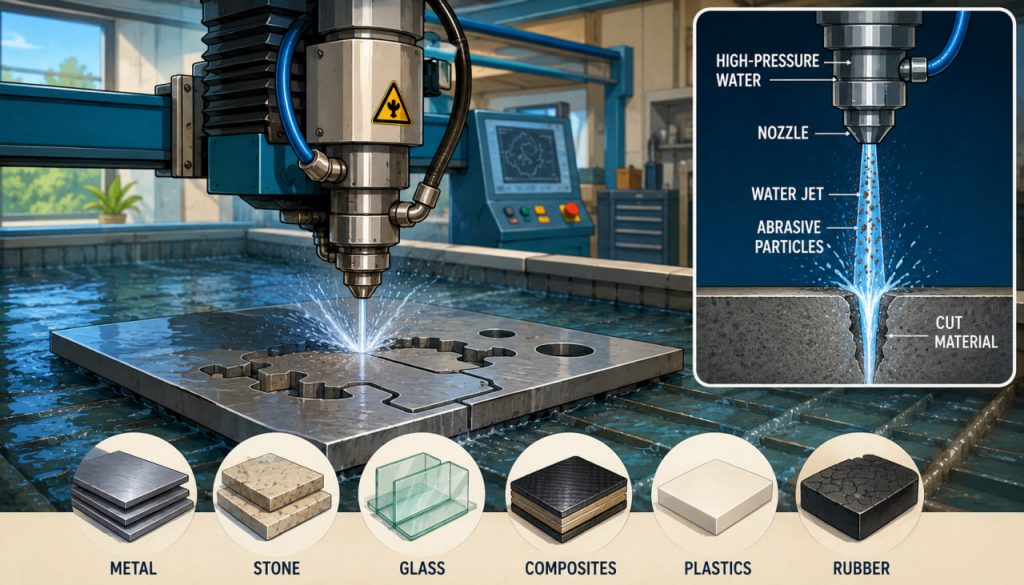
Waterjet cutting is a manufacturing process that uses an extremely high-pressure stream of water to cut materials.
In its simplest form, pure water is pressurized and forced through a tiny nozzle at tremendous speed.
For harder materials, an abrasive substance is added to the water stream, creating what is known as abrasive waterjet cutting.
This technology can cut:
- Steel
- Aluminum
- Titanium
- Stone
- Ceramic
- Glass
- Plastics
- Rubber
- Composite materials
The cutting power comes not from the water itself but from its extremely high velocity and concentrated energy.
The Physics Behind Waterjet Cutting
The principle behind waterjet cutting is surprisingly straightforward.
A high-pressure pump compresses water to pressures that may exceed 60,000 pounds per square inch (PSI), and some advanced systems operate at over 90,000 PSI.
The pressurized water is then forced through a very small orifice.
As the water exits the nozzle, pressure energy is converted into kinetic energy.
The resulting jet can travel at speeds approaching three times the speed of sound.
At these velocities, the stream carries enough energy to erode and penetrate solid materials.
Pure Waterjet vs. Abrasive Waterjet
There are two primary types of waterjet systems.
Pure Waterjet Cutting
Pure waterjet systems use only water.
They are commonly used for softer materials such as:
- Food products
- Paper
- Foam
- Rubber
- Textiles
The absence of abrasives makes the process cleaner and simpler.
Food manufacturers often use pure waterjets because they provide hygienic and precise cutting.
Abrasive Waterjet Cutting
For harder materials, abrasive particles are added to the water stream.
Common abrasives include garnet sand.
The abrasive particles dramatically increase cutting capability.
Abrasive waterjets can cut:
- Thick steel plates
- Granite
- Marble
- Titanium alloys
- Hardened metals
Most industrial waterjet systems used in heavy manufacturing belong to this category.
Why Water Can Cut Metal
Many people are surprised to learn that water can cut steel.
The explanation lies in pressure and velocity.
A water droplet falling from the sky has very little energy.
However, when water is concentrated into an extremely narrow stream moving at tremendous speed, its impact becomes highly destructive.
The abrasive particles act like countless microscopic cutting tools.
Each particle removes tiny fragments of material.
Millions of impacts occur every second, gradually creating a precise cut.
Advantages of Waterjet Cutting
Waterjet technology offers several important advantages compared with traditional cutting methods.
No Heat-Affected Zone
One of the biggest benefits is the absence of significant heat generation.
Laser cutting and plasma cutting produce intense heat.
This can alter material properties near the cut edge.
Waterjet cutting avoids this problem.
Materials retain their original characteristics because temperatures remain relatively low.
This is especially important in aerospace and medical applications.
Exceptional Material Versatility
Few manufacturing technologies can process as many different materials as waterjets.
A single machine may cut:
- Metal
- Glass
- Stone
- Plastic
- Composite materials
This flexibility reduces the need for multiple specialized cutting systems.
High Precision
Modern computer-controlled waterjets can achieve remarkable accuracy.
Complex shapes and intricate designs can be produced with minimal waste.
Architectural panels, aerospace components, and artistic sculptures often rely on waterjet precision.
Industrial Applications
Waterjet cutting is used across numerous industries.
Aerospace Manufacturing
Aerospace companies frequently use waterjets to cut:
- Titanium
- Aluminum alloys
- Composite materials
The absence of heat damage is particularly valuable for critical aircraft components.
Automotive Industry
Automobile manufacturers use waterjets for:
- Interior components
- Metal parts
- Prototypes
- Specialty materials
The technology provides both flexibility and precision.
Architecture and Construction
Stone, marble, and granite can be cut into complex decorative shapes.
Architectural waterjet applications include:
- Floor mosaics
- Decorative panels
- Custom countertops
Art and Design
Artists increasingly use waterjet technology to create intricate works from metal, glass, and stone.
Designs that would be extremely difficult by hand can be produced accurately and repeatedly.
Environmental Considerations
Compared with some traditional cutting technologies, waterjets offer several environmental benefits.
Potential advantages include:
- Reduced dust generation
- Lower heat production
- Minimal airborne pollutants
- Efficient material utilization
However, abrasive waterjets generate spent abrasive waste that must be managed appropriately.
Water consumption is also a consideration, although many facilities recycle a portion of their process water.
Limitations of Waterjet Cutting
Despite its advantages, waterjet cutting is not perfect.
Some limitations include:
- High equipment costs
- Significant energy consumption
- Slower cutting speeds for certain materials
- Abrasive disposal requirements
- Maintenance of high-pressure components
Manufacturers must balance these factors against the benefits of precision and versatility.
Expert Perspective
Mechanical engineer Mohamed Hashish is widely recognized as one of the pioneers of abrasive waterjet cutting.
His groundbreaking work during the late twentieth century helped transform waterjet technology from a niche process into a major industrial tool.
Hashish demonstrated that abrasive particles could dramatically expand the cutting capabilities of high-pressure water systems. His innovations remain fundamental to many modern waterjet machines used worldwide.
The Future of Waterjet Technology
Researchers continue improving waterjet systems through advances in:
- Pump efficiency
- Automation
- Robotics
- Computer control
- Abrasive recycling
Modern manufacturing increasingly relies on flexible production methods, and waterjet cutting fits well within this trend.
As industries demand greater precision and material versatility, waterjet technology will likely remain an important part of advanced manufacturing.
Interesting Facts
- Some waterjet systems operate at pressures exceeding 90,000 PSI.
- Waterjet streams can travel at nearly three times the speed of sound.
- Abrasive waterjets can cut steel several inches thick.
- Food manufacturers use pure waterjets to slice products hygienically.
- Waterjet cutting can process materials that are difficult to cut using lasers.
- Garnet is one of the most common abrasives used in industrial waterjet systems.
Glossary
- Waterjet Cutting — A manufacturing process that uses a high-pressure water stream to cut materials.
- Abrasive Waterjet — A waterjet system that adds abrasive particles to increase cutting power.
- PSI (Pounds per Square Inch) — A unit used to measure pressure.
- Garnet — A hard mineral commonly used as an abrasive in waterjet cutting.
- Heat-Affected Zone (HAZ) — Material whose properties have been altered by heat during cutting or welding.
- Kinetic Energy — The energy possessed by an object due to its motion.