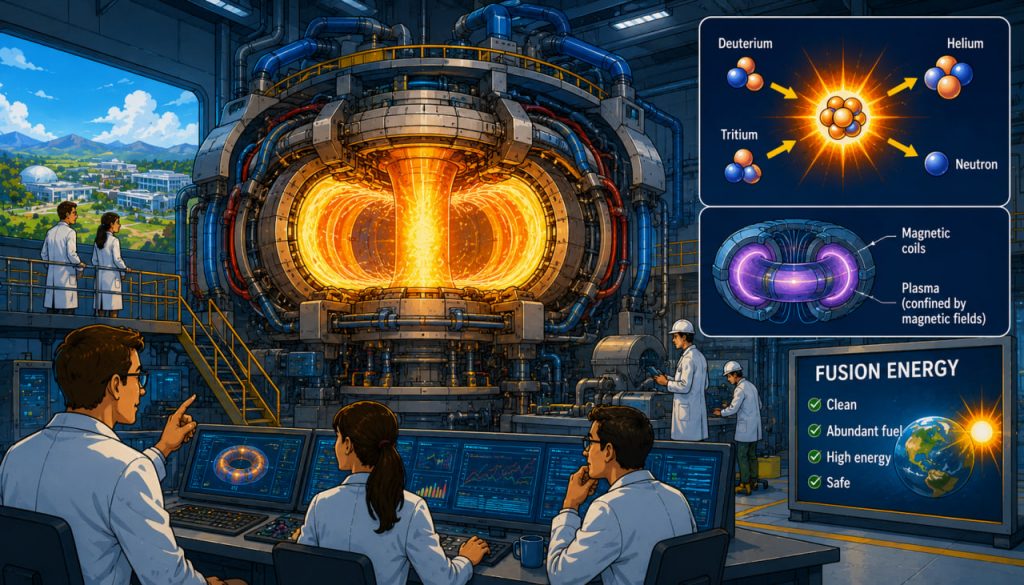
For decades, scientists have pursued one of humanity’s most ambitious technological goals: creating a miniature version of the Sun on Earth. Such a breakthrough could provide enormous amounts of clean energy using abundant fuel while producing far less long-lived radioactive waste than conventional nuclear power plants.
This quest centers on nuclear fusion, the same process that powers the Sun and countless other stars throughout the universe. Although researchers have made remarkable progress, creating a practical fusion power plant remains one of the greatest engineering challenges ever attempted.
The question is no longer whether fusion is scientifically possible—we have already achieved fusion reactions on Earth. The real challenge is whether we can sustain them efficiently enough to generate useful electricity.
What Powers the Sun?
The Sun generates energy through nuclear fusion.
Inside its core, immense pressure and temperatures exceeding 15 million degrees Celsius force hydrogen nuclei to combine.
This process produces:
- Helium
- Energy
- Light
- Heat
According to Einstein’s famous equation,
a small amount of mass is converted directly into energy during fusion.
This energy radiates outward and ultimately reaches Earth as sunlight.
Every second, the Sun converts millions of tons of matter into energy through fusion.
What Is Nuclear Fusion?
Fusion occurs when light atomic nuclei combine into heavier nuclei.
The most practical fusion reaction for Earth-based reactors involves isotopes of hydrogen:
- Deuterium
- Tritium
When these nuclei fuse, they produce:
- Helium
- A high-energy neutron
- Large amounts of energy
Unlike fossil fuels, fusion produces no carbon dioxide during operation.
Unlike conventional nuclear fission reactors, fusion does not rely on splitting heavy radioactive elements such as uranium.
Why Fusion Is So Difficult
The challenge is simple to describe but extremely difficult to solve.
Atomic nuclei naturally repel one another because they carry positive electrical charges.
To force them together, scientists must create conditions similar to those found inside stars.
This requires:
- Extremely high temperatures
- Enormous pressures
- Precise confinement systems
Fusion plasmas often reach temperatures exceeding 100 million degrees Celsius.
That is hotter than the center of the Sun.
At such temperatures, matter exists in the plasma state, where electrons separate from atomic nuclei.
Creating a Mini Sun with Magnetic Fields
Because no physical material can withstand direct contact with fusion plasma, scientists use powerful magnetic fields.
One of the most important reactor designs is called a tokamak.
A tokamak uses magnetic fields to confine plasma within a doughnut-shaped chamber.
Major fusion projects use this approach because it allows researchers to control extremely hot plasmas without touching reactor walls.
The goal is to keep the plasma stable long enough for sustained fusion reactions to occur.
The ITER Project
The largest fusion experiment currently under construction is ITER in southern France.
ITER represents collaboration among dozens of countries and thousands of scientists and engineers.
The project’s goals include:
- Demonstrating large-scale fusion
- Producing more energy than is used to heat the plasma
- Advancing fusion reactor technology
ITER is not designed as a commercial power plant.
Instead, it serves as a critical step toward future fusion electricity generation.
The reactor is expected to become one of the most complex scientific machines ever built.
Alternative Fusion Approaches
Tokamaks are not the only strategy.
Scientists are also exploring:
- Stellarators
- Laser fusion
- Magnetized target fusion
- Compact fusion reactors
One notable approach uses powerful lasers.
In this method, tiny fuel pellets are compressed using intense laser beams.
The compression briefly creates conditions suitable for fusion.
Recent experiments have achieved significant milestones, including fusion ignition under laboratory conditions.
These achievements demonstrate that fusion can release more energy than is delivered directly to the fuel target.
The Potential Benefits of Fusion Energy
If fusion becomes commercially viable, the benefits could be enormous.
Potential advantages include:
- Low greenhouse gas emissions
- Abundant fuel supplies
- High energy density
- Reduced air pollution
- Minimal long-lived radioactive waste
Deuterium can be extracted from seawater.
A relatively small amount of fusion fuel could produce large quantities of energy.
This abundance is one reason fusion remains so attractive despite its technical difficulties.
Safety Advantages
Fusion reactors differ fundamentally from conventional nuclear power plants.
A fusion reaction requires highly controlled conditions.
If those conditions are disrupted, the reaction simply stops.
There is no self-sustaining chain reaction similar to that found in fission reactors.
This characteristic significantly reduces the risk of certain types of nuclear accidents.
While fusion facilities still require careful engineering and radiation protection measures, many experts consider them inherently safer than traditional nuclear reactors.
Expert Perspective
Physicist Steven Cowley, former director of several major fusion research institutions, has emphasized that fusion represents one of humanity’s most promising long-term energy technologies.
Cowley frequently notes that the underlying science of fusion is well established. The primary challenge lies not in proving that fusion works but in developing systems that can operate reliably, economically, and continuously for power generation. His perspective reflects the broader scientific consensus that fusion is fundamentally achievable, even if practical deployment remains a major engineering challenge.
What Challenges Remain?
Despite recent breakthroughs, significant obstacles remain.
Scientists must improve:
- Plasma stability
- Reactor materials
- Energy efficiency
- Tritium handling
- Construction costs
Fusion neutrons can damage reactor components over time.
Engineers are developing advanced materials capable of withstanding these harsh conditions.
Economic challenges are equally important.
A successful fusion reactor must not only work scientifically but also compete with other energy sources.
Could Fusion Solve the Energy Crisis?
Fusion is sometimes described as the ultimate energy source.
While it has enormous potential, experts caution against expecting immediate solutions.
Commercial fusion power plants are still under development.
Even optimistic projections suggest that widespread deployment will require years or decades of additional research and engineering.
However, if successful, fusion could become a major component of future energy systems alongside:
- Solar power
- Wind energy
- Hydroelectric power
- Advanced fission reactors
Interesting Facts
- Fusion plasmas can exceed 100 million degrees Celsius.
- The Sun has been powered by fusion for approximately 4.6 billion years.
- A glass of seawater contains enough deuterium to potentially produce large amounts of fusion energy.
- ITER is one of the largest international scientific collaborations ever attempted.
- Fusion reactions power every star visible in the night sky.
- Laser fusion experiments have recently achieved ignition conditions in laboratory settings.
Glossary
- Nuclear Fusion — A process in which light atomic nuclei combine to form heavier nuclei while releasing energy.
- Plasma — A high-energy state of matter consisting of charged particles.
- Tokamak — A fusion reactor design that uses magnetic fields to confine plasma.
- Deuterium — A naturally occurring hydrogen isotope containing one neutron.
- Tritium — A radioactive hydrogen isotope commonly used in fusion research.
- Ignition — A fusion condition where the reaction becomes self-heating and sustains itself through the energy it produces.