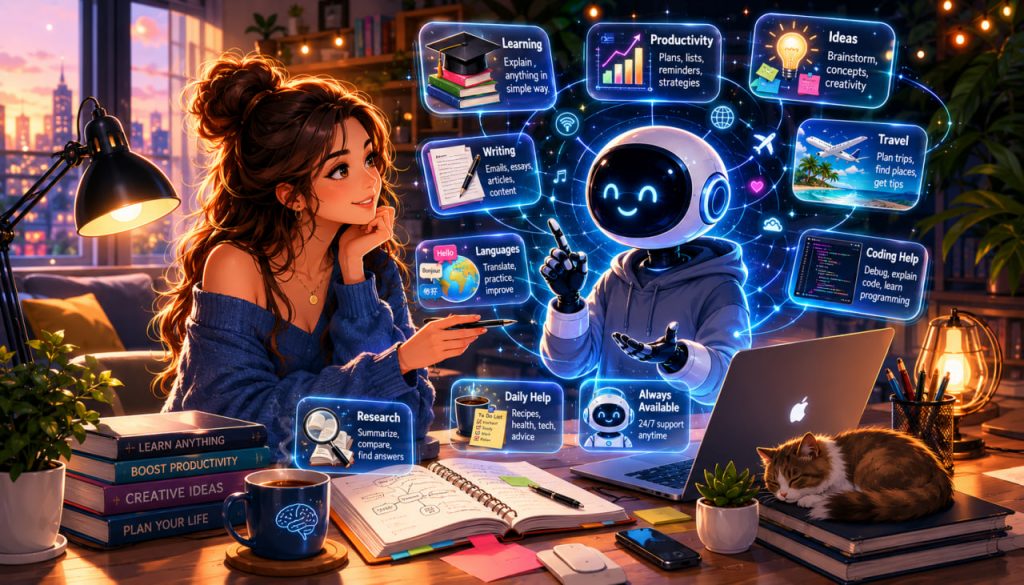
Artificial intelligence has rapidly become part of everyday life. Just a few years ago, most people associated AI with science fiction, research laboratories, or advanced technology companies. Today, millions of people interact with AI-powered chatbots daily, often without even realizing it. These systems can answer questions, explain concepts, assist with work, and help solve practical problems.
As chatbot technology continues to improve, many people wonder whether these tools are genuinely useful or simply another technological trend. The answer depends largely on how they are used. For ordinary users, chatbots can serve as assistants, tutors, research tools, creative partners, and productivity aids.
Understanding their strengths and limitations can help people gain real value from this rapidly evolving technology.
What Is a Chatbot?
A chatbot is a software system designed to communicate with humans using natural language.
Unlike traditional computer programs that rely on fixed menus and commands, modern chatbots allow users to ask questions in a conversational way.
Many AI-powered chatbots can:
- Answer questions
- Summarize information
- Generate text
- Explain complex topics
- Assist with planning
- Translate languages
The goal is to make information and digital tools easier to access through everyday conversation.
Saving Time on Everyday Tasks
One of the greatest benefits of chatbots is their ability to save time.
Many people spend significant amounts of time searching for information online, comparing sources, and organizing data.
A chatbot can often help by:
- Providing quick explanations
- Summarizing long articles
- Creating checklists
- Drafting emails
- Organizing ideas
For routine information-related tasks, a chatbot can often reduce work that would otherwise take much longer.
This allows users to focus on decision-making rather than information gathering.
A Personal Learning Assistant
Education is one of the areas where chatbots can be particularly useful.
Unlike textbooks, chatbots can adapt explanations to the user’s level of knowledge.
For example, a user can ask:
- What is quantum physics?
- Explain taxes in simple terms.
- How does a computer processor work?
- Why do eclipses happen?
The chatbot can then adjust the explanation based on follow-up questions.
This interactive approach often makes learning more engaging and accessible.
Help With Writing
Many people struggle with writing tasks.
Chatbots can assist with:
- Grammar corrections
- Article outlines
- Resume writing
- Business emails
- Social media content
- Creative projects
Importantly, the chatbot does not replace human judgment.
Instead, it serves as a tool that helps organize thoughts and improve communication.
Writers often use chatbots to overcome writer’s block and generate initial drafts.
Assistance at Work
Professionals across many industries use chatbots to increase productivity.
Examples include:
- Creating reports
- Summarizing meetings
- Drafting presentations
- Researching topics
- Brainstorming solutions
By automating repetitive information tasks, employees can devote more time to strategic and creative work.
As AI systems improve, workplace applications continue expanding.
Language Learning and Translation
Learning a new language can be difficult without regular practice.
Chatbots can provide:
- Vocabulary explanations
- Grammar guidance
- Conversation practice
- Translation assistance
- Writing corrections
Because chatbots are available at any time, learners can practice whenever convenient.
This makes language learning more accessible than ever before.
Everyday Problem Solving
Many daily questions do not require expert consultation but still require reliable information.
Examples include:
- Travel planning
- Cooking advice
- Technology troubleshooting
- Study guidance
- Household organization
A chatbot can often provide useful starting points and practical suggestions.
While important decisions should still involve professional expertise when necessary, chatbots can help users better understand their options.
Creativity and Idea Generation
Creativity is often associated exclusively with humans, yet chatbots can act as valuable creative partners.
Users frequently employ chatbots to:
- Generate story ideas
- Develop business concepts
- Brainstorm projects
- Create outlines
- Explore alternative perspectives
The chatbot serves as a source of inspiration rather than a replacement for human creativity.
Many professionals find that interacting with an AI helps stimulate new ideas.
Expert Perspective
Computer scientist Andrew Ng has frequently compared artificial intelligence to earlier transformative technologies such as electricity.
His perspective highlights the growing importance of AI tools in everyday life.
“AI is the new electricity.”
Just as electricity eventually became integrated into nearly every aspect of modern society, AI-powered tools are increasingly becoming part of daily workflows, education, communication, and entertainment.
Understanding the Limitations
Despite their usefulness, chatbots are not perfect.
Users should remember that AI systems can sometimes:
- Make mistakes
- Misinterpret questions
- Provide incomplete information
- Generate outdated answers
- Present uncertainty with confidence
For this reason, important decisions involving health, law, finance, or safety should always involve verification from reliable sources or qualified professionals.
A chatbot is best viewed as an assistant, not an infallible authority.
Critical thinking remains essential.
Accessibility and Availability
One of the most powerful advantages of chatbots is accessibility.
Unlike human experts, chatbots are available:
- Day and night
- Across time zones
- On multiple devices
- For millions of users simultaneously
This constant availability makes information and assistance more accessible to people around the world.
In many situations, a chatbot can provide immediate help when no other support is readily available.
The Future of Personal AI Assistants
The capabilities of chatbots continue to expand rapidly.
Future systems may become even better at:
- Understanding context
- Managing tasks
- Providing personalized assistance
- Integrating with software tools
- Supporting education and work
As these technologies mature, chatbots may increasingly function as digital assistants that help users manage information, learn new skills, and improve productivity.
Conclusion
Chatbots have evolved far beyond simple question-and-answer programs. Today they can assist with learning, writing, productivity, language practice, creativity, and everyday problem-solving. For ordinary people, these tools offer a convenient way to access information and complete tasks more efficiently.
While chatbots are not perfect and should not replace professional expertise in critical situations, they can serve as valuable assistants in daily life. Used thoughtfully, they have the potential to save time, improve learning, and help people navigate an increasingly information-rich world.
Interesting Facts
- Modern AI chatbots can generate human-like responses in dozens of languages.
- Millions of people use AI-powered assistants every day.
- Chatbots can help with tasks ranging from writing emails to learning physics.
- Some AI systems are trained on enormous collections of books, articles, and other texts.
- Businesses increasingly use chatbots for customer support and internal productivity.
- AI-powered language tools have significantly improved over the past decade.
Glossary
- Artificial Intelligence (AI) — Computer systems designed to perform tasks that typically require human intelligence.
- Chatbot — A software system that communicates with users through natural language conversation.
- Natural Language Processing (NLP) — A field of AI focused on understanding and generating human language.
- Productivity — The efficiency with which tasks are completed.
- Machine Learning — A branch of AI that enables systems to improve through experience and data.
- Digital Assistant — A software tool that helps users perform tasks, manage information, or answer questions.