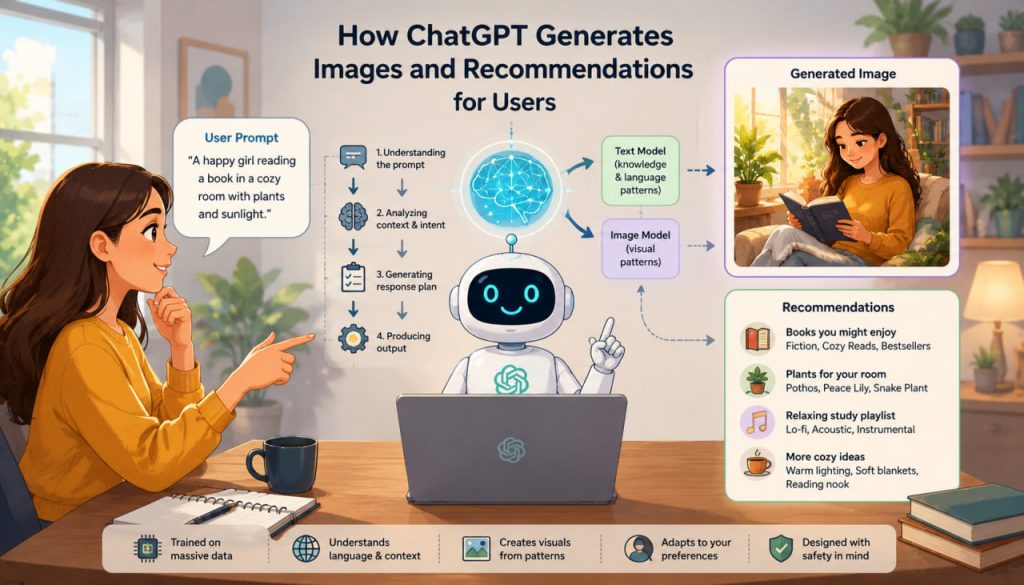
Artificial intelligence has transformed the way people interact with technology. Today, users can ask AI systems to write articles, answer questions, generate images, summarize information, and even provide personalized recommendations. Among the most widely known AI tools is ChatGPT, which has become a popular assistant for millions of users worldwide.
One of the most fascinating aspects of modern AI is its ability to generate visual content and tailor responses to individual needs. While these capabilities may appear almost magical, they are based on sophisticated machine learning systems trained on vast amounts of data.
Understanding how ChatGPT generates images and recommendations helps explain both the power and limitations of modern artificial intelligence.
What Is ChatGPT?
ChatGPT is a conversational artificial intelligence system based on large language models (LLMs).
A large language model is a type of AI trained to recognize patterns in text.
During training, the system processes enormous collections of books, articles, websites, and other publicly available sources.
Rather than memorizing facts like a traditional database, the model learns statistical relationships between words, phrases, concepts, and contexts.
When a user enters a prompt, the system predicts the most appropriate response based on these learned patterns.
ChatGPT does not think like a human being. It generates responses by identifying probable language patterns.
This distinction is important for understanding both its strengths and weaknesses.
How AI Understands User Requests
When a user submits a question, the AI performs several tasks simultaneously.
It analyzes:
- Keywords
- Context
- Sentence structure
- User intent
- Previous conversation history
For example, if a user writes:
“Explain how solar panels work.”
The system identifies:
- The topic: solar panels
- The action requested: explanation
- The likely knowledge level required
The model then generates a response designed to match the user’s request.
Modern AI systems can also adapt tone, complexity, and structure depending on context.
How ChatGPT Generates Images
Image generation uses a different type of AI model than text generation.
Instead of predicting words, image-generation models predict visual elements.
The process begins with a text prompt.
For example:
“A beautiful female scientist studying DNA in a futuristic laboratory.”
The image model converts the text into mathematical representations.
It then creates an image by gradually constructing visual details that match the prompt.
Modern systems learn visual patterns from massive datasets containing millions or even billions of images and associated descriptions.
The AI learns relationships such as:
- What scientists look like
- How laboratories are structured
- How DNA is commonly represented
- How lighting affects visual appearance
The final image is generated from these learned visual patterns rather than copied from a specific photograph.
Image generation is essentially a process of statistical visual synthesis rather than image retrieval.
Why AI Images Can Look So Realistic
Recent advances in AI image generation have dramatically improved realism.
Several factors contribute to this progress:
Larger Training Datasets
More data allows models to learn a broader range of visual concepts.
Improved Neural Networks
Modern architectures can capture complex relationships between objects, lighting, textures, and perspectives.
Better Prompt Understanding
AI systems increasingly understand detailed instructions involving:
- Artistic style
- Composition
- Lighting
- Camera angles
- Character appearance
Iterative Refinement
Many image-generation systems gradually improve image quality through multiple computational steps.
The result is highly detailed artwork that can appear surprisingly realistic.
How ChatGPT Provides Recommendations
Recommendations are generated differently from image creation.
When users ask for suggestions, the AI analyzes:
- The request itself
- Relevant context
- Known information about the topic
- General patterns learned during training
For example:
“What are good beginner cameras?”
The system evaluates:
- Typical beginner needs
- Popular recommendations
- Technical requirements
- Common expert advice
It then generates a response that attempts to balance these factors.
Unlike recommendation systems used by streaming platforms or online stores, ChatGPT does not automatically track every user action to build a detailed behavioral profile.
Instead, recommendations are largely based on the information available within the conversation itself.
Personalization Without Deep User Tracking
Many users wonder whether ChatGPT “knows” them personally.
In most cases, personalization occurs through conversation context rather than extensive personal surveillance.
The system may adapt based on:
- Current conversation history
- User preferences explicitly provided
- Previous interactions when memory features are enabled
For example, if a user repeatedly requests scientific articles with specific formatting, future responses may better match those preferences.
Personalization is often driven by contextual understanding rather than detailed personal profiling.
This differs from many traditional recommendation algorithms that heavily depend on long-term behavioral tracking.
The Role of Machine Learning
Both image generation and recommendations rely on machine learning.
Machine learning involves training algorithms to identify patterns within large datasets.
Rather than being programmed with every possible answer, the system learns through exposure to examples.
During training, models gradually improve their ability to:
- Predict text
- Recognize concepts
- Generate images
- Understand context
- Follow instructions
The larger and more diverse the training data, the more capable the resulting system tends to become.
However, training data also influences limitations and potential biases.
Expert Perspective
Computer scientist Geoffrey Hinton, often referred to as one of the pioneers of deep learning, has emphasized that modern AI systems learn representations of the world through exposure to massive amounts of data rather than explicit programming.
His work helped establish many of the neural network techniques used in contemporary AI systems.
“These systems learn from examples rather than from hand-written rules.”
This principle lies at the heart of both image generation and recommendation capabilities.
Instead of relying on predefined instructions for every scenario, AI systems learn patterns that allow them to generalize across countless situations.
Limitations of AI Recommendations and Images
Despite their impressive capabilities, AI systems are not perfect.
Potential limitations include:
Hallucinations
AI may generate plausible but incorrect information.
Bias
Training data may contain cultural, social, or historical biases.
Outdated Knowledge
Information may not always reflect the latest developments.
Image Errors
Generated images can sometimes contain:
- Anatomical mistakes
- Unrealistic details
- Logical inconsistencies
For this reason, human oversight remains important.
AI is a powerful tool, but it should not be treated as an infallible source of truth.
The Future of AI-Generated Content
AI systems continue to improve rapidly.
Future developments may include:
- More accurate recommendations
- Better image realism
- Enhanced personalization
- Multimodal interaction
- Real-time learning capabilities
- Improved reasoning systems
As these technologies evolve, the distinction between text, images, audio, and video generation may become increasingly blurred.
The underlying goal remains the same: helping users access information, create content, and solve problems more efficiently.
The remarkable capabilities of systems like ChatGPT are the result of advances in machine learning, neural networks, and data-driven pattern recognition that continue to reshape how humans interact with technology.
Interesting Facts
- Modern AI image generators can create entirely original images from text descriptions alone.
- Large language models are trained using billions or even trillions of words.
- AI-generated images are not stored photographs but newly synthesized visual creations.
- Neural networks were inspired loosely by the structure of biological brains.
- AI recommendation systems are used in streaming services, online stores, and search engines.
- Machine learning allows systems to improve performance without explicit programming for every task.
- Image-generation models and language models are often separate systems working together.
Glossary
- Artificial Intelligence (AI) — Computer systems designed to perform tasks that typically require human intelligence.
- Large Language Model (LLM) — An AI system trained to understand and generate human language.
- Machine Learning — A field of AI in which systems learn patterns from data.
- Neural Network — A computational model inspired by interconnected biological neurons.
- Prompt — The instruction or input provided to an AI system.
- Image Generation — The process of creating images using artificial intelligence.
- Recommendation System — A technology that suggests products, content, or information based on available data.
- Training Data — Information used to teach AI models during development.
- Hallucination — An AI-generated statement that appears plausible but is factually incorrect.
- Multimodal AI — Artificial intelligence capable of processing multiple types of information such as text, images, audio, and video.