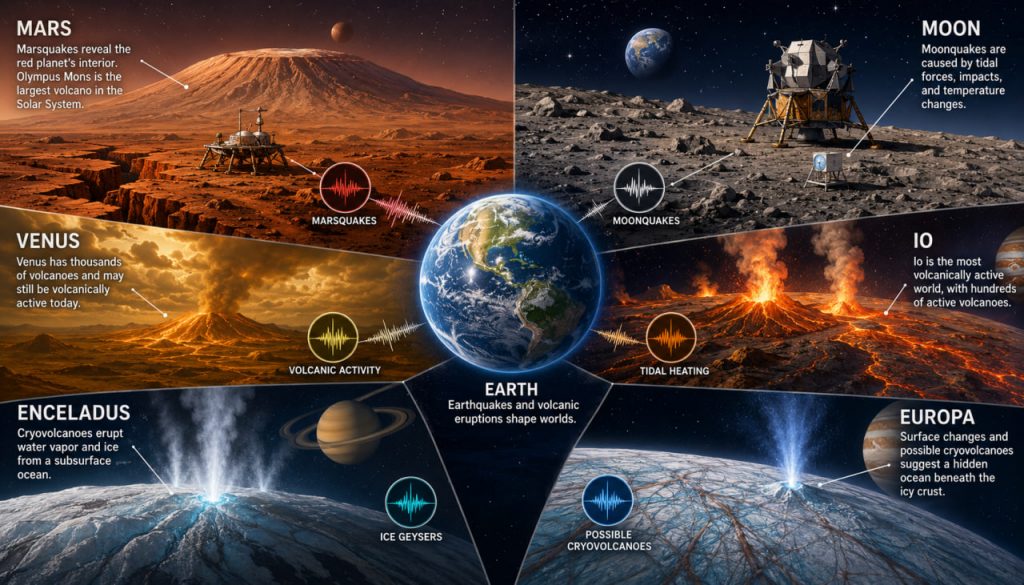
When people think about earthquakes and volcanoes, they usually imagine dramatic events on Earth. However, our planet is not the only world with geological activity. Modern space missions have revealed that earthquakes, volcanic eruptions, and tectonic processes occur—or have occurred—on several other planets and moons throughout the Solar System.
These discoveries have transformed planetary science. What once seemed like lifeless rocky worlds are now understood as dynamic environments shaped by powerful internal forces. By studying extraterrestrial geology, scientists gain valuable insights into planetary evolution, interior structure, and even the potential for life beyond Earth.
The search for “alien earthquakes” and volcanic activity has become one of the most exciting areas of modern space exploration.
What Causes Earthquakes on Planets?
On Earth, earthquakes occur when stress builds up in rocks and is suddenly released.
This stress is typically associated with:
- Plate tectonics
- Fault movement
- Volcanic activity
- Crustal deformation
Other planets do not necessarily have the same tectonic systems as Earth.
However, many planetary bodies experience internal forces capable of generating seismic activity.
Possible causes include:
- Cooling and contraction of planetary interiors
- Tidal forces from nearby planets
- Volcanic movement
- Meteorite impacts
- Crustal fractures
Scientists often use the term “quake” for these events, leading to names such as marsquakes and moonquakes.
Seismic activity provides one of the best methods for studying the hidden interiors of distant worlds.
Mars and the Discovery of Marsquakes
One of the most important breakthroughs in planetary geology occurred with NASA’s InSight mission.
Launched in 2018, InSight carried an extremely sensitive seismometer designed to detect vibrations within Mars.
The mission confirmed that Mars experiences earthquakes known as marsquakes.
Researchers discovered hundreds of seismic events.
These quakes revealed important information about:
- The Martian crust
- The mantle
- The planetary core
Unlike Earth, Mars lacks active plate tectonics.
Instead, many marsquakes appear to result from:
- Crustal stresses
- Cooling of the planet
- Fault reactivation
Some seismic activity has been linked to regions containing ancient volcanic structures.
The Giant Volcanoes of Mars
Mars hosts the largest known volcanoes in the Solar System.
The most famous is Olympus Mons, a colossal shield volcano.
Olympus Mons is approximately:
- 22 kilometers high
- Over 600 kilometers wide
For comparison, Mount Everest rises less than 9 kilometers above sea level.
Scientists believe Olympus Mons formed because Mars lacks active plate tectonics.
On Earth, tectonic movement causes volcanic hotspots to create chains of volcanoes.
On Mars, the crust remained relatively stationary, allowing volcanic activity to build a single enormous structure over millions of years.
Olympus Mons is nearly three times taller than Mount Everest.
Moonquakes on Earth’s Moon
The Moon may appear geologically inactive, but it experiences seismic activity.
Apollo astronauts placed seismometers on the lunar surface during the Apollo missions.
These instruments detected several types of moonquakes:
Deep Moonquakes
Caused by tidal forces exerted by Earth.
Shallow Moonquakes
Potentially associated with crustal stresses.
Thermal Moonquakes
Generated by temperature changes between lunar day and night.
Impact Events
Produced by meteorite collisions.
Some shallow moonquakes can last significantly longer than typical earthquakes because the Moon’s dry, fractured crust transmits vibrations differently.
Venus: A Planet of Volcanoes
Venus is often described as Earth’s twin because of its similar size and composition.
However, its environment is extremely hostile.
Surface temperatures exceed 460°C, and atmospheric pressure is crushing.
Radar observations have revealed thousands of volcanic features on Venus.
These include:
- Shield volcanoes
- Lava plains
- Volcanic domes
- Rift systems
Recent evidence suggests that Venus may still be volcanically active today.
Researchers studying radar data have identified surface changes that could indicate recent eruptions.
If confirmed, Venus would join Earth and Jupiter’s moon Io as currently volcanically active worlds.
Io: The Most Volcanically Active World
Among all known objects in the Solar System, Io, one of Jupiter’s largest moons, is the undisputed champion of volcanism.
Io experiences extraordinary volcanic activity because of tidal heating.
Powerful gravitational interactions with Jupiter continuously flex the moon’s interior.
This generates enormous amounts of heat.
As a result:
- Hundreds of active volcanoes exist.
- Massive lava flows cover the surface.
- Volcanic plumes can reach hundreds of kilometers into space.
Images from spacecraft have captured spectacular eruptions unlike anything seen on Earth.
Io produces more volcanic activity than all of Earth’s volcanoes combined.
Ice Volcanoes on Distant Moons
Not all volcanoes erupt molten rock.
Some icy moons possess cryovolcanoes, which erupt:
- Water
- Ammonia
- Methane
- Other volatile substances
Potential cryovolcanic activity has been observed on:
- Enceladus
- Europa
- Triton
For example, Saturn’s moon Enceladus ejects enormous jets of water vapor and ice particles from fractures near its south pole.
These eruptions suggest the presence of a subsurface ocean.
Such discoveries have increased interest in the possibility of extraterrestrial life.
Why Planetary Geology Matters
Studying earthquakes and volcanoes on other worlds helps scientists answer fundamental questions.
These include:
- How planets form
- How interiors evolve
- Why some worlds remain active
- Where water exists
- Which environments might support life
Geological activity often influences:
- Atmospheric composition
- Surface conditions
- Resource distribution
- Habitability
As exploration expands, planetary geology will remain central to understanding our Solar System.
Expert Perspective
Planetary scientist Dr. Bruce Banerdt, principal investigator of NASA’s InSight mission, has emphasized the importance of seismic studies for understanding planetary interiors.
His team’s work transformed knowledge of Mars by providing the first detailed seismic observations of another terrestrial planet.
“Seismology lets us look beneath the surface of a planet.”
This principle has long been essential for studying Earth and is now becoming equally valuable for planetary exploration.
Future Missions and Discoveries
The next generation of space missions may dramatically expand our understanding of extraterrestrial geology.
Scientists hope to deploy advanced instruments capable of monitoring:
- Seismic activity
- Volcanic processes
- Subsurface oceans
- Internal heat flow
Potential future targets include:
- Europa
- Enceladus
- Titan
- Venus
- Mars
As technology improves, researchers may eventually establish permanent seismic networks on multiple worlds.
Each new quake detected beyond Earth provides another clue about the hidden processes shaping planets and moons across the Solar System.
Interesting Facts
- Mars hosts the largest volcano known in the Solar System: Olympus Mons.
- NASA’s InSight mission detected hundreds of marsquakes.
- The Moon experiences several different types of moonquakes.
- Io’s volcanic eruptions can launch material hundreds of kilometers into space.
- Venus contains more volcanoes than any other terrestrial planet.
- Cryovolcanoes erupt water and ice rather than molten rock.
- Seismology is one of the most effective tools for studying planetary interiors.
Glossary
- Marsquake — An earthquake-like seismic event occurring on Mars.
- Moonquake — A seismic event occurring on the Moon.
- Volcanism — Geological activity involving the eruption of material from a planetary interior.
- Cryovolcano — A volcano that erupts water, ice, or other volatile substances instead of molten rock.
- Tidal Heating — Internal heating caused by gravitational forces stretching and flexing a celestial body.
- Shield Volcano — A broad volcano formed by fluid lava flows.
- Seismometer — An instrument used to detect and record seismic activity.
- Mantle — The layer between a planet’s crust and core.
- Planetary Geology — The study of geological processes on planets and moons.
- Habitability — The potential of an environment to support life.