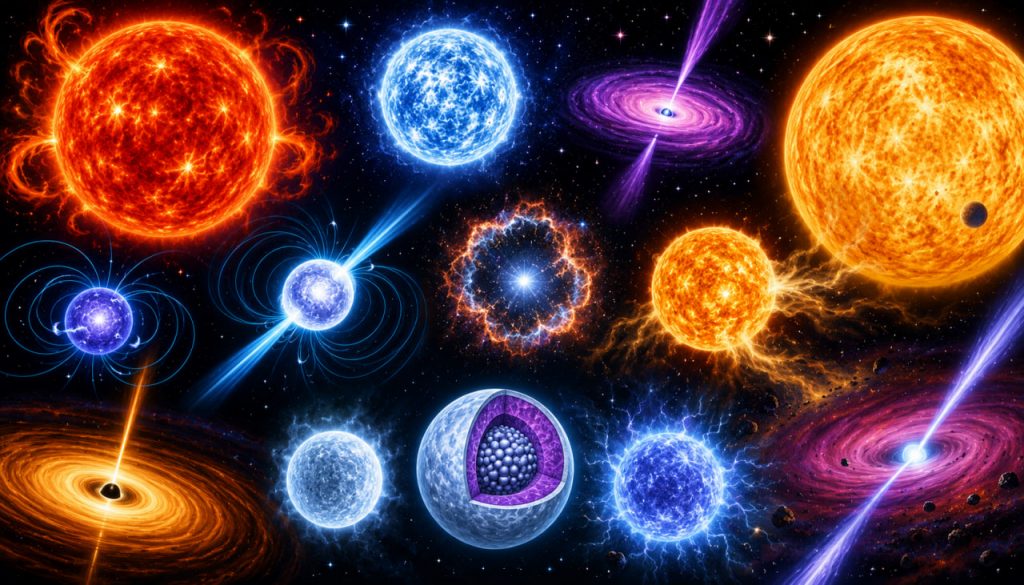
When people imagine stars, they often think of glowing yellow suns like our own. In reality, the Universe contains an astonishing variety of stellar objects that challenge our understanding of physics. Some stars spin hundreds of times every second, while others possess magnetic fields trillions of times stronger than Earth’s. There are stars made almost entirely of exotic matter, stars that pulse like cosmic lighthouses, and giant stars so large they could engulf the orbit of Jupiter.
These extraordinary objects help astronomers understand how stars evolve, how matter behaves under extreme conditions, and how the Universe itself changes over billions of years.
Modern observatories continue to discover increasingly unusual stars, proving that the cosmos is far more diverse than scientists once imagined.
What Makes a Star “Exotic”?
Most stars follow relatively predictable evolutionary paths.
They are born from collapsing clouds of gas, spend millions or billions of years fusing hydrogen into helium, and eventually evolve into white dwarfs, neutron stars, or black holes depending on their mass.
Exotic stars differ because they possess extreme characteristics such as:
- Extraordinary density
- Powerful magnetic fields
- Unusual chemical composition
- Exceptional size
- Rapid rotation
- Rare evolutionary stages
These stars often exist under physical conditions that cannot be reproduced in laboratories on Earth.
Studying them allows scientists to test theories of gravity, nuclear physics, and quantum mechanics.
Neutron Stars: Matter Compressed Beyond Imagination
Neutron stars are among the densest known objects in the Universe.
They form when massive stars explode as supernovae.
Although only about 20 kilometers across, a neutron star can contain more mass than the Sun.
Its density is astonishing.
A single teaspoon of neutron star material would weigh billions of tons on Earth.
Inside these stars:
- Atoms no longer exist.
- Electrons combine with protons.
- Matter becomes an enormous sphere of tightly packed neutrons.
Neutron stars demonstrate the incredible effects of gravity under extreme conditions.
Pulsars: Cosmic Lighthouses
Some neutron stars become pulsars.
These rapidly rotating objects emit beams of radio waves, X-rays, or gamma rays from their magnetic poles.
As the star spins, its beams sweep across space.
If Earth lies in the beam’s path, astronomers detect regular pulses.
Some pulsars rotate:
- Once every few seconds
- Hundreds of times per second
Millisecond pulsars are among the most precise natural clocks in the Universe.
Their rotational stability rivals that of atomic clocks.
Pulsars have even been used to test Einstein’s theory of general relativity with remarkable precision.
Magnetars: The Strongest Magnets in the Universe
Among the rarest neutron stars are magnetars.
These extraordinary objects possess magnetic fields approximately one thousand times stronger than ordinary neutron stars.
Their magnetic fields are estimated to be up to one quadrillion (10¹⁵) times stronger than Earth’s.
Such immense magnetic forces can:
- Distort atoms
- Trigger enormous X-ray flares
- Fracture the star’s crust
A magnetar located halfway across the galaxy could theoretically disrupt electronic equipment if it were much closer to Earth.
Fortunately, all known magnetars are safely distant.
White Dwarfs: The Final Stage of Sun-Like Stars
Our Sun is expected to become a white dwarf billions of years from now.
White dwarfs are the dense remnants left after medium-sized stars exhaust their nuclear fuel.
Although similar in size to Earth, they contain nearly the mass of the Sun.
Gravity is so intense that:
- Matter becomes highly compressed.
- Electrons exist in a quantum state called electron degeneracy.
White dwarfs gradually cool over billions of years.
Some exist in binary systems where they may eventually trigger spectacular Type Ia supernova explosions.
Hypergiants: The Largest Known Stars
At the opposite extreme are hypergiants.
These enormous stars represent the largest stellar objects known.
Examples include:
- UY Scuti
- Stephenson 2-18
- VY Canis Majoris
If one of these stars replaced the Sun, its outer atmosphere could extend beyond the orbit of Mars—or even Jupiter, depending on the specific star.
Despite their enormous size, hypergiants have relatively short lifetimes because they consume nuclear fuel extremely rapidly.
They are expected to end their lives in powerful supernova explosions.
Wolf-Rayet Stars
Wolf-Rayet stars represent one of the most violent phases of stellar evolution.
These stars have lost much of their outer hydrogen layers.
As a result:
- Extremely hot interiors become exposed.
- Powerful stellar winds eject enormous amounts of material.
- Surface temperatures may exceed 200,000°C.
Wolf-Rayet stars play an important role in enriching galaxies with heavy elements that later become part of planets and living organisms.
Hypothetical Quark Stars
Some exotic stars remain theoretical.
One example is the quark star.
Scientists believe that under even greater pressure than exists inside neutron stars, neutrons could break apart into their constituent quarks.
If this occurs, an entirely new form of matter might exist.
Although no quark star has been definitively confirmed, several candidates continue to be investigated.
Discovering one would provide remarkable insights into particle physics.
Strange Stars
An even more speculative concept is the strange star.
These hypothetical objects may consist partly of strange quark matter, an exotic state containing strange quarks alongside up and down quarks.
Some physicists suggest strange matter could represent an even more stable form of matter than ordinary atomic nuclei.
While evidence remains inconclusive, the possibility continues to inspire both theoretical research and astronomical observations.
Expert Perspective
Astrophysicist Dr. Jocelyn Bell Burnell, who discovered the first pulsar in 1967, revolutionized modern astronomy through her work on neutron stars.
Her discovery demonstrated that some stars survive supernova explosions as incredibly dense rotating remnants.
“The Universe is under no obligation to make sense to us.”
Her observation captures the spirit of modern astrophysics, where every new discovery often reveals phenomena more extraordinary than previously imagined.
The Future of Exotic Star Research
Powerful observatories are allowing astronomers to study exotic stars in unprecedented detail.
Facilities such as:
- The James Webb Space Telescope
- The Chandra X-ray Observatory
- FAST Radio Telescope
- Square Kilometre Array (under development)
will continue searching for:
- New pulsars
- Rare magnetars
- Candidate quark stars
- Unusual stellar explosions
Future gravitational wave detectors may also reveal entirely new categories of exotic stellar remnants.
The study of exotic stars continues to push the boundaries of physics, demonstrating that the Universe contains objects whose properties often exceed the limits of human imagination.
Interesting Facts
- A teaspoon of neutron star material would weigh billions of tons on Earth.
- Magnetars possess the strongest magnetic fields known in the Universe.
- Some pulsars rotate more than 700 times every second.
- Hypergiant stars can be over a thousand times larger than the Sun.
- White dwarfs are supported by quantum mechanical pressure rather than ordinary gas pressure.
- Wolf-Rayet stars lose mass through some of the strongest stellar winds known.
- Astronomers continue searching for definitive evidence of quark stars and strange stars.
Glossary
- Neutron Star — The ultra-dense remnant of a massive star after a supernova explosion.
- Pulsar — A rapidly rotating neutron star that emits beams of electromagnetic radiation.
- Magnetar — A neutron star with an extraordinarily powerful magnetic field.
- White Dwarf — The compact remnant left after a Sun-like star exhausts its nuclear fuel.
- Hypergiant — One of the largest and most luminous types of stars.
- Wolf-Rayet Star — A very hot, massive star that has lost much of its outer hydrogen layer.
- Quark Star — A hypothetical ultra-dense star composed of quark matter.
- Strange Matter — A theoretical form of matter containing strange quarks.
- Supernova — A powerful stellar explosion marking the death of certain stars.
- Electron Degeneracy Pressure — A quantum mechanical force that prevents white dwarfs from collapsing under gravity.