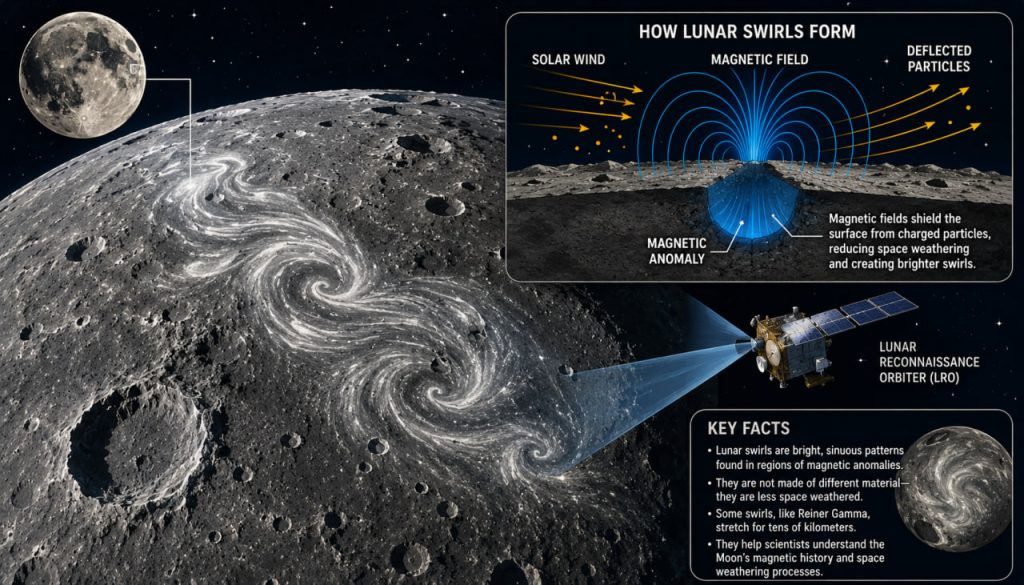
For centuries, the Moon appeared to be a simple gray world covered with craters and volcanic plains. However, modern spacecraft have revealed that its surface is far more complex than early astronomers imagined. Among the Moon’s most fascinating features are lunar swirls—bright, sinuous markings that stretch across the surface in elegant looping patterns unlike any other known geological formation.
These enigmatic structures puzzled scientists for decades because they do not correspond to mountains, valleys, lava flows, or impact craters. Instead, research has shown that lunar swirls are closely associated with localized magnetic fields, making them one of the most intriguing examples of planetary physics in the Solar System.
Studying lunar swirls not only helps scientists understand the Moon’s history but also provides valuable insights into space weathering, planetary magnetism, and the interaction between the solar wind and airless worlds.
What Are Lunar Swirls?
Lunar swirls are unusually bright, winding patterns found on the Moon’s surface.
Unlike ordinary geological formations, they:
- Cross craters and hills without following topography.
- Have no obvious volcanic origin.
- Are often surrounded by darker material.
- Extend for tens or even hundreds of kilometers.
Some of the best-known examples include:
- Reiner Gamma
- Mare Ingenii
- Mare Marginis
- Gerasimovich Swirls
Their graceful appearance resembles brushstrokes or flowing clouds painted across the lunar landscape.
Despite looking like surface deposits, lunar swirls are actually linked to invisible magnetic anomalies beneath the Moon’s crust.
The Discovery of Lunar Swirls
Astronomers first noticed unusual bright markings through telescopes centuries ago.
However, their true nature remained uncertain until spacecraft began photographing the lunar surface in detail during the Space Age.
High-resolution images from missions such as:
- Lunar Orbiter
- Clementine
- Lunar Reconnaissance Orbiter (LRO)
- Kaguya (SELENE)
revealed the extraordinary complexity of these formations.
Scientists soon realized that the swirls could not be explained by ordinary geology alone.
Why Are They So Bright?
The Moon lacks an atmosphere.
Its surface is continuously bombarded by:
- Solar wind particles
- Micrometeorites
- Cosmic radiation
Over millions of years, this process gradually darkens lunar soil through space weathering.
Lunar swirls appear brighter because the weathering process occurs more slowly in these regions.
Researchers believe that localized magnetic fields partially deflect incoming charged particles from the solar wind.
As a result:
- Less weathering occurs.
- The soil retains a fresher appearance.
- Bright patterns remain visible for extremely long periods.
The swirls are not made of different materials—they are simply less weathered than their surroundings.
The Role of Magnetic Fields
One of the Moon’s greatest mysteries is that it no longer possesses a global magnetic field like Earth’s.
However, certain regions contain small patches of magnetized crust.
These localized magnetic anomalies create miniature magnetic shields.
Although much weaker than Earth’s magnetosphere, they can still influence charged particles arriving from the Sun.
Computer simulations suggest these tiny magnetic fields redirect portions of the solar wind around protected areas.
This produces the striking contrast between bright swirls and darker surrounding terrain.
Reiner Gamma: The Most Famous Lunar Swirl
The best-known lunar swirl is Reiner Gamma, located in Oceanus Procellarum.
It is approximately 70 kilometers long and has become one of the Moon’s most studied features.
Interestingly:
- No large crater exists beneath it.
- It is not associated with volcanic lava.
- It coincides with one of the strongest magnetic anomalies on the Moon.
Because of these characteristics, Reiner Gamma has become a natural laboratory for studying interactions between magnetic fields and space weather.
Spacecraft observations continue to improve scientists’ understanding of this remarkable region.
How Did the Magnetic Anomalies Form?
The origin of the Moon’s localized magnetic fields remains an active area of research.
Several hypotheses have been proposed.
Ancient Lunar Dynamo
Billions of years ago, the Moon may have possessed a molten metallic core capable of generating a global magnetic field.
Some crustal rocks may have become magnetized before that field disappeared.
Large Impact Events
Powerful asteroid impacts could have generated shock-induced magnetization in certain regions.
Magnetic Material Concentration
Some crustal rocks may naturally contain higher concentrations of magnetic minerals.
Current evidence suggests that multiple processes may have contributed.
Why Lunar Swirls Matter
Lunar swirls are more than scientific curiosities.
They help researchers study:
- Space weathering
- Solar wind interactions
- Magnetic field evolution
- Planetary surface processes
- Lunar geological history
Understanding these processes has practical importance for future lunar exploration.
Regions protected by magnetic anomalies may experience different radiation environments than surrounding terrain.
Although the shielding is limited, studying these natural magnetic laboratories could influence future mission planning.
Lessons for Other Worlds
The Moon is not the only airless body exposed to the solar wind.
Similar processes may occur on:
- Mercury
- Asteroids
- Some moons of Mars
- Other rocky bodies lacking atmospheres
By understanding lunar swirls, scientists improve models describing how space weather alters planetary surfaces throughout the Solar System.
These studies also help interpret observations from distant planets and moons explored by robotic spacecraft.
The Moon serves as a natural laboratory for understanding planetary evolution across the Solar System.
Expert Perspective
Planetary scientist Dr. Abigail Fraeman, a researcher at NASA’s Jet Propulsion Laboratory and member of the Lunar Reconnaissance Orbiter science team, has emphasized that lunar swirls provide a unique opportunity to study the interaction between magnetic fields and the solar wind.
Her research highlights how these unusual features reveal ongoing physical processes rather than ancient geological events alone.
“Lunar swirls are among the Moon’s most mysterious and scientifically valuable surface features.”
Their study continues to improve our understanding of both lunar history and planetary science.
Future Exploration
Several upcoming lunar missions are expected to investigate magnetic anomalies in greater detail.
Scientists hope to deploy:
- Surface magnetometers
- Radiation detectors
- Soil analysis instruments
- High-resolution imaging systems
Future astronauts participating in programs such as NASA’s Artemis missions may eventually visit regions near magnetic anomalies.
Direct sampling could answer longstanding questions about:
- Surface composition
- Magnetic properties
- Space weathering rates
- Lunar crust evolution
Every new mission brings researchers closer to solving one of the Moon’s most enduring geological mysteries, revealing how invisible magnetic forces have shaped visible patterns that have survived for billions of years.
Interesting Facts
- Reiner Gamma is the most famous and best-studied lunar swirl.
- Lunar swirls can stretch for more than 100 kilometers.
- The Moon no longer has a global magnetic field but retains localized magnetic anomalies.
- Space weathering slowly darkens lunar soil over millions of years.
- Lunar swirls often cross craters without being affected by the underlying terrain.
- Scientists believe magnetic fields partially shield swirl regions from the solar wind.
- Similar space weathering processes occur on Mercury and many asteroids.
Glossary
- Lunar Swirl — A bright, winding surface feature associated with localized magnetic anomalies on the Moon.
- Space Weathering — The gradual alteration of airless planetary surfaces by solar wind and micrometeorite impacts.
- Solar Wind — A continuous stream of charged particles emitted by the Sun.
- Magnetic Anomaly — A localized region where the magnetic field differs from its surroundings.
- Magnetosphere — A magnetic field surrounding a planet that deflects charged particles.
- Lunar Regolith — The loose layer of dust, rock fragments, and soil covering the Moon.
- Micrometeorite — A tiny particle from space that impacts planetary surfaces.
- Planetary Dynamo — The process by which a planet’s molten core generates a magnetic field.
- Charged Particle — An electrically charged atomic or subatomic particle.
- Lunar Reconnaissance Orbiter (LRO) — A NASA spacecraft that has been mapping the Moon since 2009.