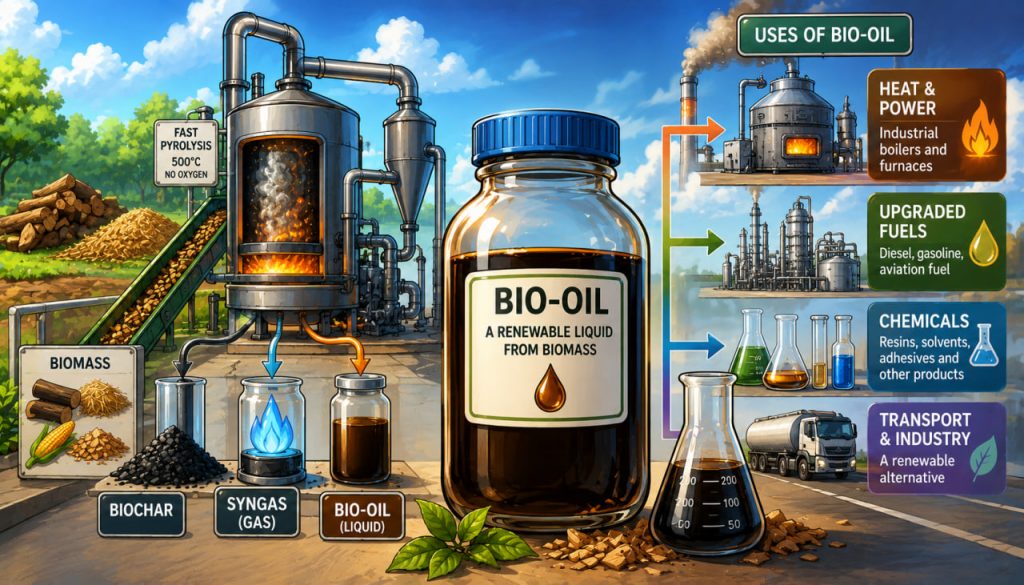
Bio-oil is a dark, energy-rich liquid produced when plant material and other forms of biomass are rapidly heated with little or no oxygen. It is also known as pyrolysis oil, fast-pyrolysis bio-oil, or sometimes bio-crude.
Despite its name, bio-oil is not cooking oil, essential oil, or ordinary petroleum. It is a complex industrial mixture containing water and hundreds of oxygen-rich organic compounds.
Bio-oil can be burned for industrial heat or upgraded into fuels and chemical ingredients. However, raw bio-oil is acidic, unstable, and unsuitable for direct use in most conventional engines.
Bio-oil is best understood as a renewable intermediate: a compact liquid made from biomass that usually requires specialized equipment or further refining.
What Is Bio-Oil?
Bio-oil is the principal liquid product of the fast pyrolysis of biomass.
During pyrolysis, organic material is heated in an oxygen-limited environment. Because there is not enough oxygen for normal combustion, the biomass breaks apart chemically rather than burning completely.
The process produces three major outputs:
- Liquid bio-oil
- Solid biochar
- Non-condensable gases
The gases can sometimes provide heat for the pyrolysis system, while biochar may be used as a soil amendment, fuel, or industrial carbon material.
USDA researchers describe bio-oil as a dark, viscous liquid containing water and hundreds of oxygenated compounds, including acids, ketones, aldehydes, sugars, and furans. Its exact composition depends on both the biomass and the production conditions.
How Is Bio-Oil Produced?
Fast pyrolysis is designed to maximize liquid production.
Biomass is usually dried and broken into relatively small particles. It is then heated very rapidly to approximately 500°C without sufficient oxygen for combustion.
The resulting hot vapors are separated from solid char and rapidly cooled. During cooling, much of the vapor condenses into liquid bio-oil.
Under suitable fast-pyrolysis conditions, a typical biomass feedstock may produce approximately:
- 60–70% bio-oil by mass
- 15–25% biochar
- 10–15% gas
Actual yields vary with moisture, feedstock composition, particle size, reactor design, temperature, heating rate, and vapor-cooling efficiency.
Slower pyrolysis usually favors biochar production. Fast heating and rapid vapor removal favor liquid bio-oil.
What Materials Can Become Bio-Oil?
Bio-oil can be produced from many forms of biomass.
Possible feedstocks include:
- Wood chips and sawdust
- Forestry residues
- Corn stalks and cobs
- Straw
- Nut shells
- Grasses
- Agricultural processing residues
- Some animal wastes
- Selected food-industry residues
USDA researchers have produced experimental bio-oils from switchgrass, corn residues, barley straw, soybean straw, wood, poultry litter, and several other materials.
Clean, dry, consistent feedstock generally makes processing easier. Contaminated wood, mixed municipal rubbish, plastics, paint, and chemically treated materials can introduce hazardous compounds and damage equipment.
The environmental value of bio-oil depends partly on using residues and responsibly sourced biomass rather than destroying healthy ecosystems for fuel production.
Is Bio-Oil the Same as Vegetable Oil or Biodiesel?
No.
Vegetable oils are extracted from oil-rich plants such as rapeseed, sunflower, soybean, or palm. They mainly consist of triglycerides.
Biodiesel is typically produced by chemically converting vegetable oil, animal fat, or used cooking oil into fatty-acid esters suitable for certain diesel engines.
Pyrolysis bio-oil is completely different. It is created by thermally decomposing fibrous biomass such as wood and crop residues.
It contains many oxygenated chemicals, suspended particles, and water. Raw bio-oil is therefore not a direct substitute for petrol, diesel, biodiesel, or heating oil.
Bio-oil should also not be confused with hydrothermal biocrude, which is produced by processing wet biomass in hot, pressurized water. The U.S. Department of Energy distinguishes fast pyrolysis from hydrothermal liquefaction as separate routes to liquid bio-intermediates.
What Does Bio-Oil Look and Smell Like?
Bio-oil is usually dark brown or nearly black. It may resemble heavy oil, molasses, or a watery tar depending on its composition and temperature.
It commonly has a smoky, sharp, acidic odor. Some of its compounds are related to those responsible for smoke aromas in foods, but industrial bio-oil is not edible.
Its viscosity can change during storage. Reactions among its many components may gradually make the liquid thicker and harder to handle.
Bio-oil is often acidic, with a pH around 2–3, and may be corrosive to materials not designed for it.
Can Bio-Oil Be Used as Fuel?
Raw bio-oil can be burned in specially designed or modified boilers, furnaces, and industrial heating systems.
It may replace some fossil heating oil in applications where appropriate burners, pumps, storage tanks, and emission controls are installed. IEA Bioenergy reports that industrial-scale combustion has demonstrated the use of fast-pyrolysis bio-oil as an alternative to heavy fuel oil in certain district-heating applications.
However, raw bio-oil presents several difficulties:
- Lower energy content than petroleum fuels
- High oxygen content
- Significant water content
- Acidity and corrosiveness
- Storage instability
- Possible solid particles
- Difficult ignition in unsuitable equipment
USDA estimates that its energy content is generally about 50–70% of that of petroleum-based fuels.
It should never be poured into an ordinary car, diesel generator, home oil heater, or agricultural machine unless that equipment has been specifically designed and approved for it.
How Bio-Oil Can Become Transportation Fuel
To produce petrol-like, diesel-like, marine, or aviation fuel, bio-oil must usually be upgraded.
One major problem is oxygen. The oxygen-containing compounds reduce energy density, increase acidity, and make the liquid chemically unstable.
Upgrading may involve:
- Hydrotreatment with hydrogen
- Catalytic processing
- Removal of water and solids
- Fractionation
- Co-processing in a petroleum refinery
- Catalytic fast pyrolysis during production
The U.S. Department of Energy describes catalysts as a key method for converting bio-oil intermediates into hydrocarbon products and fuel blendstocks.
Researchers have also demonstrated co-processing pyrolysis bio-oil with petroleum refinery streams. This approach may allow renewable carbon to enter existing fuel-production infrastructure, although corrosion, catalyst performance, oxygen removal, and product certification remain important challenges.
Bio-Oil as a Source of Chemicals
Bio-oil is not valuable only as fuel.
Its complex mixture contains compounds that may serve as starting materials for:
- Resins and adhesives
- Flavor and smoke products after controlled purification
- Agricultural chemicals
- Aromatic compounds
- Hydrogen
- Industrial solvents
- Polymer ingredients
USDA research has explored refining bio-oil into transportation fuels and separating commercially useful chemicals.
Recovering high-value chemicals before using the remaining material for energy could improve the economics of a biorefinery.
The challenge is separation. Bio-oil contains hundreds of compounds with different boiling points and chemical behaviors. Ordinary petroleum-refining methods cannot always be applied directly because heating may trigger further reactions.
Why Bio-Oil Is Difficult to Store
Bio-oil is not chemically stable in the same way as conventional diesel.
Even at ordinary storage temperatures, some components continue reacting with one another. Molecules can combine into larger structures, increasing viscosity and changing fuel behavior.
Heat accelerates this aging process. Contamination, exposure to air, and incompatible tank materials may create additional problems.
Specialized storage may require:
- Controlled temperature
- Compatible stainless steel or suitable polymers
- Limited storage duration
- Circulation or mixing
- Protection from water contamination
- Regular quality testing
IEA Bioenergy research notes that reactions can continue during long storage periods, altering the physical and chemical characteristics of fast-pyrolysis bio-oil.
Is Bio-Oil Environmentally Friendly?
Bio-oil can reduce dependence on fossil carbon when it is made from sustainable biomass and used efficiently.
Potential benefits include:
- Converting low-density residues into a transportable liquid
- Replacing part of fossil fuel consumption
- Supporting rural biomass-processing industries
- Producing biochar as a useful coproduct
- Using process gas to help power pyrolysis
- Providing renewable carbon for fuels and chemicals
Liquid bio-oil is denser and often easier to transport than loose straw, branches, or wood residues. This creates the possibility of small regional pyrolysis plants supplying a larger central refinery.
However, environmental performance depends on the complete lifecycle. Harvesting, drying, transport, land-use change, processing emissions, hydrogen production, upgrading energy, and final combustion must all be considered.
Poorly controlled pyrolysis can release smoke and hazardous pollutants. Unsustainable biomass harvesting can damage forests, soils, and biodiversity.
Expert Perspective
USDA Agricultural Research Service scientists describe raw bio-oil as a promising but challenging material because it is highly oxygenated, acidic, unstable, and corrosive. Their research focuses on catalysts, process changes, filtration, and upgrading methods that can produce more stable and commercially useful liquids.
IEA Bioenergy experts similarly distinguish between direct industrial use and advanced fuel production. Bio-oil can already serve selected heating applications, while aviation and marine fuels require substantial upgrading and must meet strict technical standards.
Bio-oil is not a finished universal fuel. It is a flexible renewable platform that can become heat, fuel, hydrogen, or chemicals when the right processing technology is used.
Interesting Facts
- Bio-oil may contain more than 200 identifiable chemical compounds.
- Fresh bio-oil can gradually become more viscous during storage.
- Bio-oil is usually heavier than water.
- Fast pyrolysis can convert biomass into liquid within seconds.
- Biochar and combustible gas are produced alongside bio-oil.
- Some pyrolysis systems can use their own gases to provide process heat.
- Bio-oil contains substantial water, but it does not behave like a simple mixture of petroleum and water.
- Raw bio-oil cannot normally be refined by straightforward atmospheric distillation without decomposition and chemical reactions.
- Mobile pyrolysis units have been developed to process agricultural biomass close to where it is produced.
- Bio-oil can potentially supply renewable carbon to existing refineries.
Glossary
- Bio-Oil — A dark liquid produced by thermally decomposing biomass with little or no oxygen.
- Fast Pyrolysis — Rapid heating of biomass followed by rapid cooling of the vapors to maximize liquid production.
- Biomass — Organic material derived from plants, animals, or biological residues.
- Feedstock — The raw material supplied to an industrial conversion process.
- Biochar — A carbon-rich solid produced during biomass pyrolysis.
- Syngas — A combustible gas mixture produced during thermal processing.
- Bio-Crude — A general term for a biomass-derived liquid intended for further refining; it can refer to products from different processes.
- Oxygenated Compound — An organic chemical containing oxygen within its molecular structure.
- Viscosity — A liquid’s resistance to flowing.
- Corrosive — Capable of chemically damaging metals or other materials.
- Hydrotreatment — Catalytic processing with hydrogen to remove oxygen and improve fuel quality.
- Catalyst — A substance that accelerates a chemical reaction without being permanently consumed.
- Co-Processing — Refining a renewable intermediate together with a conventional petroleum stream.
- Biorefinery — A facility that converts biomass into fuels, energy, chemicals, and materials.
- Energy Density — The amount of usable energy stored in a given mass or volume of material.
- Lifecycle Assessment — Evaluation of environmental effects across production, transport, use, and disposal.