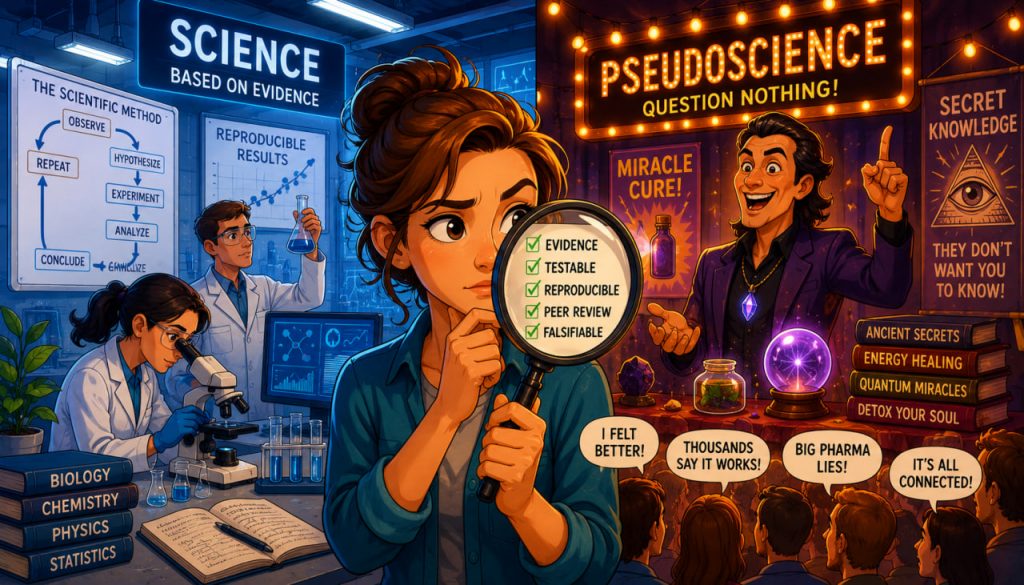
Pseudoscience is a system of beliefs, methods, or claims that presents itself as scientific without following the standards that make science reliable. It often uses technical language, impressive charts, laboratory imagery, and references to “research,” yet avoids rigorous testing, independent verification, and meaningful correction.
This does not mean every unusual or unproven idea is pseudoscientific. Science frequently investigates bold hypotheses. The difference lies in how claims are tested, challenged, and revised when evidence changes.
Understanding pseudoscience is increasingly important because misleading health advice, conspiracy theories, miracle products, and fabricated scientific explanations can spread rapidly online.
What Is Pseudoscience?
The word “pseudoscience” literally means “false science.” It describes claims that imitate the appearance of science while lacking its essential safeguards.
Scientific knowledge is based on observation, controlled testing, transparent methods, reproducible results, and critical review. A scientific explanation must be open to possible disproof.
Pseudoscientific systems often begin with a desired conclusion and then search for information that appears to support it. Contradictory evidence may be ignored, dismissed, or explained away.
Science asks, “What evidence would show that this idea is wrong?” Pseudoscience often asks, “How can I protect this idea from criticism?”
The Difference Between Science and Pseudoscience
Science is not simply a collection of correct facts. It is a method for reducing error.
Researchers create hypotheses, collect data, compare competing explanations, publish methods, and allow other specialists to examine their work. Findings may later be corrected or rejected.
Pseudoscience usually lacks this self-correcting structure. Its supporters may rely on personal stories, selective examples, secret knowledge, or claims that experts are deliberately hiding the truth.
A scientific claim normally becomes stronger when independent researchers reproduce the result. A pseudoscientific claim may remain popular even after repeated tests fail to confirm it.
Importantly, science does not promise certainty. Scientific conclusions are expressed with different levels of confidence and may change when better evidence appears.
Common Warning Signs of Pseudoscience
No single warning sign proves that a claim is pseudoscientific. However, several warning signs appearing together should raise concern.
One of the clearest is reliance on testimonials instead of controlled evidence. A person may sincerely believe that a treatment, device, or ritual helped them, but personal experience cannot reliably establish cause and effect.
Another warning sign is the use of vague scientific language. Expressions such as “quantum energy,” “cellular frequency,” “vibrational healing,” or “detoxifying toxins” may sound technical while lacking a clear, measurable meaning.
Pseudoscientific claims may also promise unusually broad results. A single product might supposedly improve immunity, remove toxins, balance hormones, increase energy, prevent aging, and cure multiple unrelated diseases.
Other warning signs include:
- Claims that cannot be tested or disproved
- Selective use of supportive studies
- Rejection of all criticism as conspiracy
- Absence of independent replication
- Dependence on secrecy or exclusive knowledge
- Exaggerated certainty
- Commercial pressure to buy quickly
- Claims that ordinary scientific methods are unnecessary
Why Testimonials Are So Persuasive
Human beings naturally trust stories. A vivid personal account can feel more convincing than a statistical analysis involving thousands of participants.
However, symptoms often change naturally. Some illnesses improve without treatment. People may also begin several treatments at the same time, making it difficult to know which factor caused the improvement.
The placebo effect can influence pain, mood, fatigue, and a person’s perception of symptoms. It can produce genuine experiences of improvement without proving that a treatment addresses the underlying condition.
People also tend to remember successful predictions and forget unsuccessful ones. This mental tendency, known as confirmation bias, helps explain why fortune-telling, miracle remedies, and personality systems may appear accurate.
Why Intelligent People Believe Pseudoscience
Belief in pseudoscience is not simply a sign of low intelligence.
Highly educated people can still be influenced by fear, hope, group identity, personal experience, and distrust of institutions. Intelligence may even help a person construct more sophisticated arguments in defense of a belief they already hold.
Pseudoscience becomes especially attractive during periods of uncertainty. Serious illness, financial insecurity, social change, and frightening world events create a desire for simple answers and a feeling of control.
Scientific explanations are often complicated and cautious. Pseudoscientific explanations may be emotionally satisfying, easy to understand, and presented with complete confidence.
A claim can feel meaningful, comforting, or empowering and still be unsupported by reliable evidence.
The Role of Social Media
Social media platforms allow scientific information to travel quickly, but they also reward sensational and emotionally charged content.
A careful explanation of uncertainty may attract less attention than a dramatic claim promising a hidden cure or exposing a supposed conspiracy. Repetition can also create the impression that a statement is true, even when many posts trace back to the same unreliable source.
Algorithms may repeatedly show users content similar to what they previously watched or shared. Over time, this can create an information environment where unsupported claims appear widely accepted.
Professional-looking videos, artificial intelligence-generated images, invented experts, and misleading graphs make it increasingly difficult to judge credibility by appearance alone.
Pseudoscience in Health and Medicine
Medical pseudoscience can be particularly dangerous.
Some unproven treatments are relatively harmless, but others delay diagnosis, interact with medication, cause direct injury, or encourage patients to abandon effective care.
Red flags include claims of a secret cure, promises of guaranteed results, statements that one treatment works for nearly every condition, and warnings that doctors oppose the treatment because they fear losing money.
The absence of scientific evidence does not always mean that a treatment is useless. It may simply mean that adequate research has not yet been completed. However, lack of evidence should never be presented as proof of effectiveness.
Unproven treatments should be clearly described as unproven rather than marketed as established medical facts.
Expert Perspective on Scientific Thinking
Philosopher of science Karl Popper emphasized that scientific ideas must be open to falsification. In other words, there must be some possible observation or experiment that could show a claim to be wrong.
This principle is important because a claim that explains every possible outcome explains very little. If supporters treat both success and failure as proof, the claim cannot be meaningfully tested.
Astronomer and science communicator Carl Sagan promoted a related principle: extraordinary claims require strong evidence. The more surprising a claim is, the more carefully alternative explanations must be investigated.
These ideas do not demand closed-mindedness. They encourage open-minded investigation combined with disciplined skepticism.
How to Evaluate a Scientific Claim
Begin by asking whether the claim is clearly defined. What exactly is supposed to happen, under what conditions, and how would the result be measured?
Check the quality of the evidence rather than the number of links provided. A long list of references can still be misleading if the studies are irrelevant, poorly designed, unpublished, or selectively quoted.
Look for independent research groups that reached similar conclusions. Findings are more convincing when they do not depend entirely on one laboratory, company, or charismatic individual.
Consider whether the claim has been published in a reputable peer-reviewed journal. Peer review is not perfect, but it creates an important level of scrutiny.
Also examine whether the promoter makes money from the claim. Financial interest does not automatically make a statement false, but undisclosed commercial incentives deserve attention.
Finally, search for the strongest criticism of the idea. Reliable claims should survive serious examination rather than depend on avoiding it.
Pseudoscience, Bad Science, and Unfinished Science
Not every flawed study is pseudoscience.
Bad science may involve weak methods, small samples, measurement errors, or incorrect analysis. These problems can occur within legitimate research and may later be corrected.
Unfinished science involves questions that remain uncertain because the evidence is limited or conflicting.
Pseudoscience is different because it often resists correction as a matter of principle. It may continue making the same claims regardless of failed predictions or negative results.
The boundary is not always perfectly sharp. Some ideas move from speculation into serious research, while others lose credibility as evidence accumulates against them.
Interesting Facts
- The term “pseudoscience” has been used since at least the nineteenth century.
- Many pseudoscientific movements borrow vocabulary from physics, genetics, neuroscience, or psychology.
- A real scientific study can be misused to support a conclusion that the researchers never made.
- Graphs can mislead through truncated axes, selective dates, distorted scales, or missing context.
- A claim repeated by thousands of accounts may still originate from a single unreliable source.
- Scientific consensus does not mean that every expert agrees; it means that the available evidence strongly supports one explanation.
- Some ideas once considered speculative later became accepted science, but only after they produced strong, reproducible evidence.
- Failed scientific predictions usually weaken a theory, while failed pseudoscientific predictions are often reinterpreted as confirmation.
- People are more likely to accept misinformation when it supports their existing beliefs or group identity.
- Scientific literacy includes understanding uncertainty, not merely memorizing scientific facts.
Glossary
- Pseudoscience — A belief system or method that appears scientific but does not follow reliable scientific standards.
- Hypothesis — A testable proposed explanation for an observation.
- Falsifiability — The possibility that evidence could demonstrate that a claim is wrong.
- Replication — Repeating a study to determine whether similar results can be obtained.
- Peer Review — Evaluation of research by other specialists before publication.
- Scientific Consensus — Broad expert agreement based on accumulated evidence.
- Confirmation Bias — The tendency to notice and favor information that supports existing beliefs.
- Placebo Effect — A change in symptoms influenced by expectations rather than the specific action of a treatment.
- Anecdotal Evidence — Evidence based on individual experiences or personal stories.
- Cherry-Picking — Selecting only evidence that supports a preferred conclusion while ignoring contradictory information.
- Correlation — A relationship between two variables that does not necessarily prove causation.
- Causation — A relationship in which one factor directly contributes to producing another.
- Controlled Study — Research designed to compare outcomes while limiting alternative explanations.
- Reproducibility — The ability to obtain consistent results using the same data, methods, or experimental procedures.
- Conflict of Interest — A personal or financial interest that may influence professional judgment.
- Cognitive Bias — A predictable mental tendency that can distort reasoning or decision-making.