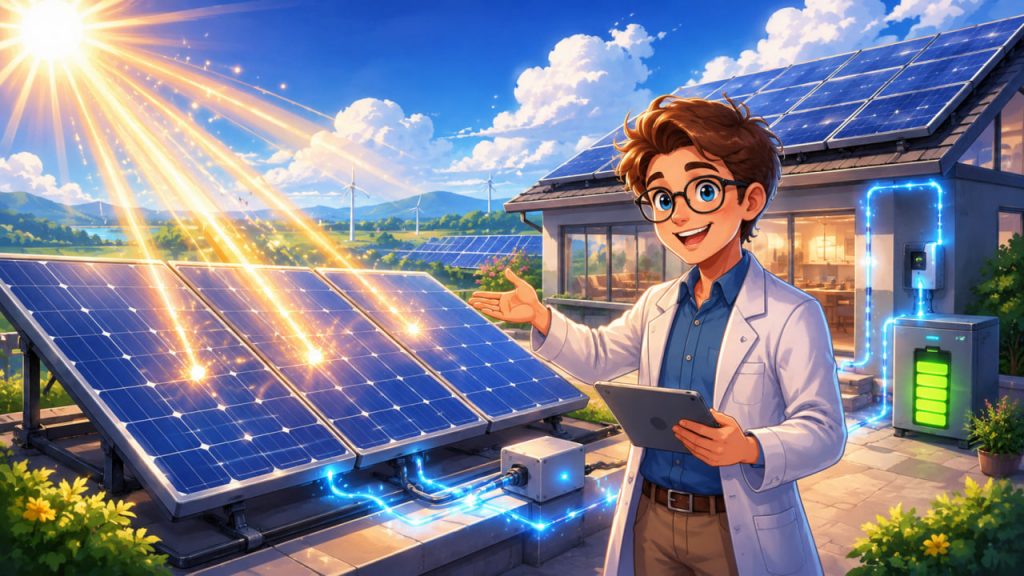
Photovoltaics is the technology that converts sunlight directly into electricity. It powers everything from pocket calculators and rooftop solar panels to satellites, factories, and utility-scale solar farms.
Unlike solar thermal systems, which use sunlight to produce heat, photovoltaic systems generate electric current inside semiconductor materials. They have no turbines, fuel combustion, or moving parts inside the solar cells.
Solar photovoltaics, commonly abbreviated as PV, has become one of the fastest-growing electricity technologies in the world. The International Energy Agency expects utility-scale and distributed solar PV to account for nearly 80% of global renewable-capacity growth between 2025 and 2030.
What Does “Photovoltaic” Mean?
The term combines “photo,” relating to light, with “voltaic,” relating to electricity.
A photovoltaic cell is a non-mechanical device that converts the energy of light directly into electrical energy. Although people usually associate PV cells with sunlight, some cells can also generate small amounts of electricity from artificial light.
One cell typically produces only a small amount of power. Manufacturers connect multiple cells to create a module, commonly called a solar panel. Several panels form an array, and arrays can be combined into large power stations.
How Does a Solar Cell Work?
Sunlight consists of packets of energy called photons.
When photons strike a solar cell, some are reflected, some pass through, and others transfer their energy to electrons inside the semiconductor. If a photon carries sufficient energy, it can free an electron from its normal position.
Most commercial solar cells use silicon. Manufacturers deliberately add tiny quantities of other elements to create two semiconductor layers with different electrical properties. The boundary between them forms an internal electric field.
This electric field pushes released electrons in a preferred direction. Metal contacts collect them, and the moving electrons create direct current electricity.
The solar cell does not store this energy. It produces electricity only while sufficient light is reaching it.
Why Solar Panels Need an Inverter
Solar cells generate direct current, or DC. Most homes, offices, and public electricity grids use alternating current, or AC.
An inverter converts the panel’s DC output into usable AC electricity. Modern inverters may also monitor system performance, detect faults, manage grid interaction, and optimize the operating point of the array.
A complete grid-connected photovoltaic system usually includes:
- Solar modules
- Mounting structures
- DC cables and protective devices
- One or more inverters
- Electricity meters
- Grid-connection equipment
- Monitoring software
Batteries are optional. A solar system can feed electricity directly into a building or grid without storing it first.
Monocrystalline, Thin-Film, and Emerging Solar Cells
Most modern panels use crystalline silicon.
Monocrystalline cells are cut from silicon crystals with a highly ordered structure. They typically provide high efficiency and are widely used where roof or land area is limited.
Thin-film technologies deposit extremely thin semiconductor layers onto glass, metal, or flexible material. They may use cadmium telluride, copper indium gallium diselenide, or amorphous silicon.
Thin-film modules can perform well in certain hot or low-light conditions, but technologies differ in efficiency, manufacturing requirements, availability, and material content.
Researchers are also developing perovskite and tandem solar cells. A tandem cell combines materials that absorb different parts of the solar spectrum, potentially capturing more energy than a conventional single-junction silicon cell.
NREL research focuses on improving cell efficiency, reducing system costs, and increasing reliability across numerous photovoltaic technologies.
What Determines Solar Panel Efficiency?
Efficiency is the percentage of incoming solar energy converted into electrical energy.
A panel’s real output depends on more than its laboratory efficiency. Important factors include:
- Strength and angle of sunlight
- Panel orientation and tilt
- Temperature
- Shade
- Dust, snow, and dirt
- Inverter losses
- Cable losses
- Module age and condition
Solar panels generally produce less electricity when their cells become very hot. A bright but extremely hot roof may therefore deliver less power than the same panel under bright, cooler conditions.
Partial shade can also have a disproportionate effect. Shade from one chimney, tree, or neighboring building may reduce the output of several connected cells unless bypass diodes or module-level electronics limit the problem.
A well-designed system considers annual energy yield, not only the panel’s headline efficiency rating.
Do Solar Panels Work in Cloudy or Cold Weather?
Yes, but their output changes.
PV cells respond to light, not heat. Panels can produce electricity on cold days and often operate efficiently at lower cell temperatures.
Clouds reduce the intensity of sunlight reaching the panels, so production usually falls. However, diffuse light passing through clouds can still generate electricity.
Snow may temporarily cover a panel and stop production. At the same time, clean snow surrounding an uncovered panel can reflect additional light toward it.
Local solar resources, weather patterns, orientation, shading, and system design determine how much electricity a project generates over the year.
Rooftop, Utility-Scale, Floating, and Integrated PV
Photovoltaics can be installed at many scales.
Rooftop systems generate electricity close to where it is consumed. They can reduce grid purchases during daylight hours and may export surplus power where regulations allow it.
Utility-scale solar farms use thousands or millions of modules. Some include tracking systems that slowly rotate panels to follow the Sun and increase annual production.
Floating PV systems are installed on reservoirs, lakes, and other suitable water bodies. They conserve land but require specialized designs to handle humidity, corrosion, waves, wind, and electrical safety.
Building-integrated photovoltaics place solar cells inside roofs, facades, windows, or shading structures. Agrivoltaic projects combine solar generation with farming or grazing on the same land.
Why Photovoltaics Is Growing So Quickly
PV systems are modular. A small household array and a huge solar farm use the same basic principle.
They can often be installed faster than large conventional power plants, require no fuel deliveries, and produce no direct air pollution while operating.
The IEA reports that solar PV supplied more than three-quarters of new renewable capacity added worldwide in 2025.
Another advantage is predictable operating cost. Once constructed, the system’s “fuel”—sunlight—is free. The remaining expenses include financing, maintenance, cleaning, component replacement, land, insurance, and grid services.
The Main Limitations of Solar Electricity
Photovoltaic generation changes with daylight and weather. It produces nothing at night unless electricity generated earlier has been stored.
A power system with large amounts of solar therefore needs flexibility from some combination of batteries, hydropower, transmission lines, demand management, flexible generation, and other energy sources.
Grid connection can become a major bottleneck. Solar plants may be ready before transmission capacity or substations are available.
Manufacturing is also geographically concentrated. The IEA has reported that China’s share across major solar-panel manufacturing stages exceeds 80%, creating both economies of scale and supply-chain concerns.
Large solar farms require careful land planning. Poorly located projects may affect habitats, agriculture, landscapes, or local communities. Rooftops, car parks, industrial land, degraded sites, and compatible agricultural projects can reduce some land-use conflicts.
Are Solar Panels Truly Environmentally Friendly?
Photovoltaic panels do not burn fuel during operation, but they are not impact-free.
Mining, material processing, manufacturing, transport, construction, maintenance, and end-of-life treatment all require energy and resources. Environmental performance varies with panel technology, factory electricity sources, lifetime, local solar yield, and recycling practices.
These impacts should be assessed across the entire lifecycle rather than only during operation. The IEA Photovoltaic Power Systems Programme maintains standardized lifecycle data to support credible comparisons of materials, energy use, and emissions.
Panels also gradually lose some performance. NREL reports that degradation is commonly around 0.5%–1% annually, although actual rates vary by product, climate, installation quality, and failure mechanisms.
Can Solar Panels Be Recycled?
Most of a conventional module’s mass consists of glass and aluminum, both of which are familiar recyclable materials. The U.S. Department of Energy states that more than 85% of a PV module is made from materials already commonly recycled.
The difficulty is separating the tightly bonded layers economically while recovering smaller quantities of valuable materials such as silicon, silver, copper, and specialized semiconductors.
Current research aims to make panels easier to disassemble, extend their useful lives, reduce hazardous or scarce materials, and improve recycling economics. Reuse and refurbishment may also give functional modules a second life before material recycling becomes necessary.
Expert Perspective
Fraunhofer Institute for Solar Energy Systems researchers emphasize that photovoltaic performance should be evaluated through a combination of module efficiency, system reliability, energy yield, lifecycle impacts, and market conditions—not by one laboratory record alone. Its regularly updated Photovoltaics Report brings these factors together to track the technology’s real development.
Energy experts also stress that rapid deployment must be accompanied by stronger electricity grids, storage, flexible demand, diversified manufacturing, and responsible end-of-life management.
Photovoltaics is not a complete energy system by itself, but it is an increasingly important building block within one.
Interesting Facts
- Solar cells were first used extensively in space because satellites needed reliable electricity without fuel deliveries.
- A photovoltaic cell can generate electricity without mechanical movement.
- Silicon is the dominant solar-cell material and one of the most abundant elements in Earth’s crust.
- Solar panels generate direct current, while household grids generally use alternating current.
- Cold sunlight can be better for panel efficiency than equally bright extreme heat.
- Bifacial panels collect light from both their front and rear surfaces.
- Solar trackers can follow the Sun across the sky.
- A module may continue producing electricity for decades even after its warranty period.
- Solar panels do not need perfectly direct sunlight to work.
- Inverters often require replacement earlier than the modules themselves.
- More than 85% of a conventional module’s mass consists of materials already commonly recycled.
- Photovoltaics can be integrated into roofs, facades, vehicles, greenhouses, noise barriers, and floating structures.
Glossary
- Photovoltaics — The direct conversion of light into electricity using semiconductor devices.
- Photon — A packet of electromagnetic energy associated with light.
- Solar Cell — The smallest photovoltaic device that converts light into electricity.
- Module — A sealed group of electrically connected solar cells, commonly called a solar panel.
- Solar Array — A group of interconnected photovoltaic modules.
- Semiconductor — A material whose electrical conductivity can be controlled.
- Photovoltaic Effect — The process by which light creates voltage and electric current in a material.
- Direct Current — Electric current that flows predominantly in one direction.
- Alternating Current — Electric current that periodically reverses direction.
- Inverter — A device that converts direct current into alternating current.
- Efficiency — The proportion of incoming solar energy converted into electricity.
- Energy Yield — The amount of electricity a system produces over a specified period.
- Monocrystalline Silicon — Crystalline silicon formed with a highly ordered single-crystal structure.
- Thin-Film Solar Cell — A photovoltaic device made by depositing thin semiconductor layers on a supporting surface.
- Perovskite Solar Cell — An emerging photovoltaic technology using materials with a perovskite-type crystal structure.
- Tandem Cell — A solar cell combining multiple light-absorbing layers to use more of the solar spectrum.
- Bifacial Module — A panel capable of generating electricity from light reaching both sides.
- Degradation Rate — The annual decline in a module’s power-generating ability.
- Grid Integration — The technical process of incorporating electricity generation into a power network.
- Agrivoltaics — The combined use of land for photovoltaic generation and agriculture.