Genetics is the science of heredity: how biological information passes from parents to offspring and how inherited instructions shape living organisms.
Today, researchers can sequence entire genomes, identify disease-associated variants, study ancient DNA, and edit selected genes. Yet modern genetics began with simple breeding experiments carried out long before anyone knew that DNA existed.
The history of genetics is the story of how an invisible pattern of inheritance became a measurable, molecular science.
Before Genetics Became a Science
For thousands of years, farmers selectively bred plants and animals with desirable characteristics. They understood that strong animals, productive crops, and particular colors or shapes could reappear in later generations.
However, early explanations of inheritance were mostly speculative. A common idea was “blending inheritance,” according to which parental traits mixed permanently in their offspring, like two colors of paint.
This model could not explain why a trait might disappear in one generation and return in the next.
Charles Darwin’s theory of evolution by natural selection, published in 1859, made heredity an even more important scientific problem. Evolution required inherited variation, but Darwin did not know the mechanism by which biological traits were transmitted.
Gregor Mendel and the Laws of Inheritance
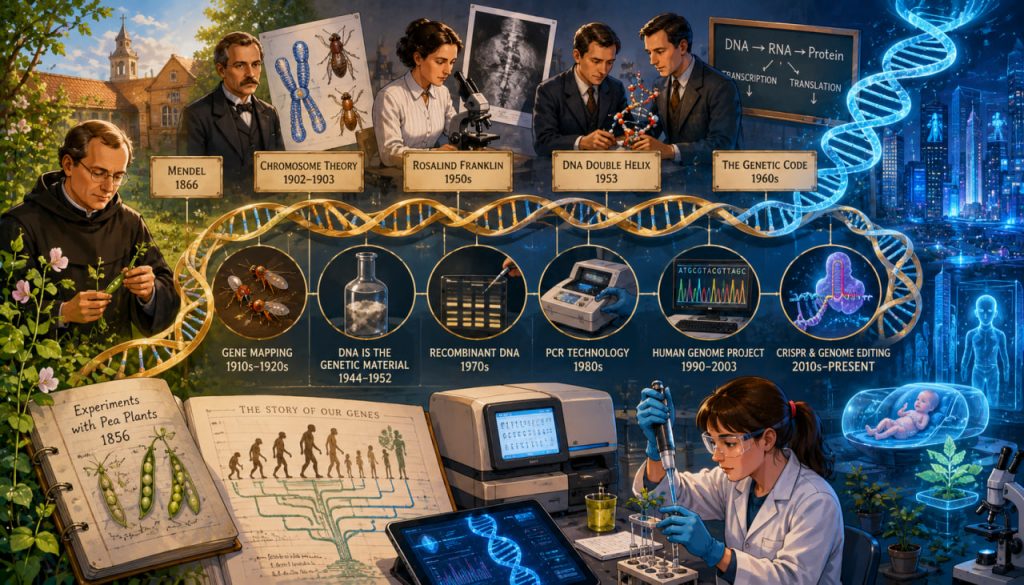
The foundations of genetics were established by Gregor Mendel, an Augustinian friar who experimented with pea plants in the 1850s and 1860s.
Mendel selected traits that appeared in distinct forms, such as tall or short plants and yellow or green seeds. By carefully controlling pollination and counting thousands of offspring, he discovered predictable numerical patterns.
He concluded that inherited characteristics were controlled by separate “factors,” now called genes. Each organism received two versions of a factor, one from each parent.
His work produced two central principles:
- The law of segregation: the two versions of a hereditary factor separate during the production of reproductive cells.
- The law of independent assortment: different hereditary factors may be inherited independently, although scientists later discovered important exceptions involving linked genes.
Mendel published his findings in 1866, but they attracted little attention. Their importance was widely recognized only around 1900, when several botanists independently produced similar results.
Chromosomes Connect Heredity With Cells
During the late nineteenth century, improved microscopes allowed researchers to observe chromosomes—thread-like structures that appear during cell division.
Walter Sutton and Theodor Boveri independently argued in the early twentieth century that Mendel’s hereditary factors were located on chromosomes. Chromosomes occurred in pairs and separated during the formation of eggs and sperm in exactly the way Mendel’s factors were expected to behave.
This became the chromosome theory of inheritance.
Thomas Hunt Morgan and his colleagues later tested the theory using fruit flies. Morgan discovered a white-eyed male fly and showed that the trait was connected to the X chromosome.
His laboratory demonstrated that genes occupy particular positions on chromosomes. By measuring how often inherited traits became separated through recombination, researchers could estimate the relative distances between genes and construct genetic maps.
Genes were no longer abstract statistical factors; they had physical locations inside cells.
The Search for the Genetic Material
Scientists knew that chromosomes contained both proteins and DNA, but many initially assumed that proteins carried hereditary information because proteins appeared more chemically complex.
In 1928, Frederick Griffith showed that material from dead disease-causing bacteria could permanently transform harmless bacteria into a harmful form. He did not identify the responsible substance, but his experiment revealed that biological information could move between cells.
In 1944, Oswald Avery, Colin MacLeod, and Maclyn McCarty presented strong evidence that the transforming substance was DNA.
Further confirmation came in 1952, when Alfred Hershey and Martha Chase studied viruses that infect bacteria. Their experiment showed that viral DNA entered bacterial cells and directed the production of new viruses, while most viral protein remained outside.
These discoveries established DNA as the primary genetic material in most organisms.
Rosalind Franklin and the DNA Double Helix
Discovering that DNA carried genetic information created a new question: how could its molecular structure store and copy biological instructions?
Rosalind Franklin and Maurice Wilkins studied DNA using X-ray diffraction at King’s College London. Franklin’s exceptionally precise experimental work revealed crucial information about DNA’s helical form, dimensions, and water content.
Using X-ray evidence, chemical data, and molecular modeling, James Watson and Francis Crick proposed the double-helix structure in 1953. DNA consists of two complementary strands, with adenine pairing with thymine and cytosine pairing with guanine.
This structure immediately suggested a copying mechanism: the two strands could separate, and each could serve as a template for a new partner.
The 1962 Nobel Prize in Physiology or Medicine went to Watson, Crick, and Wilkins. Franklin had died in 1958 and could not receive the prize, which is not awarded posthumously. Nobel historical accounts acknowledge that Franklin’s X-ray diffraction evidence was central to understanding DNA’s structure.
From DNA to Proteins
After the double helix was identified, scientists turned to the question of how DNA controls cellular activity.
Researchers established that genetic information generally flows from DNA to RNA and then to protein. DNA sequences are copied into messenger RNA through transcription, and ribosomes read that RNA to assemble proteins through translation.
During the 1960s, Marshall Nirenberg, Har Gobind Khorana, Robert Holley, and other scientists deciphered the genetic code. They showed that groups of three RNA bases, called codons, specify particular amino acids or provide start and stop signals.
This work revealed that the order of DNA bases determines the order of amino acids in proteins.
Recombinant DNA and the Biotechnology Revolution
In the 1970s, scientists learned how to cut DNA at specific sequences using restriction enzymes and join fragments from different sources.
This created recombinant DNA technology, which allowed genes to be copied, studied, and transferred between organisms.
One of its earliest major medical applications was genetically engineered human insulin. Before recombinant insulin became available, insulin was commonly extracted from animal pancreases. Engineered bacteria made it possible to manufacture a human protein at industrial scale.
DNA sequencing also advanced rapidly. Frederick Sanger and colleagues developed a practical sequencing method in the 1970s, enabling researchers to determine the precise order of bases in DNA.
Polymerase chain reaction, developed in the 1980s, made it possible to produce millions of copies of a selected DNA region. PCR transformed medical testing, forensic science, evolutionary research, and molecular biology.
The Human Genome Project
The Human Genome Project officially began in 1990 as an international effort to map and sequence the human genome.
The project developed faster sequencing methods, powerful computing tools, genetic maps, and open databases. A working draft was announced in 2000, and the project was completed in 2003 with a sequence covering more than 90% of the genome accessible to the technology of the time.
The project also established a policy of rapidly releasing genomic data into the public domain. This helped create a culture of open data sharing that influenced biomedical research worldwide.
NHGRI describes the Human Genome Project as a global collaboration conducted from 1990 to 2003 that produced the first sequence of the human genome and reshaped genomic science.
Genetics Becomes Genomics
Traditional genetics often concentrates on individual genes and inherited traits. Genomics examines entire genomes and the interactions among thousands of genes, regulatory sequences, cells, and environmental influences.
Faster sequencing technologies dramatically reduced the cost and time required to read DNA. Researchers began comparing genomes across individuals, populations, species, tumors, and ancient remains.
Modern genomics supports:
- Diagnosis of rare inherited disorders
- Identification of cancer mutations
- Pharmacogenomics and medication selection
- Pathogen surveillance
- Ancestry and population studies
- Conservation biology
- Agricultural breeding
It also showed that many common conditions do not result from one defective gene. They reflect complex interactions involving numerous genetic variants, lifestyle, development, and environment.
CRISPR and the Age of Genome Editing
Earlier genetic engineering methods could modify DNA, but targeting a precise location was often slow and difficult.
CRISPR-based genome editing transformed the field during the 2010s. Adapted from a microbial defense system, CRISPR tools use a guide RNA to direct a DNA-cutting protein toward a selected genetic sequence.
Scientists can then disable a gene, repair certain mutations, or introduce a planned change.
Genome editing has enormous potential in medicine, agriculture, and biological research. It also raises serious questions about safety, unintended changes, access, consent, and editing embryos in ways that could affect future generations.
Expert Perspective
Geneticist and physician Francis Collins, one of the principal leaders of the Human Genome Project, has emphasized that sequencing the genome was not an endpoint but a foundation for understanding human biology and disease.
That perspective reflects a central lesson from genetics: reading DNA is easier than fully explaining how it works. Gene activity depends on cellular context, development, regulatory networks, environmental exposure, and chance.
Modern genetics is therefore moving beyond simple claims that one gene inevitably produces one characteristic.
The Darker History of Genetics
Genetics has not always been used responsibly.
During the late nineteenth and twentieth centuries, eugenics movements misused ideas about heredity to justify forced sterilization, racial discrimination, immigration restrictions, and mass persecution.
Eugenic policies treated complex human characteristics as simple inherited qualities and combined poor science with prejudice and political power.
This history remains relevant as genetic testing and genome editing become more powerful. Ethical genetics requires informed consent, privacy protection, accurate interpretation, fair access, and respect for human diversity.
Interesting Facts
- The word “genetics” was introduced by William Bateson in the early twentieth century.
- Mendel’s original paper received little recognition during his lifetime.
- Fruit flies became major research organisms because they reproduce quickly and show easily observed traits.
- Human cells normally contain 23 pairs of chromosomes.
- Mitochondria carry a small genome separate from the DNA in the cell nucleus.
- Identical twins can develop biological differences as they age.
- Most human DNA is not composed of protein-coding genes.
- The Human Genome Project helped establish rapid public release of sequencing data.
- Ancient DNA allows researchers to study extinct populations and migrations.
- Some traits are influenced by hundreds or thousands of genetic variants.
- CRISPR originated from a natural defense mechanism used by bacteria and archaea.
- Genes influence biology, but they rarely operate independently of environment and development.
Glossary
- Genetics — The study of genes, heredity, and biological variation.
- Heredity — The transmission of biological information from parents to offspring.
- Gene — A functional unit of inherited information encoded in DNA.
- Allele — One of several possible versions of a gene or genetic sequence.
- Chromosome — A long DNA molecule packaged with proteins.
- DNA — Deoxyribonucleic acid, the principal hereditary material in most organisms.
- Genome — The complete genetic material of an organism.
- Genomics — The study of complete genomes and their functions and interactions.
- Mutation — A change in a DNA sequence.
- Recombination — The rearrangement and exchange of genetic material during reproduction.
- Transcription — The production of RNA using DNA as a template.
- Translation — The production of a protein using information carried by messenger RNA.
- Codon — A sequence of three RNA bases that specifies an amino acid or control signal.
- Recombinant DNA — DNA constructed by joining genetic material from different sources.
- DNA Sequencing — Determining the order of bases in a DNA molecule.
- PCR — A laboratory method used to make many copies of a selected DNA region.
- Genome Editing — The deliberate modification of a selected DNA sequence.
- CRISPR — A family of programmable genome-editing technologies adapted from microbial defense systems.
- Eugenics — A discredited movement that attempted to control human reproduction according to biased ideas about inherited worth.
- Epigenetics — The study of changes in gene activity that do not necessarily alter the underlying DNA sequence.