Solar energy is the foundation of modern space exploration. It powers communications satellites, scientific observatories, navigation systems, robotic spacecraft, and the International Space Station. Future lunar settlements may also depend heavily on sunlight for electricity, life support, communications, construction, and resource extraction.
Space offers an important advantage: there are no clouds or atmospheric pollution to block sunlight. However, solar power beyond Earth also faces harsh radiation, extreme temperature changes, orbital darkness, abrasive lunar dust, and difficult maintenance.
The future of space solar energy will depend not only on better solar cells, but also on energy storage, power transmission, durable materials, and intelligent electrical networks.
How Solar Panels Generate Electricity in Space
Spacecraft solar arrays use photovoltaic cells that convert sunlight directly into electricity.
When photons strike a semiconductor, they transfer energy to electrons. The resulting electrical current is collected and distributed to onboard equipment or stored in batteries.
Individual solar cells are connected into larger modules and arrays. Small satellites may use panels attached directly to their bodies, while spacecraft with higher power demands deploy large wings after launch.
The amount of electricity generated depends on several factors:
- Solar-cell efficiency
- Array surface area
- Distance from the Sun
- Orientation toward sunlight
- Temperature
- Radiation damage
- Shadowing
- Electrical conversion losses
Modern spacecraft usually include mechanisms or attitude-control systems that keep their solar arrays pointed toward the Sun as effectively as possible.
Why Satellites Depend on Solar Power
Solar arrays are well suited to satellites because they can generate electricity for years without carrying large quantities of fuel.
The electricity supports communications equipment, computers, sensors, thermal-control systems, propulsion components, and scientific instruments.
Satellites in low Earth orbit repeatedly move between daylight and darkness. During the illuminated part of an orbit, their arrays power the spacecraft and recharge batteries. The batteries then provide electricity while Earth blocks the Sun.
Geostationary communications satellites remain in sunlight for much of the year but still experience eclipse periods around the equinoxes. Their electrical systems must therefore combine solar generation with reliable energy storage.
A satellite power system must survive thousands of charging cycles while continuing to operate in vacuum and radiation.
The International Space Station as a Solar Power Plant
The International Space Station demonstrates how solar energy can support a large inhabited orbital facility.
NASA reports that the station’s eight main solar arrays generate approximately 75–90 kilowatts of electrical power under operating conditions. New roll-out arrays have been added to increase production and support research, life-support equipment, laboratories, computers, cooling systems, and communications.
The station passes through approximately 16 day-night cycles during a typical Earth day. Its batteries store electricity during sunlight and release it during orbital night.
The ISS also shows why power management is as important as generation. Electricity must be converted, distributed, protected, stored, and prioritized across a complex network of international modules and experiments.
Why Space Solar Panels Are Different
Solar modules designed for rooftops on Earth are generally unsuitable for spacecraft.
Launch systems impose strict limits on mass and volume. Arrays must survive vibration during launch, unfold reliably in orbit, and operate without routine repair.
Space solar cells are often made from advanced semiconductor materials that achieve higher efficiencies than conventional terrestrial silicon modules. Multi-junction cells use several layers designed to absorb different parts of the solar spectrum.
However, high performance comes at a high price. Space-grade cells, deployment mechanisms, protective materials, testing, and qualification can be extremely expensive.
Radiation gradually damages solar cells. High-energy particles can alter semiconductor structures and reduce output, so spacecraft engineers normally include a performance margin for degradation over the mission’s lifetime.
Solar Power on the Moon
A lunar base would require electricity for almost every essential function.
Power would be needed for:
- Oxygen production
- Water processing
- Heating and cooling
- Communications
- Scientific laboratories
- Lighting
- Rovers
- Construction machinery
- Habitat systems
- Charging batteries
- Extracting local resources
The Moon has no clouds and almost no atmosphere, so sunlight can be intense and predictable. This makes solar energy highly attractive.
NASA has supported the development of tall, vertically deployable solar arrays for lunar use. Elevated panels could capture sunlight at the Moon’s south pole while avoiding some shadows created by uneven terrain.
The Challenge of the Lunar Night
The greatest problem for lunar solar power is the long night.
In many regions, a lunar day lasts roughly 14 Earth days, followed by a night of similar duration. NASA notes that some systems may face about 350 consecutive hours without sunlight.
Keeping a crewed base operating through this period would require enormous energy-storage capacity.
Possible solutions include:
- Large rechargeable batteries
- Regenerative fuel cells
- Stored hydrogen and oxygen
- Thermal-energy storage
- Multiple connected solar stations
- Beamed power
- Nuclear fission systems
Batteries alone may become too heavy for high-power bases. Transporting every kilogram from Earth remains costly, so future missions may need to manufacture energy-storage materials or fuels using lunar resources.
Why the Lunar South Pole Is Important
Some high locations near the Moon’s poles receive sunlight for much longer periods than equatorial sites.
The Sun remains low on the horizon, and hills or crater rims may experience extended illumination. Nearby permanently shadowed craters may contain water ice, making the region attractive for future exploration.
However, polar lighting is complex. A panel may lose sunlight when a distant hill blocks the low Sun. Accurate terrain mapping, tracking systems, and distributed power networks will therefore be necessary.
ESA explains that certain polar locations offer unusually long illumination, although most lunar regions still experience extended darkness.
Building a Lunar Microgrid
A mature lunar settlement may use a microgrid rather than one isolated power plant.
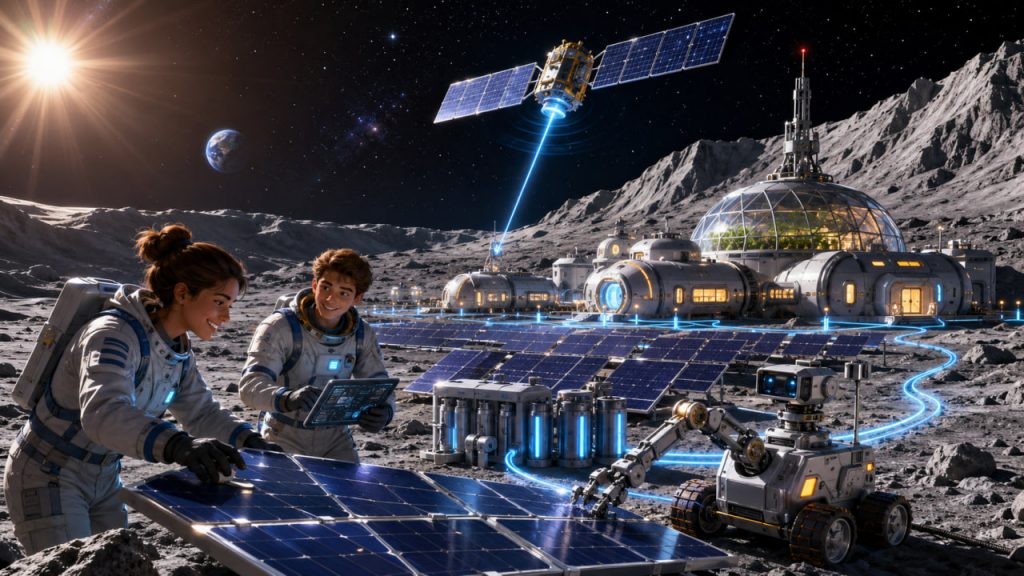
Several solar farms, batteries, fuel cells, reactors, habitats, and industrial sites could be connected through cables or wireless transmission.
A microgrid could redirect electricity when one source fails or moves into shadow. It could prioritize life support and communications while temporarily reducing power to less critical equipment.
Autonomous software would need to forecast energy production, manage storage, detect damaged cables, and balance demand without waiting for instructions from Earth.
Reliability will come from combining several power sources rather than depending entirely on one solar array.
Solar Power Beamed From Orbit
Another concept involves collecting sunlight with satellites and transmitting energy to the lunar surface using microwaves or lasers.
An orbital solar power station could illuminate receivers at locations that are dark or difficult to reach with cables. Rovers operating during the lunar night might be among the earliest useful applications.
ESA has studied concepts in which space-based solar power could support lunar vehicles and future inhabited bases. One proposed lunar power station concept was designed to transmit megawatts of microwave energy to the surface, although such systems remain conceptual rather than operational.
Engineers would need to solve major challenges involving transmission efficiency, antenna size, precise targeting, safety, heat removal, construction, and launch cost.
Lunar Dust and Extreme Temperatures
Lunar dust is sharp, electrostatically charged, and highly abrasive.
It can settle on solar cells, block sunlight, damage moving mechanisms, and reduce electrical output. Future arrays may use protective coatings, mechanical cleaning, electrostatic dust removal, or robotic maintenance.
Temperature changes are another challenge. Sunlit equipment can become extremely hot, while shaded surfaces may become intensely cold.
Solar arrays, cables, batteries, and electronics must tolerate repeated thermal expansion and contraction without cracking or losing performance.
Expert Perspective
NASA’s lunar-power planning treats solar arrays as a major part of surface exploration, but it also recognizes that sunlight alone may not provide continuous energy everywhere. The agency is developing fission surface power systems because reactors could operate during long lunar nights and inside permanently shadowed regions.
This reflects a realistic engineering strategy: solar power is likely to dominate during illuminated periods, while storage, power sharing, and nuclear systems provide resilience when sunlight is unavailable.
The goal is not to find one perfect energy source. It is to create an integrated system capable of protecting crews and equipment under every expected condition.
Solar Energy Farther From the Sun
Solar power becomes more difficult as spacecraft travel farther into the Solar System because sunlight weakens with distance.
Mars receives less solar energy than Earth, while missions near Jupiter receive far less. Large, efficient arrays can still support some distant spacecraft, but beyond a certain point nuclear power may become more practical.
Dust storms also affect solar-powered Mars missions. A spacecraft must be designed for reduced sunlight, accumulated dust, and seasonal variation.
Closer to the Sun, solar arrays face the opposite problem: extreme heat and intense radiation. Some spacecraft use heat shields, tilted arrays, or active cooling to protect their power systems.
Interesting Facts
- Spacecraft were using solar cells within the first years of the Space Age.
- Satellites recharge batteries while they are illuminated and use stored electricity in darkness.
- The International Space Station’s solar wings extend across a distance comparable to the wingspan of a large passenger aircraft.
- Space solar cells are usually more efficient and expensive than typical rooftop panels.
- A normal lunar night lasts about two Earth weeks.
- Vertical lunar arrays may capture sunlight above shadows created by nearby terrain.
- Lunar dust can reduce solar output and damage mechanical equipment.
- Orbiting power stations could theoretically transmit electricity to lunar rovers or bases.
- Solar panels slowly lose performance because of radiation exposure.
- Future lunar settlements may combine solar, batteries, fuel cells, and nuclear power in one microgrid.
Glossary
- Photovoltaic Cell — A semiconductor device that converts sunlight directly into electricity.
- Solar Array — A connected group of solar panels or cells used to generate electrical power.
- Multi-Junction Cell — A high-efficiency solar cell containing several semiconductor layers.
- Low Earth Orbit — An orbit relatively close to Earth, commonly used by satellites and space stations.
- Geostationary Orbit — An orbit in which a satellite appears fixed over one point on Earth.
- Orbital Eclipse — A period when a planet or moon blocks sunlight from reaching a spacecraft.
- Lunar Night — The long period of darkness experienced at a location on the Moon.
- Regenerative Fuel Cell — A system that generates electricity from stored reactants and can later recreate those reactants using electrical energy.
- Microgrid — A local electrical network connecting multiple generators, storage systems, and users.
- Beamed Power — Energy transmitted remotely using microwaves, lasers, or another directed method.
- Permanently Shadowed Region — A lunar area, usually inside a polar crater, that receives little or no direct sunlight.
- Regolith — Loose dust, broken rock, and soil-like material covering the Moon’s surface.
- Radiation Degradation — The gradual loss of equipment performance caused by energetic particles.
- Power Management — The control, conversion, storage, and distribution of electrical energy.
- Fission Surface Power — A compact nuclear reactor system designed to provide continuous electricity on a planetary surface.