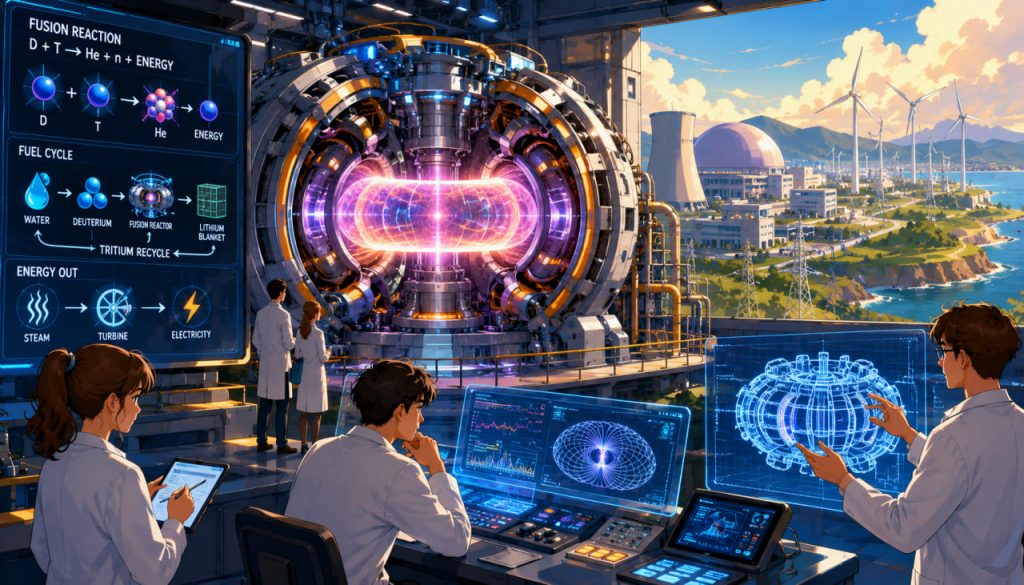
Nuclear fusion is often described as the ultimate energy technology: abundant fuel, enormous energy density, no carbon dioxide emissions during operation, and no possibility of the runaway chain reaction associated with conventional nuclear fission.
Recent laboratory breakthroughs have moved fusion from distant theory toward serious engineering development. However, producing a brief fusion reaction is very different from building a reliable power station that generates affordable electricity every day.
Fusion has demonstrated that it can release substantial energy under controlled conditions. The remaining challenge is turning that scientific success into a durable, economical industrial system.
What Is Nuclear Fusion?
Fusion occurs when light atomic nuclei combine to form a heavier nucleus, releasing energy in the process. It is the reaction that powers the Sun and other stars.
Most experimental reactor concepts focus on two hydrogen isotopes: deuterium and tritium. When they fuse, they produce a helium nucleus, a fast neutron, and a large amount of energy.
Deuterium can be extracted from water. Tritium is rare in nature and would probably need to be produced inside future reactors using lithium-containing materials.
For fusion to occur efficiently, the fuel must be heated to extremely high temperatures. At these temperatures, electrons separate from atomic nuclei, creating an electrically charged state of matter called plasma.
No ordinary material container can directly hold such hot plasma. Scientists must therefore confine it using magnetic fields or compress it rapidly with powerful lasers.
Magnetic Confinement Fusion
The best-known magnetic fusion design is the tokamak, a doughnut-shaped chamber surrounded by powerful magnets.
Magnetic fields guide charged particles and keep the plasma away from the reactor walls. Heating systems raise the plasma temperature, while control equipment attempts to maintain a stable fusion reaction.
ITER, under construction in France, is the world’s largest international fusion experiment. Its purpose is to demonstrate fusion power at reactor scale and test essential technologies, although it is not designed to sell electricity to the grid.
ITER involves China, the European Union, India, Japan, South Korea, Russia, and the United States. Its scale reflects both the difficulty of fusion engineering and the belief that no single research program should solve every problem alone.
The project’s evolving research plan is intended to progress toward high-gain plasma operation while resolving remaining challenges in plasma control, heating, materials, and reactor systems.
Inertial Confinement and Fusion Ignition
A different approach is inertial confinement fusion.
At the US National Ignition Facility, powerful lasers strike a tiny capsule containing fusion fuel. The capsule rapidly compresses and heats, creating fusion conditions for an extremely short time.
In December 2022, the facility achieved fusion ignition for the first time, meaning the fusion energy released from the target exceeded the laser energy delivered to it. Since then, ignition has been repeated.
In April 2025, a National Ignition Facility experiment delivered approximately 2.08 megajoules of laser energy to the target and produced a record fusion yield of 8.6 megajoules, giving a target gain above four.
This was a major scientific achievement, but it did not represent an electricity-producing power plant. The full facility required much more energy to operate its lasers and supporting systems than the target released.
Scientific breakeven at the fuel target is not the same as generating net electricity after every system in a power station is included.
Why Fusion Energy Is So Attractive
Fusion could offer several important advantages.
The deuterium required for fusion is widely available, while lithium resources could potentially support tritium production. Fusion fuel contains far more energy per unit of mass than fossil fuels.
A fusion plant would not burn coal, oil, or gas, so its normal operation would not release carbon dioxide from fuel combustion.
Fusion also differs fundamentally from fission. It does not depend on a self-sustaining chain reaction. If plasma conditions are disturbed, the fusion reaction naturally stops.
The reaction does not directly produce the same long-lived high-level waste created by spent fission fuel. However, energetic neutrons can make reactor structures radioactive, so material selection, component replacement, and waste management remain important engineering concerns.
Fusion could eventually provide continuous electricity that complements variable renewable sources such as wind and solar. The International Atomic Energy Agency considers fusion a potentially significant future source of low-carbon, dependable power.
The Problem of Plasma Stability
Creating hot plasma is not enough. It must remain stable, confined, and predictable.
Plasma can develop waves, turbulence, sudden disruptions, and other instabilities. These events may reduce performance or transfer damaging heat and electromagnetic forces to reactor components.
Scientists use magnetic coils, fuel injection, heating systems, sensors, and real-time control algorithms to manage these conditions.
Future reactors will need to maintain useful fusion performance for long periods rather than for seconds or brief experimental pulses.
They must also operate repeatedly with high availability. A commercial power plant that frequently shuts down for repairs would struggle to compete with other energy technologies.
Materials Must Survive an Extreme Environment
The neutrons produced by deuterium-tritium fusion carry most of the reaction’s energy.
Unlike charged particles, neutrons are not confined by magnetic fields. They strike the reactor’s inner structures, causing atomic damage, material swelling, embrittlement, and radioactive activation.
The plasma-facing components must also tolerate intense heat. Some regions may experience conditions comparable to those encountered by spacecraft re-entering an atmosphere.
Engineers are developing specialized steels, tungsten components, advanced cooling systems, and replaceable internal modules.
A successful fusion reactor requires not only excellent plasma physics but also materials capable of surviving years of neutron exposure and extreme heat.
Tritium Breeding and Fuel Self-Sufficiency
Tritium has a radioactive half-life of approximately 12.3 years and exists naturally only in very small quantities. A large fusion industry could not depend permanently on existing supplies.
Most power-plant concepts therefore include a breeding blanket around the plasma chamber. Neutrons from fusion would interact with lithium inside the blanket to produce new tritium.
The system would also capture neutron energy as heat. That heat could produce steam or power another turbine cycle to generate electricity.
A commercial reactor must breed, extract, process, and recycle enough tritium to replace what it consumes. ITER and later demonstration projects are intended to advance technologies related to tritium handling, heat removal, and fuel-cycle development.
From Experiments to Fusion Power Plants
ITER is expected to be followed by demonstration reactors commonly called DEMO projects. These machines would attempt to generate electricity, breed fuel, and integrate technologies resembling those needed in commercial plants.
After DEMO, prototype reactors would need to prove that fusion electricity can be produced reliably and competitively. ITER notes that the timing of this progression depends strongly on engineering success, funding, political commitment, and the urgency attached to energy development.
Meanwhile, private fusion companies are pursuing smaller and potentially faster designs. Their concepts include compact tokamaks, stellarators, magnetized-target systems, pulsed machines, and alternative fuels.
High-temperature superconducting magnets are particularly important because they may create stronger magnetic fields in more compact devices. The IAEA has identified these magnets as a potentially transformative development in the global fusion sector.
Can Fusion Become Commercial in the 2030s?
Some government programs and private companies aim to demonstrate pilot plants or commercially relevant systems during the 2030s.
The US Department of Energy’s fusion strategy focuses on closing scientific and technological gaps, supporting a commercially relevant pilot plant, preparing for deployment, and strengthening public-private collaboration. Its newer roadmap is intended to build infrastructure that could help private-sector expansion during the 2030s.
These targets are ambitions rather than guarantees.
A pilot plant must demonstrate far more than a high fusion-energy gain. It must produce electricity, manage tritium, replace damaged components, meet safety regulations, operate predictably, and control costs.
Widespread commercial deployment is therefore likely to take longer than the first pilot demonstrations.
Expert Perspective
The IAEA’s global outlook presents fusion as a field undergoing unusually rapid scientific, technological, and commercial development. At the same time, it emphasizes that progress depends on solving integrated challenges involving materials, fuel cycles, regulation, workforce development, and power-plant engineering.
The US Department of Energy takes a similar view: fusion commercialization requires a coordinated program that combines fundamental science, engineering infrastructure, industrial partnerships, and deployment planning.
Fusion is no longer only a physics experiment, but it is not yet a commercial energy technology. It is entering the demanding stage where every component must work together.
Will Fusion Solve Climate Change?
Fusion may eventually become an important part of a low-carbon energy system, but it cannot replace actions required today.
Commercial fusion plants are not yet supplying electricity, while emissions reductions are needed immediately. Renewable energy, energy efficiency, grid modernization, storage, existing nuclear power, and other available technologies remain essential.
Fusion’s greatest contribution may come later in the century, especially if global electricity demand rises sharply due to electrification, industrial growth, desalination, and hydrogen production.
It should therefore be viewed as a potential long-term energy option rather than a reason to delay currently available climate solutions.
Interesting Facts
- Fusion powers the Sun, but Earth-based reactors use very different conditions to reproduce it.
- Plasma is often called the fourth state of matter.
- Deuterium occurs naturally in ordinary water.
- Tritium must probably be bred from lithium inside future reactors.
- ITER is an experimental machine and will not supply commercial electricity.
- Fusion ignition has now been achieved repeatedly at the National Ignition Facility.
- A fusion plasma can be hotter than the centre of the Sun.
- Magnetic confinement prevents the hot plasma from directly touching solid walls.
- Neutron-resistant materials are one of fusion engineering’s greatest challenges.
- A reactor may achieve high fusion gain and still fail to produce net electricity after auxiliary systems are counted.
Glossary
- Nuclear Fusion — A reaction in which light atomic nuclei combine and release energy.
- Plasma — An electrically charged state of matter containing free electrons and atomic nuclei.
- Deuterium — A stable hydrogen isotope containing one proton and one neutron.
- Tritium — A radioactive hydrogen isotope containing one proton and two neutrons.
- Tokamak — A doughnut-shaped magnetic device designed to confine fusion plasma.
- Stellarator — A magnetic-confinement device using complex twisted magnetic fields.
- Inertial Confinement Fusion — Fusion created by rapidly compressing and heating a small fuel target.
- Ignition — A condition in which fusion heating becomes sufficient to sustain or strongly amplify the reaction.
- Fusion Gain — The ratio between fusion energy produced and energy delivered to the fuel or plasma.
- Breeding Blanket — A reactor structure designed to capture neutron energy and produce tritium from lithium.
- Superconducting Magnet — A magnet made from material that can carry electrical current with extremely low resistance under suitable conditions.
- Neutron Activation — The process by which neutron exposure makes a material radioactive.
- DEMO — A planned demonstration fusion reactor intended to integrate electricity production and power-plant technologies.
- Pilot Plant — An early operational facility built to demonstrate that a technology can function at commercially relevant scale.