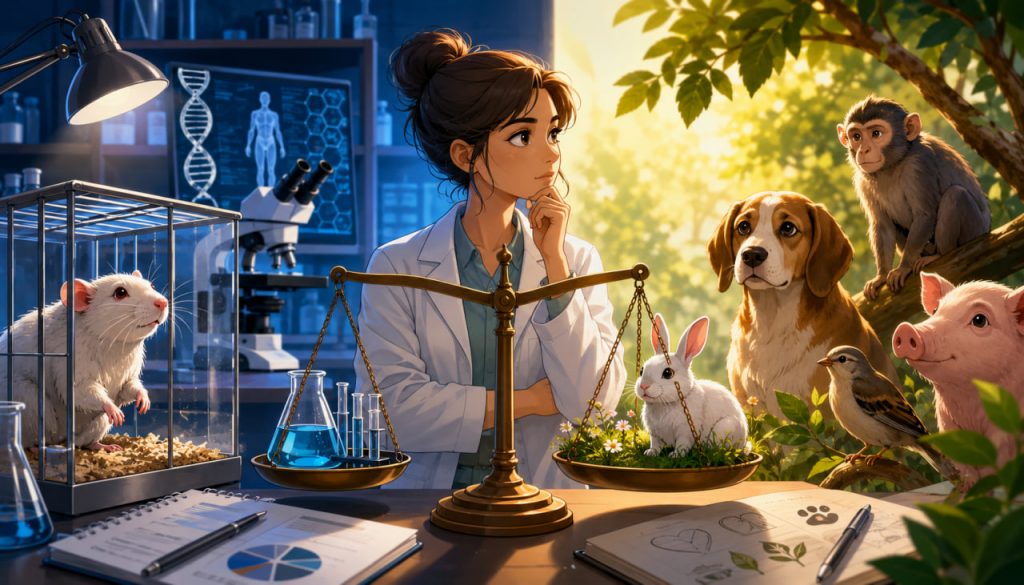
Animal experimentation has contributed to medical research, drug development, toxicology, neuroscience, and the study of disease. At the same time, it raises one of science’s most difficult moral questions: when, if ever, is it acceptable to cause suffering to animals in pursuit of knowledge or human benefit?
The debate is not simply a conflict between people who support science and people who care about animals. Researchers, veterinarians, ethicists, regulators, and animal-welfare advocates often agree that suffering should be minimized. Their deepest disagreement concerns whether the expected benefits can justify using animals at all.
Modern animal-research ethics therefore focuses on necessity, scientific value, proportionality, transparency, and the search for reliable alternatives.
Why Are Animals Used in Scientific Research?
Living organisms are extraordinarily complex. A drug may affect the immune system, heart, liver, brain, hormones, and metabolism at the same time. Cell cultures can reveal important mechanisms, but they may not reproduce all interactions occurring inside a complete organism.
Animals have therefore been used to study:
- Disease development
- Drug safety and effectiveness
- Organ function
- Immune responses
- Brain and behavior
- Surgical techniques
- Medical devices
- Environmental and chemical hazards
Different species are selected for different scientific reasons. Mice and rats are widely used because they reproduce quickly, are relatively easy to maintain, and share many biological processes with humans. Other research may involve fish, rabbits, birds, farm animals, dogs, or non-human primates.
However, biological similarity does not guarantee that results will translate successfully to humans. An experiment can harm animals and still fail to produce useful medical knowledge.
This is why scientific quality is an ethical issue, not merely a technical one.
The Central Ethical Conflict
The ethical debate usually begins with two competing considerations.
The first is the potential benefit of research. An experiment may improve understanding of a serious disease, identify dangerous effects of a substance, or contribute to a treatment.
The second is the harm imposed on animals. This can include pain, fear, isolation, physical restraint, invasive procedures, illness, behavioral deprivation, and death.
A harm-benefit assessment asks whether the expected scientific or social value is great enough to justify those harms.
Yet this calculation is difficult. Benefits may be uncertain or appear only many years later, while suffering is immediate. Researchers may also overestimate the importance of their own work.
Ethical approval should not depend on whether a study sounds interesting. It should depend on whether it is necessary, methodologically sound, and likely to produce meaningful knowledge.
The Three Rs of Humane Research
The most influential framework for animal experimentation is known as the Three Rs: Replacement, Reduction, and Refinement.
William Russell and Rex Burch introduced these principles in 1959. They are now incorporated into research policies and regulatory systems in many countries.
Replacement means using a method that does not require live animals whenever a scientifically suitable alternative exists.
Possible replacements include:
- Human cell and tissue cultures
- Organoids
- Organ-on-a-chip systems
- Computer simulations
- Mathematical models
- Donated human tissue
- Medical imaging
- Volunteer-based microdosing studies
Reduction means using the smallest number of animals capable of producing a reliable answer. It does not mean simply using fewer animals regardless of study quality.
An experiment with too few animals may produce an inconclusive result and waste every animal involved. Good statistical planning can prevent both excessive use and underpowered research.
Refinement means modifying procedures, housing, handling, pain relief, and endpoints to minimize suffering and improve welfare.
Examples include better anesthesia, less stressful handling, environmental enrichment, improved housing, and ending an experiment before severe deterioration occurs.
Why Good Science and Animal Welfare Are Connected
Poorly designed research is ethically unacceptable because it exposes animals to harm without producing dependable evidence.
Bias, inadequate sample sizes, unsuitable models, weak statistical methods, and incomplete reporting can make findings difficult to reproduce. Repeating failed or inconclusive studies may then require additional animals.
The Three Rs are therefore not only a welfare framework. They can also support stronger research design and more reliable translation.
Stress is another important factor. Animals experiencing fear, pain, poor housing, or disrupted social conditions may show altered immune, hormonal, cardiovascular, and behavioral responses.
Better welfare can improve the quality of scientific data because the animal’s condition directly affects experimental results.
Ethical Review and Regulatory Oversight
In regulated research systems, scientists cannot normally begin an animal experiment merely because they believe it may be useful.
A proposed study may be reviewed by an institutional committee that includes scientists, veterinarians, welfare specialists, and independent or public representatives.
Reviewers may ask:
- Is animal use genuinely necessary?
- Is there a suitable non-animal alternative?
- Is the chosen species appropriate?
- Are the expected benefits realistic?
- Is the number of animals justified?
- How will pain and distress be controlled?
- What humane endpoints will be used?
- Are staff properly trained?
- What will happen to the animals afterward?
In the United States, institutions receiving certain federal support must follow Public Health Service animal-welfare requirements and maintain oversight systems.
In Great Britain, regulated scientific procedures require licences under the Animals (Scientific Procedures) Act 1986, together with institutional welfare and ethical review.
Regulation varies by country, species, and research purpose. Legal approval also does not automatically settle the moral question. Something may be legally permitted while remaining ethically controversial.
Pain Relief and Humane Endpoints
Researchers have a responsibility to prevent or relieve pain whenever doing so is compatible with the study’s legitimate purpose.
This may involve anesthesia during surgery, analgesics afterward, careful monitoring, veterinary care, and predefined humane endpoints.
A humane endpoint is the stage at which an animal is treated, removed from the experiment, or euthanized to prevent further suffering. Researchers should not automatically wait for death or irreversible collapse when an earlier scientifically valid endpoint is available.
Refinement also includes everyday care. Appropriate temperature, nutrition, nesting materials, opportunities for movement, compatible social housing, and species-specific enrichment can substantially affect welfare.
The National Academies’ laboratory-animal guidance states that everyone involved in producing, caring for, or using animals in research must accept responsibility for their well-being.
Are the Three Rs Enough?
The Three Rs are widely accepted, but some ethicists argue that they do not answer every moral question.
A study might use very few animals and minimize pain, yet still pursue a trivial objective. It could satisfy the Three Rs while lacking sufficient scientific or social value.
Critics also argue that the framework manages animal use rather than directly asking whether certain experiments should be prohibited regardless of potential benefits.
Scholars have therefore proposed broader principles, including respect for animals, transparency, social value, accountability, and strict limits on severe suffering.
This criticism does not make the Three Rs useless. It suggests they should be treated as a minimum ethical foundation rather than a complete moral solution.
Alternatives to Animal Experiments
Non-animal research methods are advancing rapidly.
Organoids are miniature three-dimensional tissue structures grown from cells. Organ-on-a-chip devices use small channels and living human cells to reproduce selected features of organs and blood flow.
Computer models can predict chemical interactions, disease pathways, or drug behavior. Human tissue studies and advanced imaging may reveal information that is more directly relevant to patients.
These methods can sometimes be faster, more reproducible, and more human-specific than animal models.
However, alternatives also have limitations. A liver organoid does not reproduce an entire person, and a computer model is only as reliable as its assumptions and data.
The most realistic near-term strategy is often to combine several methods and use animals only when a question cannot yet be answered adequately in another way.
Expert Perspective
Russell and Burch’s Three Rs remain the central international framework for humane experimental science. Modern animal-welfare organizations emphasize that Replacement should be considered first, followed by careful Reduction and Refinement whenever animals remain necessary.
A further ethical insight comes from critiques of low-value research: animal welfare measures cannot make an experiment ethical when the underlying research question or design lacks sufficient scientific value.
This means ethical responsibility begins long before an animal enters a laboratory. It begins with asking whether the experiment deserves to be conducted at all.
Transparency and Public Trust
Animal research has often been surrounded by secrecy because institutions fear misunderstanding, criticism, or threats.
Yet excessive secrecy can weaken public trust. People have legitimate questions about which animals are used, what they experience, why alternatives are insufficient, and what benefits actually result.
Responsible transparency may include publishing non-technical study summaries, reporting animal numbers and severity levels, disclosing negative results, and explaining efforts to apply the Three Rs.
Open reporting also reduces unnecessary duplication. When unsuccessful experiments disappear from the scientific record, other laboratories may unknowingly repeat them.
Honest communication should acknowledge both scientific goals and the real moral cost imposed on animals.
Interesting Facts
- The Three Rs framework was first published in 1959.
- Reduction does not mean using the fewest animals possible if the resulting experiment becomes scientifically unreliable.
- Both poor welfare and uncontrolled stress can distort research findings.
- Organoids can reproduce selected features of human organs but are not complete miniature organs.
- Humane endpoints are intended to stop suffering before an experiment reaches its most severe possible outcome.
- Ethical-review committees often include members who are not directly involved in animal research.
- Publishing negative findings can prevent unnecessary repetition of animal experiments.
- Some regulations distinguish between mild, moderate, severe, and non-recovery procedures.
- Animal-free methods may complement one another rather than replace every animal study with a single alternative.
- The ethical acceptability of animal research remains debated even when all legal requirements are met.
Glossary
- Animal Experimentation — The use of living animals in research, testing, education, or scientific investigation.
- Three Rs — The principles of Replacement, Reduction, and Refinement.
- Replacement — Using non-animal methods instead of live animals whenever scientifically possible.
- Reduction — Using an appropriately minimized number of animals while maintaining reliable research.
- Refinement — Changing procedures and care to reduce pain, distress, and lasting harm.
- Harm-Benefit Assessment — A comparison between expected research benefits and the harm imposed on animals.
- Humane Endpoint — A predefined point at which an experiment is stopped or an animal receives intervention to prevent further suffering.
- Analgesia — Medical treatment used to reduce or eliminate pain.
- Anesthesia — A controlled loss of sensation, sometimes including unconsciousness, during a procedure.
- Organoid — A small laboratory-grown structure that reproduces selected features of an organ.
- Organ-on-a-Chip — A microengineered device containing living cells that models aspects of organ function.
- In Vitro — Research conducted outside a living organism, usually using cells, tissues, or biological materials.
- In Vivo — Research conducted within a living organism.
- Reproducibility — The ability of other researchers to obtain consistent results using comparable methods.
- Sentience — The capacity to experience sensations or states such as pain, fear, or pleasure.