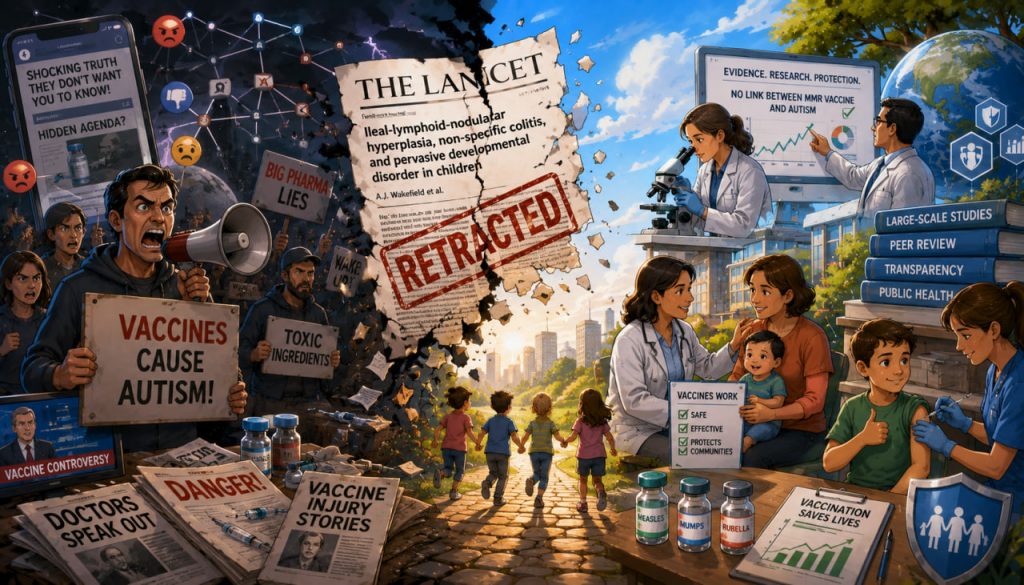
Modern vaccine resistance did not begin with one scientific paper. Opposition to vaccination has existed since the nineteenth century, when early smallpox vaccination campaigns faced religious, political, and safety objections.
However, the most influential modern vaccine panic was accelerated in 1998 by a deeply flawed paper published in The Lancet. It suggested a connection between the measles, mumps, and rubella vaccine, intestinal problems, and autism.
The paper was eventually fully retracted, its conclusions collapsed under investigation, and extensive later research found no association between the MMR vaccine and autism. Yet the claim survived.
This episode demonstrates how one alarming story can spread faster than its correction and continue harming public health for decades.
What Does “Anti-Vaxxer” Mean?
The term “anti-vaxxer” usually describes someone who rejects vaccines broadly or actively promotes claims that exaggerate their risks while dismissing their benefits.
Not every person with a vaccine question belongs in that category. Parents may have understandable concerns about side effects, ingredients, schedules, or conflicting information.
Public-health experts use the broader term vaccine hesitancy to describe delayed acceptance or refusal of vaccination despite the availability of vaccination services. Hesitancy varies by vaccine, place, time, personal experience, trust, and access to healthcare.
The distinction matters. A person asking questions may need clear information and respectful medical advice, while organized anti-vaccine campaigns often spread predetermined claims regardless of the evidence.
Vaccine Opposition Existed Before the MMR Scare
Vaccination controversy is almost as old as vaccination itself.
When governments introduced compulsory smallpox vaccination in the nineteenth century, opponents objected to state interference, feared medical complications, and distrusted authorities. Some concerns reflected the limited hygiene and inconsistent manufacturing standards of the era.
Modern vaccines are produced and monitored under very different conditions, but several old arguments remain familiar: vaccination is portrayed as unnatural, dangerous, financially motivated, or part of a hidden plan.
The 1998 MMR controversy did not create vaccine opposition. It gave an existing movement a dramatic scientific-looking narrative that could be repeated worldwide.
The 1998 Lancet Paper
In February 1998, The Lancet published a report involving only 12 children.
The paper described children with developmental disorders and gastrointestinal symptoms. It did not prove that the MMR vaccine caused autism, but its presentation and the public statements surrounding it encouraged the impression that such a link might exist.
The research design could not establish causation. It lacked a proper control group, relied heavily on parental recollections, and involved an extremely small and selected group of patients.
Nevertheless, the study received enormous media attention. The claim was emotionally powerful because autism signs often become noticeable around the same age that children receive routine vaccinations.
Events occurring close together in time are not necessarily connected by cause and effect.
Why the Paper Was Retracted
Problems with the research emerged gradually.
In 2004, most of the paper’s authors formally withdrew its interpretation that the findings suggested a connection between MMR vaccination and autism, stating that the available data were insufficient.
A lengthy investigation by the United Kingdom’s General Medical Council later found serious ethical and professional misconduct associated with the research. The Lancet fully retracted the paper in 2010.
A subsequent investigation published by The BMJ reported discrepancies between the children’s medical records and the descriptions appearing in the paper. The journal’s editors characterized the article as fraudulent rather than merely mistaken.
The World Health Organization now describes the 1998 report as a fraudulent paper that asserted an MMR–autism connection without robust scientific evidence.
Large Studies Found No Link With Autism
The original report involved 12 children. Later studies examined populations containing hundreds of thousands of children.
A Danish nationwide cohort study followed 657,461 children and found that MMR vaccination did not increase autism risk, trigger autism in susceptible children, or produce a clustering of diagnoses after vaccination.
An earlier Danish population study involving more than 537,000 children also found strong evidence against the claim that MMR vaccination causes autism.
Reviews cited by the US Centers for Disease Control and Prevention conclude with high confidence that MMR vaccination is not associated with autism spectrum disorder.
The claim was not rejected because authorities disliked it. It was rejected because larger, better-designed studies repeatedly failed to confirm it.
Why the Myth Survived the Retraction
Corrections rarely receive the same emotional attention as frightening initial claims.
“Researchers may have discovered that a common childhood vaccine causes autism” is an alarming headline. “Years of epidemiological research found no causal association” is more reassuring but less sensational.
The myth also offers a simple explanation for a complex developmental condition. Autism has a strong genetic component and involves many biological and developmental factors, but uncertainty about its exact causes can be emotionally difficult for families.
Personal stories reinforce the belief. A parent may notice developmental changes after vaccination and sincerely conclude that one caused the other. The experience is real, but the timing alone cannot establish causation.
Online communities then repeat selected stories, videos, and quotations. Repetition makes information feel familiar, and familiarity can be mistaken for truth.
Social Media Transformed Vaccine Misinformation
Earlier anti-vaccine campaigns depended on leaflets, meetings, books, and television appearances. Social media allows misleading claims to reach millions of people within hours.
Algorithms often reward content that provokes fear, anger, or surprise. A dramatic story about an allegedly injured child may spread farther than a statistical study or a careful explanation of relative risk.
Anti-vaccine content may also change form when one argument fails. Campaigners move from autism to fertility, immune overload, toxins, DNA alteration, government control, or undisclosed side effects.
This makes misinformation difficult to eliminate. The central belief remains fixed while the supporting explanation constantly changes.
WHO identifies misinformation, declining trust, and vaccine hesitancy as continuing threats to immunization programmes.
What Happens When Vaccination Rates Fall?
Vaccines protect individuals, but high coverage also limits the ability of infectious diseases to move through communities.
Measles is exceptionally contagious. Outbreak prevention generally requires approximately 95% coverage with two doses in every community, not merely a high national average. WHO and UNICEF warned in 2026 that areas below this level remain vulnerable to continuing transmission.
When vaccination declines, the first people placed at risk include:
- Infants who are too young for routine vaccination
- People with severe immune disorders
- Cancer patients receiving certain treatments
- Individuals who cannot receive particular vaccines
- People in communities with poor healthcare access
Global first-dose measles coverage remained below the 2019 level in 2025, and 57 countries reported large or disruptive measles outbreaks that year.
Refusing vaccination is therefore not always a purely private decision. It can increase exposure for people who have limited ability to protect themselves.
Vaccines Are Not Risk-Free
Trustworthy health communication should not claim that vaccines can never cause side effects.
Common reactions may include temporary soreness, fatigue, mild fever, or swelling. Rare serious reactions can also occur, which is why vaccines are tested before authorization and monitored after widespread use.
The correct comparison is not “vaccine risk versus zero risk.” It is vaccine risk versus the risks of infection and its complications.
Measles can cause pneumonia, encephalitis, hospitalization, long-term disability, and death. Mumps can cause meningitis, hearing loss, and inflammation of reproductive organs. Rubella during pregnancy can severely harm a developing fetus.
Acknowledging genuine risks strengthens informed consent. Inventing or exaggerating risks undermines it.
Why Mocking Hesitant Parents Does Not Work
Calling every worried person ignorant or selfish may deepen mistrust.
People are more likely to reconsider misinformation when healthcare professionals listen, answer the specific concern, explain uncertainty honestly, and provide understandable evidence.
A useful conversation may include:
- Asking what the person has heard
- Identifying the exact source of concern
- Explaining what is known and unknown
- Comparing disease risks with vaccine risks
- Discussing personal medical contraindications
- Giving time for follow-up questions
Respectful communication does not mean treating false claims as scientifically equal to established evidence. It means correcting them without humiliating the person who encountered them.
Expert Perspective
WHO emphasizes that vaccine hesitancy is complex and context-dependent. Confidence, convenience, complacency, misinformation, and previous experiences can all affect decisions.
The organization also warns that declining coverage is contributing to renewed measles transmission and preventable deaths, including in wealthy countries.
The lesson of the MMR controversy is broader than vaccination. Scientific fraud can be corrected inside journals, yet its social consequences may persist long after the original claim has been discredited.
Interesting Facts
- Organized opposition to vaccination existed long before the internet.
- The 1998 MMR paper included only 12 children.
- The paper itself did not demonstrate that MMR vaccination caused autism.
- Most of its co-authors withdrew the disputed interpretation in 2004.
- The Lancet fully retracted the article in 2010.
- Later studies examined populations of more than half a million children.
- Autism signs often become noticeable during the same period in which children receive several routine vaccines.
- Temporal sequence alone does not prove causation.
- Measles can spread before an infected person realizes they are ill.
- National vaccination averages can hide vulnerable local communities.
- People unable to receive vaccines depend partly on the immunity of others.
- Retractions remove unreliable research from the scientific record, but they cannot automatically remove copies and claims circulating online.
Glossary
- Anti-Vaxxer — A person who broadly opposes vaccination or actively promotes claims against it.
- Vaccine Hesitancy — Delay in accepting or refusal of vaccination despite its availability.
- MMR Vaccine — A combined vaccine against measles, mumps, and rubella.
- Autism Spectrum Disorder — A developmental condition affecting communication, behavior, sensory processing, and social interaction in varied ways.
- Retraction — Formal withdrawal of a published scientific paper because its findings or conduct are unreliable.
- Scientific Fraud — Deliberate fabrication, falsification, or serious misrepresentation in research.
- Causation — A relationship in which one factor produces or contributes to an outcome.
- Correlation — A statistical relationship that does not necessarily prove causation.
- Control Group — A comparison group used to help determine whether an observed effect is associated with an intervention or exposure.
- Cohort Study — Research that follows a defined group of people and compares health outcomes over time.
- Epidemiology — The study of disease patterns, causes, and risk factors in populations.
- Adverse Event — A health problem occurring after an intervention, whether or not the intervention caused it.
- Contraindication — A medical reason why a particular treatment or vaccine should not be used.
- Immunization — The process of becoming protected against a disease, usually through vaccination.
- Community Immunity — Reduced disease transmission when a sufficiently large proportion of a population is immune.
- Misinformation — False or misleading information shared regardless of intent.
- Disinformation — False information deliberately created or spread to deceive.
- Confirmation Bias — The tendency to favor information that supports an existing belief.
- Peer Review — Evaluation of research by specialists before publication.
- Informed Consent — A voluntary decision made after receiving understandable information about benefits, risks, and alternatives.