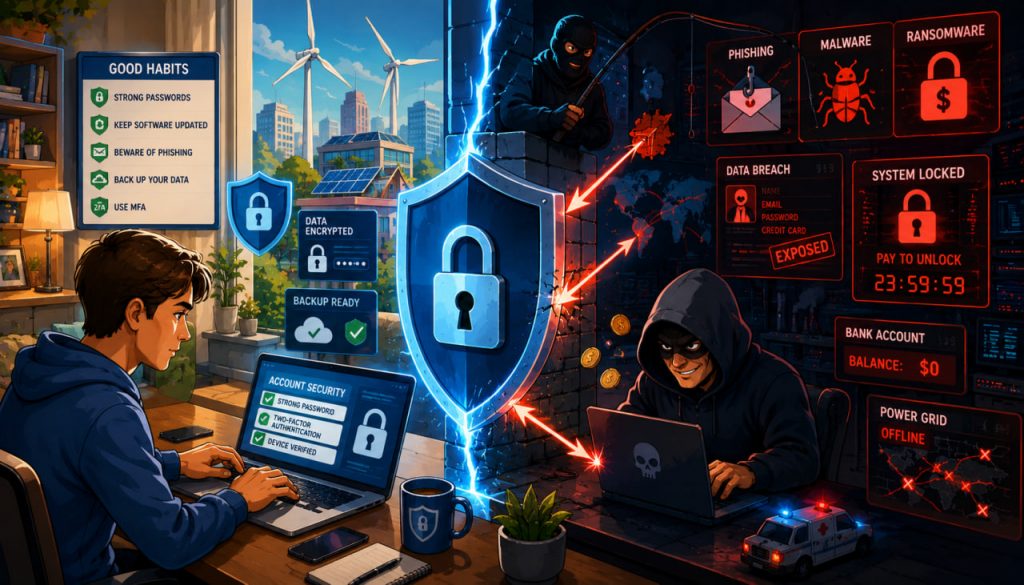
Cybersecurity is the protection of computers, smartphones, networks, online accounts, industrial systems, and digital information from theft, disruption, manipulation, or destruction.
It matters because modern life depends on connected technology. Banks process payments digitally, hospitals store medical records electronically, cities operate transport and utilities through computer systems, and families keep photographs, documents, and private conversations online.
A cyberattack is therefore no longer limited to “someone hacking a computer.” Criminals can steal money, expose confidential information, interrupt medical care, shut down business operations, and disrupt critical infrastructure.
Why Cybersecurity Has Become Essential
Every connected device creates a possible entry point.
Employees work remotely, businesses rely on cloud services, factories connect machinery to digital control systems, and smartphones contain banking apps, passwords, photographs, contacts, and location history.
Cybercriminals do not always need advanced technical methods. Many attacks begin with a convincing email, reused password, unpatched program, deceptive telephone call, or poorly protected supplier.
Verizon’s 2025 Data Breach Investigations Report examined more than 12,000 confirmed breaches. It found that third-party involvement had doubled to 30%, exploitation of vulnerabilities had increased, and ransomware remained a major threat.
Cybersecurity is not only an IT department’s responsibility. One careless click or compromised account can affect an entire organization.
What Cybercriminals Want
Attackers may be motivated by money, espionage, political objectives, revenge, disruption, or personal curiosity.
Their targets commonly include:
- Bank accounts and payment cards
- Passwords and login credentials
- Medical and identity records
- Confidential business documents
- Intellectual property
- Cryptocurrency
- Customer databases
- Industrial control systems
- Email and social media accounts
Stolen information may be sold, used for fraud, published for embarrassment, or combined with other leaked data to create convincing impersonation attacks.
The FBI’s Internet Crime Complaint Center reported complaint-related losses of approximately $16.6 billion in 2024, up from $12.5 billion in 2023. These figures cover reported incidents only, so the complete financial impact is likely larger.
Ransomware Can Stop an Entire Organization
Ransomware is malicious software that encrypts files or disables systems and then demands payment for their restoration.
Modern ransomware groups often steal information before encryption. They may threaten to publish confidential documents unless the victim pays, creating two forms of pressure at once.
A hospital attacked by ransomware may lose access to patient records, laboratory systems, appointment schedules, and communication tools. A manufacturer may stop production because employees cannot access control or logistics systems.
CISA describes ransomware as malware that makes files and dependent systems unusable. Its guidance recommends multifactor authentication, offline backups, updated software, and a tested recovery plan.
Paying does not guarantee recovery. Criminals may provide a defective decryption tool, keep stolen data, demand additional money, or attack the same organization again.
Example: The Colonial Pipeline Attack
In May 2021, ransomware affected the business systems of Colonial Pipeline, a major supplier of fuel to the eastern United States.
The company temporarily halted pipeline operations, contributing to disruption in the delivery of petrol and other petroleum products. The incident demonstrated how an attack on corporate computer systems could produce consequences far beyond the affected office network.
The attackers did not need to physically damage the pipeline. Operational uncertainty and the need to protect connected systems were enough to interrupt an essential service.
Cybersecurity failures can become transportation, energy, and public-safety problems.
Example: The Change Healthcare Cyberattack
In February 2024, a ransomware attack affected Change Healthcare, a major processor of healthcare payments and information in the United States.
The disruption affected claims processing and created financial and administrative difficulties for healthcare providers. The US Department of Health and Human Services described the incident as having an unprecedented impact on patients and the healthcare sector.
The case showed the danger of concentration. When thousands of organizations depend on one technology provider, an attack against that provider can spread disruption throughout an entire industry.
HHS later referred to the breach as the largest reported healthcare data breach in the country’s history.
Example: The MGM Resorts Incident
In September 2023, MGM Resorts reported a cybersecurity incident affecting some of its US systems.
The company shut down certain systems while investigating and restoring operations. MGM later estimated that the disruption reduced its third-quarter results by approximately $100 million.
Guests encountered problems involving digital room keys, reservations, payments, and other services.
This example illustrates that cybercrime can disrupt physical experiences even when the attack begins online. Hotels, shops, airports, and entertainment venues now depend heavily on interconnected software.
Phishing Turns People Into Entry Points
Phishing is an attempt to trick someone into revealing information, opening a malicious attachment, visiting a false website, or approving a fraudulent request.
A message may appear to come from:
- A bank
- A colleague
- A delivery company
- A tax authority
- Technical support
- A senior manager
- A familiar online service
Criminals create urgency: “Your account will be closed,” “Pay this invoice immediately,” or “Your parcel could not be delivered.”
Some attackers use stolen personal information to make the message more believable. Artificial intelligence can help generate polished emails, fake voices, and realistic impersonations.
Business email compromise is especially costly. Criminals enter or imitate a business account and instruct employees to send money to a fraudulent bank account. The FBI estimated global exposed losses connected with reported business email compromise cases at more than $55 billion between October 2013 and December 2023.
Criminals Can Steal an Identity
Personal information can be used to open accounts, apply for loans, redirect payments, obtain medical services, or impersonate the victim.
A criminal does not always need a complete identity file. A name, date of birth, email address, telephone number, and reused password may be enough to begin an attack.
Account takeover can spread quickly. Access to an email account may allow the attacker to reset passwords for banking, shopping, cloud storage, and social media services.
Victims may lose money, access to important accounts, or control of their online reputation. Correcting fraudulent records can take months or years.
Cyberattacks Can Manipulate Information
Attackers do not always steal or delete data. They may secretly alter it.
Changing payment instructions by one digit can redirect money. Modifying medical, scientific, or industrial information may create serious safety risks. Manipulated photographs, messages, or documents can also be used for blackmail and disinformation.
Data integrity is therefore as important as secrecy. Information that has been silently changed may be more dangerous than information that has disappeared.
Organizations need access controls, audit logs, backups, and methods for verifying that important records remain authentic.
Critical Infrastructure Is a Major Target
Electricity grids, water systems, pipelines, communications networks, factories, and transport systems increasingly use industrial control technology.
Cybercriminals or hostile state-linked groups may attempt to disrupt operations, damage equipment, or maintain hidden access for future use.
CISA warns that industrial control systems face both immediate operational incidents and long-term cybersecurity risks.
Attacking operational technology can have physical consequences. Pumps may stop, alarms may fail, production lines may shut down, and technicians may lose visibility into equipment conditions.
Strong separation between ordinary business networks and critical control systems reduces the chance that one compromised laptop will provide a path into essential machinery.
How Individuals Can Protect Themselves
Use a unique password for every important account. A password manager can create and store long, random passwords.
Enable multifactor authentication, particularly for email, banking, cloud storage, and social media. CISA recommends phishing-resistant methods such as security keys or passkeys when available because text-message codes can sometimes be intercepted or socially engineered.
Install operating-system and application updates promptly. Updates often repair vulnerabilities that criminals are already exploiting.
Back up important files using at least one copy that is not permanently connected to the computer. Ransomware can encrypt connected external drives as well as internal storage.
Pause before clicking links or approving payments. Verify unusual requests using a separate communication channel rather than replying directly to the suspicious message.
How Organizations Can Reduce the Damage
No organization can guarantee that an attack will never occur. The realistic objective is to reduce the likelihood, limit the spread, and recover safely.
Essential measures include:
- Multifactor authentication
- Timely security updates
- Restricted administrative privileges
- Network segmentation
- Encrypted sensitive data
- Offline and tested backups
- Employee awareness training
- Continuous monitoring and logging
- Supplier security assessments
- A practised incident-response plan
CISA advises organizations to maintain offline backups and test restoration rather than assuming that stored copies will work during a crisis.
A response plan should identify who makes technical, legal, operational, and public-communication decisions. Discovering these responsibilities during an attack wastes valuable time.
Expert Perspective
CISA consistently treats cybersecurity as a risk-management and resilience problem rather than a purely technical issue. Its guidance prioritizes multifactor authentication, updated software, secure backups, network visibility, and rehearsed incident response.
The US Government Accountability Office similarly argues that attacks on pipelines and other critical infrastructure demonstrate the urgent need for stronger cybersecurity governance and protection.
The central lesson is that cybercrime becomes dangerous when digital access controls real money, confidential information, essential services, or physical machinery—which now describes much of modern society.
Interesting Facts
- Ransomware criminals may steal information before encrypting it.
- A compromised supplier can provide access to many customers at once.
- Email accounts are valuable because they can reset passwords for other services.
- Some cyberattacks remain undetected for months.
- Criminals may telephone employees while pretending to be technical-support staff.
- A strong password cannot protect an account when the user gives it to a fake website.
- Offline backups can remain safe when ransomware attacks connected storage.
- Smart buildings, factories, and hospitals combine digital and physical security risks.
- Small businesses are attractive targets because they may hold valuable data but have limited security resources.
- Software updates frequently contain fixes for exploitable security weaknesses.
- Attackers may change data instead of stealing it.
- Reporting an incident quickly can help banks, law enforcement, and other potential victims respond.
Glossary
- Cybersecurity — Protection of digital systems, networks, devices, and information against unauthorized access or damage.
- Cyberattack — A deliberate attempt to compromise, disrupt, manipulate, or destroy a digital system.
- Malware — Software designed to damage, spy on, or gain unauthorized access to a device.
- Ransomware — Malware that blocks access to systems or data and demands payment.
- Phishing — Fraudulent communication intended to steal information or trigger an unsafe action.
- Social Engineering — Manipulation of people into revealing information or bypassing security procedures.
- Data Breach — Unauthorized access to or disclosure of protected information.
- Identity Theft — Criminal use of another person’s personal information.
- Business Email Compromise — Fraud involving compromised or impersonated business email accounts.
- Multifactor Authentication — Login protection requiring more than one form of verification.
- Passkey — A cryptographic login method designed to resist phishing and replace traditional passwords.
- Vulnerability — A weakness that an attacker may exploit.
- Patch — A software update that repairs defects or security weaknesses.
- Encryption — Conversion of information into a protected form readable only with authorization.
- Backup — A separate copy of information used for recovery.
- Network Segmentation — Dividing a network into controlled sections to limit attacker movement.
- Operational Technology — Hardware and software that monitors or controls physical processes and machinery.
- Critical Infrastructure — Essential systems such as energy, water, transport, healthcare, and communications.
- Incident Response — Organized actions used to investigate, contain, and recover from a cyberattack.
- Data Integrity — Assurance that information remains accurate and has not been improperly altered.