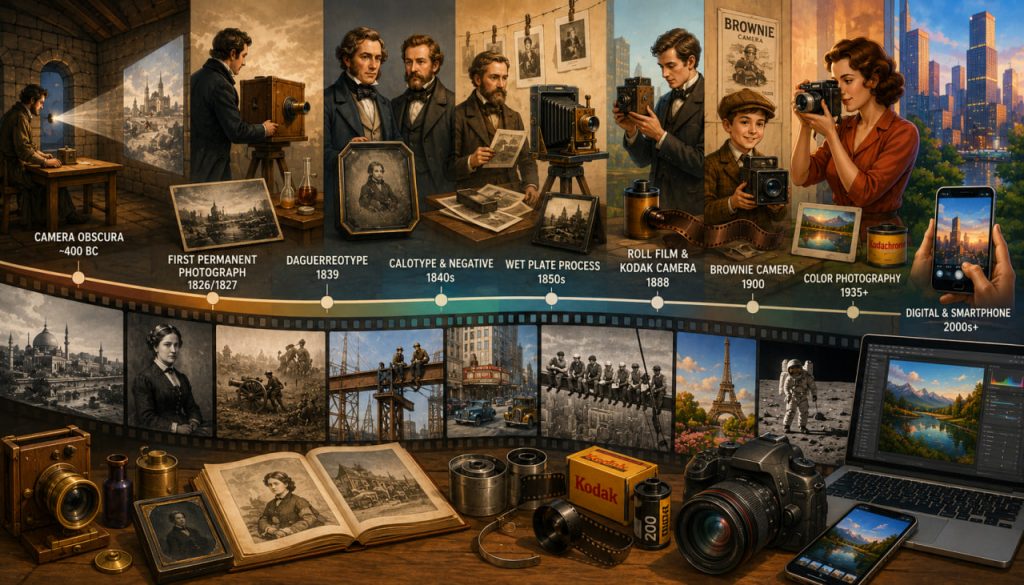
Photography changed the way humanity remembers people, documents events, studies nature, reports news, and creates art. Before photographs, accurate visual records depended mainly on drawing, painting, engraving, or written description.
The development of photography was not a single invention made by one person. It emerged through centuries of experiments with optics, chemistry, light-sensitive materials, mechanical cameras, film, electronic sensors, and digital software.
The history of photography is the story of making images progressively faster, more reproducible, more affordable, and more accessible.
The Camera Obscura: Photography Before Photographs
Long before anyone could permanently capture an image, people understood that light passing through a small opening could project an inverted view onto a dark surface.
This principle formed the basis of the camera obscura, whose name means “dark chamber.” Early versions were entire rooms, while later devices became portable boxes fitted with lenses.
Artists used the projected image to study perspective and trace landscapes or architectural scenes. However, the camera obscura could only display an image. It could not preserve it.
The missing element was a material that would react to light and retain the projected scene.
The First Permanent Photographs
During the eighteenth and early nineteenth centuries, researchers experimented with silver compounds that darkened when exposed to light.
French inventor Joseph Nicéphore Niépce eventually created one of the earliest surviving permanent camera photographs. His process required a long exposure and used a light-sensitive coating on a plate.
Niépce later worked with Louis-Jacques-Mandé Daguerre, who continued their experiments after Niépce’s death.
In 1839, Daguerre’s improved method was formally announced in France. That year is often treated as the public birth of practical photography.
The Daguerreotype Revolution
The daguerreotype produced an exceptionally detailed direct-positive image on a polished, silver-plated copper sheet.
The plate was sensitized with iodine vapor, exposed inside a camera, developed using mercury vapor, and chemically fixed. Each finished photograph was unique because the process did not produce a reusable negative.
Daguerreotypes became especially popular for portraits. For the first time, many middle-class families could obtain remarkably accurate images of relatives.
Early exposure times could still be long, requiring subjects to remain motionless. Studios used controlled lighting, head supports, painted backgrounds, and carefully arranged poses.
The daguerreotype transformed portraiture, but every image remained a fragile, one-of-a-kind object.
William Henry Fox Talbot and the Negative
At roughly the same time, English inventor William Henry Fox Talbot developed a different approach.
His calotype process created a paper negative from which multiple positive prints could be produced. The images were generally less sharp than daguerreotypes, but the negative-positive principle offered a major advantage: one exposure could generate many copies.
Paper photography began replacing the daguerreotype during the 1850s. Negatives could be printed repeatedly, inserted into albums, reproduced in books, and distributed more widely.
This negative-to-positive system became the foundation of most film photography for more than a century.
Glass Plates and Faster Photography
Early paper negatives had visible fibers that reduced image detail. Photographers therefore began using glass plates coated with light-sensitive chemicals.
The wet collodion process, introduced in the 1850s, produced sharp negatives and shorter exposures. However, the glass plate had to be coated, exposed, and developed while still wet.
Photographers working outside a studio often carried portable darkrooms, chemicals, glass plates, and heavy cameras.
Later dry plates removed much of this difficulty. Factory-prepared plates could be stored, transported, exposed, and developed later. Photography became faster and more practical for scientists, journalists, travelers, and ordinary users.
Photography as Documentation and Art
Photography soon became more than portraiture.
It documented wars, cities, landscapes, scientific experiments, distant cultures, industrial development, and social conditions. Images gave audiences a powerful sense that they were witnessing real events rather than artistic interpretations.
At the same time, photographers argued that the medium could be a form of art. They experimented with composition, lighting, soft focus, printing methods, and symbolic subjects.
Movements such as Pictorialism deliberately created atmospheric photographs resembling paintings, drawings, or prints. Later photographers emphasized sharp detail, geometric structure, modern life, and the distinctive visual qualities of the camera itself.
George Eastman and Photography for Everyone
Photography remained technically demanding until manufacturers simplified cameras and processing.
George Eastman played a major role in this transformation. His company developed dry plates, roll-film systems, and cameras designed for non-specialists.
In 1888, the Kodak camera was marketed with a service model in which customers took photographs and returned the camera for processing and reloading. The company’s message was simple: the user pressed the button while Kodak handled the complicated chemical work.
Commercial transparent roll film appeared in 1889. In 1900, the inexpensive Brownie camera brought snapshot photography within reach of a much larger public.
Photography was no longer limited to professionals and wealthy enthusiasts. It became part of ordinary family life.
The Rise of Color Photography
Photographers experimented with color throughout the nineteenth century, but early methods were complex and difficult to reproduce.
One important breakthrough was the Autochrome process introduced by Auguste and Louis Lumière in 1907. Autochromes created delicate color transparencies on glass and became the first commercially viable color-photography process.
Other pioneers used separate red, green, and blue exposures. Sergei Prokudin-Gorskii, for example, photographed scenes through three color filters and projected the combined images to recreate full color.
Color photography became much more convenient during the twentieth century. Kodachrome, introduced in 1935, became a major commercially successful amateur color film.
Over time, improved color-negative films and automated processing made color photographs the everyday standard.
Smaller Cameras and Photojournalism
The development of compact roll-film and 35 mm cameras changed how photographers worked.
Instead of relying on large tripods and carefully staged scenes, photographers could move rapidly and capture spontaneous moments. Compact cameras became important in street photography, documentary work, war reporting, sports, fashion, and travel.
Photojournalism grew alongside illustrated newspapers and magazines. A single photograph could shape public understanding of war, poverty, political movements, disasters, and historic celebrations.
Photography became both evidence and interpretation. The photographer’s position, timing, framing, and selection influenced what viewers saw and how they understood it.
Polaroid and the Instant Photograph
Instant photography introduced another dramatic change: users no longer needed to send film to a laboratory.
Polaroid cameras produced a physical photograph shortly after exposure. This made photography immediate, social, and playful.
Instant cameras became popular with families, artists, professionals, and institutions that needed quick visual records. Although conventional film usually offered higher quality, instant photography created a unique experience by delivering a finished object within minutes.
The Digital Photography Revolution
Digital imaging replaced light-sensitive film with electronic sensors.
Charge-coupled devices, known as CCDs, converted light into electronic information. The Computer History Museum notes that CCD technology helped revolutionize photography and that the first commercial digital camera appeared in 1990.
Early digital cameras were expensive and produced relatively small images. Improvements in sensors, memory cards, batteries, processors, and computer software rapidly increased their usefulness.
By the 1990s and early 2000s, professional news organizations began adopting digital systems because photographs could be reviewed, edited, and transmitted without chemical development.
Digital photography eliminated the cost of individual film exposures and allowed photographers to take hundreds or thousands of images on reusable storage.
Smartphones and Computational Photography
The camera phone completed photography’s transformation into an everyday communication tool.
Modern smartphones combine lenses, electronic sensors, image stabilization, software processing, internet connectivity, and large storage capacity in one small device.
Computational photography can merge multiple exposures, reduce noise, brighten dark scenes, blur backgrounds, assemble panoramas, and improve dynamic range automatically.
Today, photographs are not only printed or preserved in albums. They are sent instantly through messaging services, published on social networks, stored in cloud systems, analyzed by software, and shared with global audiences.
The modern photograph is both an image and a piece of digital information that can be copied, edited, searched, and transmitted almost instantly.
Expert Perspective
Photography historians frequently describe the medium as both a technology and a cultural practice.
The Metropolitan Museum of Art’s historical materials show how each major process changed not only image quality but also what photographers could create and how photographs could circulate—from unique daguerreotype plates to reproducible paper prints and commercially viable color images.
This reveals a central pattern in photography’s development: every technical breakthrough changed who could make pictures, what could be photographed, and how quickly images could reach an audience.
Interesting Facts
- A daguerreotype has no separate negative and is therefore a unique image.
- Some early photographs required exposures lasting several minutes or longer.
- Wet-plate photographers sometimes carried mobile darkrooms in wagons or tents.
- The negative-positive process made it possible to create many prints from one exposure.
- The Brownie camera helped popularize casual family snapshots.
- Early color photographers sometimes recorded one scene three times through red, green, and blue filters.
- Autochrome plates used a microscopic color-screen system and were viewed with light passing through them.
- Roll film helped make both still photography and motion pictures practical.
- Digital cameras initially competed with film on speed and convenience before matching it in image quality.
- Smartphones now combine traditional optics with extensive automatic software processing.
- Billions of photographs can now be created globally in the time once required to expose a single early plate.
Glossary
- Photography — The process of creating images by recording light on a sensitive surface or electronic sensor.
- Camera Obscura — A darkened chamber or box that projects an inverted external image through a small opening or lens.
- Daguerreotype — A direct-positive photograph made on a silver-plated copper sheet.
- Calotype — An early paper-negative process developed by William Henry Fox Talbot.
- Negative — An image in which light and dark values are reversed and from which positive prints can be produced.
- Exposure — The amount of light allowed to reach photographic film, a plate, or a digital sensor.
- Collodion Process — A nineteenth-century photographic method using a chemically coated glass plate.
- Dry Plate — A factory-prepared glass photographic plate that could be exposed and developed later.
- Roll Film — Flexible photographic material wound around a spool for multiple exposures.
- Autochrome — An early commercially successful color-transparency process introduced in 1907.
- Photojournalism — The use of photography to report and interpret news events.
- CCD — A charge-coupled device that converts light into electronic image data.
- Digital Sensor — An electronic component that records light as digital information.
- Computational Photography — The use of software and multiple image-processing techniques to create or enhance photographs.