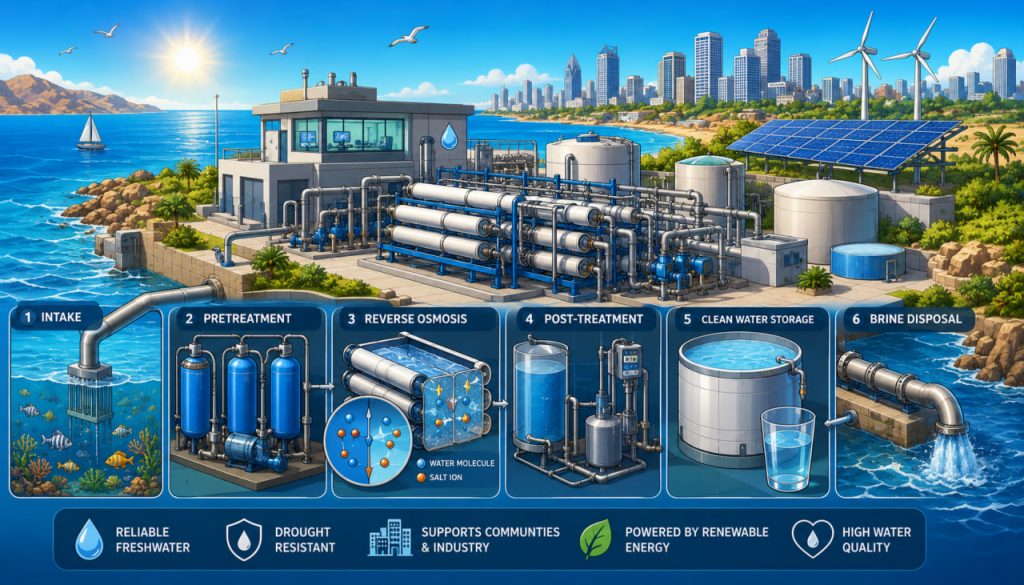
Seawater desalination transforms salty ocean water into fresh water suitable for drinking, industry, and selected agricultural uses. It is already an essential water source in many arid coastal regions where rivers, reservoirs, and groundwater cannot reliably meet demand.
Modern desalination plants can produce large quantities of high-quality water regardless of rainfall. However, they require substantial infrastructure, energy, careful pretreatment, and responsible management of concentrated brine.
Desalination is highly effective as a dependable water-supply technology, but it is not a cheap or environmentally neutral replacement for conservation, wastewater reuse, and better water management.
How Seawater Desalination Works
Seawater contains dissolved salts, microorganisms, suspended particles, and organic material. A desalination plant must separate most of these substances from the water before it can enter a municipal supply system.
A typical plant includes several stages:
- Seawater intake
- Screening and pretreatment
- Salt-removal process
- Post-treatment and remineralization
- Disinfection
- Freshwater storage
- Brine management
Pretreatment removes particles and biological material that could damage equipment or clog membranes. After desalination, the water may be too low in minerals and chemically unstable, so operators adjust its mineral content and acidity before distribution.
Reverse Osmosis: The Leading Technology
Reverse osmosis, commonly abbreviated as RO, is the dominant modern desalination technology.
In normal osmosis, water naturally moves through a semipermeable membrane toward the side containing more dissolved material. Reverse osmosis applies pressure greater than the natural osmotic pressure, forcing water in the opposite direction.
Water molecules pass through the membrane, while most dissolved salts and many other contaminants remain behind. The process produces two streams:
- Freshwater, called permeate
- Concentrated saltwater, called brine or concentrate
The U.S. Department of Energy identifies membrane separation and thermal distillation as the two principal approaches to desalination.
RO plants rely on high-pressure pumps because seawater must be forced through extremely fine membranes. Modern energy-recovery devices capture pressure from the outgoing brine and transfer much of it back into the system, significantly reducing electricity consumption.
Why Reverse Osmosis Is So Widely Used
Reverse osmosis has become popular because it usually requires less energy than evaporating and condensing seawater.
It also offers:
- Modular construction
- Relatively compact equipment
- Scalable plant capacity
- High salt rejection
- Compatibility with renewable electricity
- Faster construction than some large thermal plants
The U.S. Bureau of Reclamation describes RO as the most widely used and well-established desalination technology, including for brackish groundwater and off-grid systems.
However, membrane performance depends heavily on pretreatment. Algae, bacteria, minerals, oil, sediment, and organic matter can cause fouling or scaling, increasing pressure requirements and maintenance costs.
Multi-Stage Flash Distillation
Multi-stage flash distillation, or MSF, is a thermal desalination process.
Seawater is heated and passed through a series of chambers operating at progressively lower pressures. In each chamber, part of the hot water rapidly “flashes” into vapor without additional boiling.
The vapor condenses on heat-exchange surfaces and becomes fresh water. The remaining seawater grows increasingly concentrated as it moves through the system.
MSF plants are robust and can handle large volumes of water, but they require considerable thermal energy and complex infrastructure. They have traditionally been used in regions where desalination facilities could operate alongside large power stations.
Multi-Effect Distillation
Multi-effect distillation, or MED, also produces freshwater through evaporation and condensation.
Instead of using many pressure chambers for flashing, MED passes vapor through a sequence of evaporation stages called effects. Heat released when vapor condenses in one effect helps evaporate water in the next.
This repeated use of heat can make MED more thermally efficient than older distillation designs.
MED may be attractive where low-cost waste heat, industrial heat, geothermal energy, or solar thermal energy is available. Like MSF, it generally requires more construction material and heat-related equipment than reverse osmosis.
Electrodialysis for Brackish Water
Electrodialysis uses an electrical field and ion-selective membranes to remove dissolved salts.
Positive and negative ions migrate toward oppositely charged electrodes. Special membranes allow either positively or negatively charged ions to pass, gradually separating fresher water from concentrated water.
Electrodialysis and electrodialysis reversal are especially suitable for brackish water, which contains less salt than seawater. Their energy use rises as salinity increases, so they are usually less competitive for ordinary ocean water.
The Bureau of Reclamation includes electrodialysis among established desalting technologies alongside reverse osmosis and thermal processes.
Membrane Distillation
Membrane distillation is an emerging thermal-membrane technology.
A hydrophobic membrane prevents liquid water from passing through its pores but allows water vapor to move across. A temperature difference creates the vapor-pressure gradient that drives separation.
Membrane distillation may use low-temperature heat from:
- Solar thermal systems
- Industrial waste heat
- Geothermal sources
- Power-generation equipment
It can treat very salty water that is difficult for conventional RO. However, membrane wetting, heat loss, scaling, and commercial cost remain important challenges.
Forward Osmosis
Forward osmosis uses the natural movement of water across a membrane toward a highly concentrated draw solution.
The process itself may require relatively little hydraulic pressure. However, the freshwater must later be separated from the draw solution, and that regeneration stage can consume substantial energy.
Forward osmosis is being researched for seawater desalination, industrial wastewater, and hybrid systems. The Bureau of Reclamation has investigated its potential to reduce energy use and costs, although it is not yet the standard choice for large municipal seawater plants.
Solar Desalination
Solar desalination can take several forms.
Small solar stills use sunlight to evaporate water and condense the vapor on a cooler surface. They are simple but produce limited quantities.
Larger systems can combine solar photovoltaic electricity with reverse osmosis or use concentrated solar heat for distillation and membrane-distillation processes.
The Department of Energy has supported solar-powered systems designed to improve water recovery and reduce the quantity of concentrated brine.
Renewable energy reduces operational emissions, but it does not eliminate the need for intake systems, membranes, chemicals, pipelines, storage, and brine disposal.
How Energy-Efficient Is Desalination?
Seawater desalination is inherently energy-intensive because dissolved salt does not separate from water spontaneously.
Modern seawater RO plants are much more efficient than earlier facilities. Typical electricity consumption can be around several kilowatt-hours per cubic metre, depending on salinity, plant design, pretreatment, recovery rate, and pumping requirements. Bureau of Reclamation research has cited RO energy requirements near 3 kilowatt-hours per cubic metre in some contexts.
Thermal desalination may consume both electricity and large quantities of heat.
The International Energy Agency notes that desalination can represent a major share of national energy demand in countries that rely heavily on it.
Desalination becomes more sustainable when paired with efficient membranes, energy recovery, low-carbon power, short pipelines, and reduced leakage in the water network.
How Much Freshwater Can a Plant Recover?
A desalination plant does not convert every litre of seawater into freshwater.
In seawater RO, part of the intake becomes product water, while the remainder carries the rejected salts away as concentrated brine. Recovery depends on water chemistry, membrane limits, pressure, temperature, and environmental requirements.
Trying to recover too much freshwater can increase scaling, membrane stress, energy use, and brine concentration.
Brackish-water plants can generally achieve higher recovery because their feedwater contains less salt.
The Environmental Challenge of Brine
Brine is saltier than the original seawater and may contain traces of treatment chemicals, cleaning agents, metals, or temperature differences.
If poorly discharged, it can increase local salinity and affect organisms living near the seabed. Environmental impacts also arise from seawater intakes, which may trap larger organisms or draw in eggs and larvae.
The World Bank identifies brine discharge, intake-related impingement and entrainment, energy use, and greenhouse gas emissions as major environmental concerns.
Modern mitigation methods include:
- Carefully designed diffusers
- Mixing brine with treated wastewater
- Locating outfalls in areas with strong circulation
- Subsurface seawater intakes
- Improved chemical management
- Recovering useful salts and minerals
- Zero-liquid-discharge research
Complete elimination of brine is technically possible in some specialized systems but can be expensive and energy-intensive.
Is Desalinated Water Safe to Drink?
Properly treated desalinated water can meet strict drinking-water standards.
Reverse osmosis removes most salts and many contaminants, but the final water still requires post-treatment. Operators commonly add minerals such as calcium and adjust alkalinity to improve taste, protect pipelines, and make the water chemically stable.
Disinfection prevents microbial contamination during storage and distribution.
The safety of the final product depends on plant operation, monitoring, maintenance, source-water conditions, and the quality of the distribution network—not merely on the desalination membrane itself.
Where Desalination Is Most Useful
Desalination is most attractive when a region has:
- Severe water scarcity
- Access to seawater or brackish groundwater
- Reliable energy
- Sufficient financial resources
- Limited alternative water supplies
- Strong technical and regulatory capacity
It can provide drought-resistant water for cities, islands, industries, ships, military facilities, and remote communities.
It is often less suitable for large-scale irrigation of low-value crops because the water may cost too much to produce and transport. High-value agriculture, greenhouse farming, and blended water supplies may be more realistic applications.
Expert Perspective
The International Energy Agency treats desalination as an increasingly important part of the water-energy relationship. Its analysis shows that electrification and reverse osmosis are changing the sector, while growing dependence on desalination can significantly increase electricity demand.
The most balanced engineering assessment is that desalination is highly effective at producing reliable freshwater, but its overall value depends on energy prices, environmental safeguards, plant location, alternative supplies, and responsible water consumption.
Interesting Facts
- Reverse osmosis does not boil seawater; it uses high pressure and selective membranes.
- Seawater is harder to desalinate than brackish water because it contains more dissolved salt.
- Energy-recovery devices can reuse pressure that would otherwise be wasted.
- Desalinated water is often remineralized before entering drinking-water pipelines.
- Thermal desalination can use waste heat from power stations or industrial facilities.
- Solar stills are simple but normally produce far less water than industrial plants.
- Brine may contain potentially valuable salts and minerals.
- Membrane fouling can increase both energy use and maintenance costs.
- A desalination plant can operate during drought because its source does not depend directly on rainfall.
- Reducing leaks may sometimes provide cheaper water than building additional desalination capacity.
Glossary
- Desalination — Removal of dissolved salts and minerals from seawater or brackish water.
- Reverse Osmosis — A pressure-driven process that pushes water through a semipermeable membrane.
- Semipermeable Membrane — A barrier that allows certain molecules to pass while blocking others.
- Permeate — The purified water that passes through a membrane.
- Brine — Concentrated salty water remaining after desalination.
- Pretreatment — Removal of particles, organisms, and chemicals before the main desalination stage.
- Post-Treatment — Adjustment and disinfection of desalinated water before use.
- Remineralization — Addition of selected minerals to purified water.
- Multi-Stage Flash Distillation — Thermal desalination using rapid evaporation in chambers with decreasing pressure.
- Multi-Effect Distillation — Thermal desalination that reuses heat across several evaporation stages.
- Electrodialysis — Removal of dissolved ions using electricity and selective membranes.
- Membrane Distillation — A heat-driven process in which water vapor crosses a hydrophobic membrane.
- Forward Osmosis — Movement of water through a membrane toward a concentrated draw solution.
- Recovery Rate — The proportion of feedwater converted into product water.
- Fouling — Accumulation of biological or chemical material on a membrane or other surface.
- Scaling — Formation of mineral deposits inside desalination equipment.