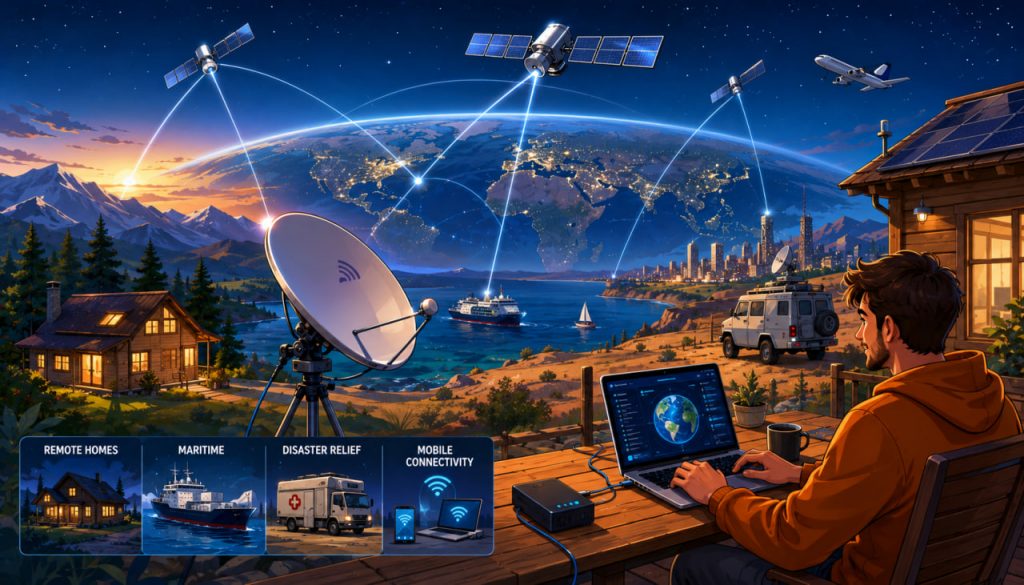
Satellite internet delivers online access through communication satellites orbiting Earth rather than relying entirely on underground fiber-optic cables, telephone lines, or nearby mobile towers.
For people living in remote villages, mountainous regions, islands, deserts, ships, or disaster-affected areas, it can provide connectivity where conventional broadband is unavailable or too expensive to build.
Modern low Earth orbit networks have significantly improved satellite broadband performance. However, satellite internet is not automatically the fastest, cheapest, or most reliable option for every household. Its quality depends on the orbit, provider, local capacity, weather, installation, and visibility of the sky.
How Does Satellite Internet Work?
A satellite internet connection usually involves three main components:
- A user terminal or satellite dish
- One or more satellites in orbit
- Ground stations connected to the wider internet
When a user opens a website, the terminal transmits the request toward a satellite. The satellite then sends the data either to a ground gateway or through other satellites before it reaches the internet.
The response travels back through the network to the user’s terminal.
Some systems use satellites mainly as relay stations between users and ground infrastructure. More advanced constellations may use inter-satellite links, allowing data to move between satellites before returning to Earth.
The distance that the signal must travel strongly affects connection latency.
GEO, MEO, and LEO Satellite Internet
Satellite broadband systems are commonly classified by orbital altitude.
Geostationary satellites, known as GEO or GSO satellites, orbit approximately 36,000 kilometers above the equator. From the ground, they appear to remain in the same position in the sky. One satellite can therefore cover an enormous geographic region.
Medium Earth orbit, or MEO, generally lies between low and geostationary orbits. The International Telecommunication Union describes MEO systems as operating roughly 8,000–20,000 kilometers above Earth.
Low Earth orbit satellites operate much closer to the planet, commonly at altitudes between approximately 400 and 2,000 kilometers. Because they are closer, signals travel a shorter distance, reducing latency.
LEO satellites move quickly relative to the ground. A satellite in low Earth orbit may complete an orbit in roughly 90 minutes, so continuous service requires a coordinated constellation rather than one stationary spacecraft.
Why Traditional Satellite Internet Has High Latency
Latency is the delay between sending data and receiving a response.
With a GEO system, a signal must travel tens of thousands of kilometers upward and then back to Earth. In a typical internet exchange, it may need to make this journey more than once.
This delay can be noticeable during:
- Video calls
- Online gaming
- Remote desktop sessions
- Financial trading
- Cloud-based applications
- Real-time collaboration
A GEO connection may still provide useful download speeds, but high latency can make an otherwise fast connection feel less responsive.
LEO networks reduce this problem because their satellites orbit far closer to Earth. Current commercial LEO specifications can advertise terrestrial latency measured in tens of milliseconds, although actual performance varies by region, network load, routing, and distance from supporting ground infrastructure.
Why LEO Satellite Constellations Need So Many Satellites
A single geostationary satellite can continuously observe a large area because it appears fixed in the sky.
A LEO satellite covers a smaller region and rapidly passes overhead. As it moves away, the user terminal must transfer the connection to another satellite. This process is called a handover.
To maintain uninterrupted coverage, operators deploy hundreds or thousands of satellites in coordinated orbital planes.
For example, Eutelsat states that its OneWeb LEO network includes more than 600 satellites orbiting at approximately 1,200 kilometers.
The ITU reported in 2025 that the number of active satellites had increased dramatically over the previous decade, with much of that growth occurring in low Earth orbit.
Main Advantages of Satellite Internet
The greatest advantage is geographic reach.
Terrestrial broadband requires expensive physical infrastructure. Fiber cables must be installed, towers constructed, and equipment maintained. In sparsely populated areas, the cost per customer can become too high.
Satellite service can connect locations that are difficult to reach by land, including:
- Rural homes
- Farms and mines
- Offshore platforms
- Ships and aircraft
- Scientific stations
- Temporary construction sites
- Emergency response centers
- Areas affected by damaged infrastructure
Satellite broadband can also serve as a backup connection for businesses, hospitals, public services, and communication networks.
Its strategic value is often greatest where ordinary infrastructure is absent, unreliable, damaged, or geographically impractical.
Common Limitations
Satellite internet still has important disadvantages.
The equipment can be more expensive than a basic terrestrial modem. Some services require professional installation, while others use self-aligning or electronically steered terminals.
The antenna normally needs a clear view of the relevant part of the sky. Buildings, trees, mountains, roofs, and other obstructions may interrupt the signal.
Network congestion can reduce speeds when many customers in the same coverage area are active simultaneously. Providers may also prioritize certain subscription plans over lower-cost or best-effort services.
Weather can affect some satellite frequencies. Heavy rain, snow, ice accumulation, or dense storm clouds may weaken the signal, a phenomenon often called rain fade.
Power consumption also matters in off-grid locations. A modern satellite terminal may require substantially more electricity than a simple mobile hotspot or fiber modem. One current standard terminal specification lists average power consumption in the range of approximately 75–100 watts, although equipment varies.
Is Satellite Internet Good for Gaming and Video Calls?
Modern LEO satellite internet can support video conferencing, streaming, cloud applications, and many online games.
However, performance may fluctuate more than a high-quality fiber connection. Brief interruptions can occur when the terminal changes satellites, encounters an obstruction, or experiences network congestion.
Competitive gaming is especially sensitive to latency variation, packet loss, and jitter. A connection with a reasonable average latency can still feel unstable when delays suddenly increase.
Video streaming is generally less sensitive because platforms buffer content in advance. Live communication is less forgiving because data must arrive immediately.
For real-time applications, consistency is often as important as headline download speed.
Satellite Internet During Emergencies
Satellite systems can restore communications when storms, earthquakes, fires, floods, or armed conflict damage terrestrial infrastructure.
Emergency teams may deploy portable terminals to establish connections for hospitals, rescue coordination, logistics, and public communications.
However, satellite internet is not completely independent of ground systems. User terminals require electricity, and many networks still depend on ground stations, data centers, supply chains, and licensed radio spectrum.
A satellite connection should therefore be treated as one layer of resilience rather than an indestructible communication system.
Direct-to-Device Satellite Connectivity
Traditional satellite broadband usually requires a dedicated dish or terminal.
A newer approach connects satellites directly to ordinary or specially compatible mobile devices. This technology is frequently described as direct-to-device connectivity or a non-terrestrial network.
Early services may initially support emergency messaging, text communication, or low-bandwidth data before offering broader mobile broadband.
The European Space Agency reported a successful direct 5G connection to a LEO satellite using standardized non-terrestrial-network technology, demonstrating how terrestrial and satellite mobile systems may increasingly work together.
Direct-to-device systems are unlikely to replace high-capacity terrestrial networks everywhere. Their strongest role may be filling coverage gaps and providing communication where no tower is available.
Environmental and Orbital Concerns
Large constellations require frequent launches and the operation of many spacecraft.
This raises concerns about orbital congestion, collision risk, space debris, atmospheric effects, and interference with astronomical observations.
Operators must track satellites, coordinate frequencies, perform collision-avoidance maneuvers, and safely remove spacecraft after their useful lives.
The European Space Agency notes that mega-constellations containing hundreds or thousands of satellites require careful debris-management and mitigation strategies.
Radio-frequency coordination is also essential because multiple systems may attempt to use similar frequency bands. The ITU plays a central international role in coordinating spectrum and satellite-orbit use.
How to Choose a Satellite Internet Service
Before subscribing, examine more than advertised maximum speed.
Check:
- Actual availability at your address
- Expected download and upload speeds
- Typical latency
- Data limits or fair-use rules
- Equipment and installation costs
- Contract requirements
- Power consumption
- Weather performance
- Obstruction requirements
- Technical support
- Pause or cancellation policies
Look for independent local experiences because performance can differ significantly between neighboring regions.
A roof with an unobstructed sky may receive excellent service, while a nearby house surrounded by tall trees may experience frequent interruptions.
Expert Perspective
The International Telecommunication Union describes non-geostationary satellite systems as an important part of expanding global connectivity, particularly because LEO systems can offer lower latency than traditional geostationary networks. At the same time, the ITU emphasizes the need for international regulation and spectrum coordination as constellations grow.
The central lesson is that satellite internet is evolving from a last-resort connection into a serious broadband platform, but its success depends on responsible network design, orbital management, and realistic expectations from users.
Interesting Facts
- A geostationary satellite appears stationary because its orbital period matches Earth’s rotation.
- GEO communication satellites orbit approximately 36,000 kilometers above Earth.
- Many LEO satellites circle Earth in approximately 90 minutes.
- LEO networks require frequent handovers as satellites move across the sky.
- Satellite internet can serve moving aircraft, ships, and land vehicles.
- Some modern satellites communicate with one another using optical or radio links.
- Rain can weaken certain high-frequency satellite signals.
- A clear line of sight matters because buildings and trees can block the terminal’s connection.
- Mega-constellations may contain hundreds or thousands of satellites.
- Satellite broadband can be used as a backup when fiber or cellular infrastructure fails.
Glossary
- Satellite Internet — Internet access provided through communication satellites.
- GEO — Geostationary Earth orbit, approximately 36,000 kilometers above the equator.
- MEO — Medium Earth orbit, located between low and geostationary orbits.
- LEO — Low Earth orbit, generally extending to about 2,000 kilometers above Earth.
- Latency — The delay between transmitting data and receiving a response.
- Bandwidth — The amount of data a connection can transfer within a given period.
- Constellation — A coordinated group of satellites working as one network.
- Ground Station — A terrestrial facility that communicates with satellites.
- User Terminal — The dish, antenna, or electronic device connecting a customer to a satellite network.
- Handover — The transfer of a connection from one moving satellite to another.
- Rain Fade — Signal weakening caused by rain or atmospheric moisture.
- Jitter — Variation in latency over time.
- Packet Loss — Data packets that fail to reach their destination.
- Non-Terrestrial Network — A communication network using satellites or other airborne platforms.
- Direct-to-Device — Satellite communication delivered directly to a mobile device without a conventional large dish.
- Mega-Constellation — A very large network containing hundreds or thousands of satellites.