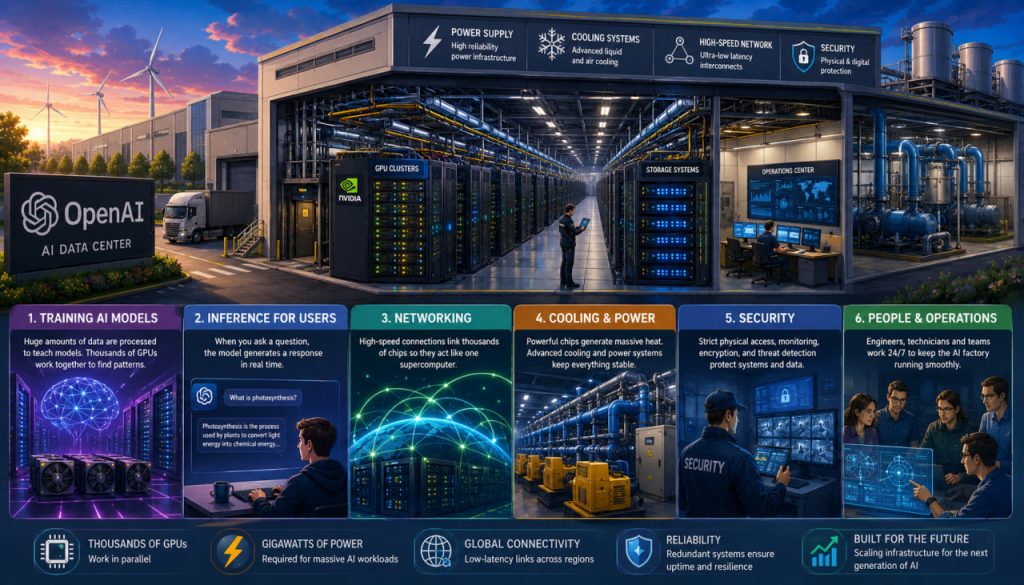
An OpenAI data center is not a single mysterious room full of one giant computer. It is a highly engineered AI computing facility built to run enormous numbers of calculations at extreme speed. It supports the systems behind tools such as ChatGPT, API services, research models, and future AI applications.
The exact layout, security details, hardware configuration, and operational procedures of OpenAI-related data centers are not publicly disclosed in full. That is normal for facilities handling advanced computing, sensitive infrastructure, and valuable intellectual property.
But based on OpenAI’s public infrastructure announcements, partnership details, and job descriptions, we can describe the big picture accurately: an OpenAI data center is closer to an industrial-scale AI factory than a traditional office server room.
What an OpenAI Data Center Probably Looks Like
From the outside, a major AI data center may look like a large industrial campus: long buildings, power infrastructure, cooling equipment, fiber connections, security checkpoints, loading areas, backup systems, and restricted access zones.
Inside, the core areas usually include:
- Rows of server racks
- GPU and accelerator clusters
- High-speed networking equipment
- Storage systems
- Cooling pipes or air-cooling corridors
- Power distribution units
- Monitoring rooms
- Fire suppression systems
- Security-controlled access points
Unlike ordinary office IT rooms, AI data centers are designed for extremely dense computing. The hardware produces massive heat and requires carefully managed electricity, cooling, networking, and maintenance.
The visual impression would be futuristic but highly practical: glowing status lights, cables, metal racks, cooling systems, and strict order everywhere.
OpenAI’s Infrastructure Is Built With Partners
OpenAI does not publicly present its infrastructure as one isolated company-owned building. Instead, it works through major partnerships.
OpenAI and Microsoft have worked together for years on Azure-based supercomputing systems. In 2023, OpenAI stated that Microsoft and OpenAI had built multiple supercomputing systems powered by Azure, used to train OpenAI models, and that Azure’s architecture supported both training and inference workloads.
OpenAI has also announced Stargate, described as a long-term AI infrastructure platform. The original Stargate announcement said the project intended to invest $500 billion over four years to build new AI infrastructure for OpenAI in the United States, beginning with $100 billion deployed immediately.
In later announcements, OpenAI described Stargate as its long-term effort to build the compute foundation required for broad and reliable AGI access, adding new data center capacity to meet growing demand from consumers, businesses, developers, and governments.
What Happens Inside: Training AI Models
One major activity inside AI infrastructure is model training.
Training means teaching a model to recognize patterns in data. For large language models, this involves processing huge amounts of text and other information, then adjusting billions of internal values called parameters.
During training, thousands of GPUs or AI accelerators may work together. They must communicate constantly, synchronize calculations, and recover from failures.
OpenAI has described research infrastructure work as involving frontier reinforcement-learning training runs, inference bottlenecks, numerical problems, hardware failures, orchestration issues, and large horizontal integrations.
That sentence reveals something important: AI data centers are not passive warehouses. They are active, fragile, high-performance systems that need constant engineering.
What Happens Inside: Inference for Users
Training creates the model. Inference uses the model.
Every time a user asks ChatGPT a question, uploads a file, calls the API, or runs an AI-powered workflow, a data center processes that request. The system receives input, sends it through the model, generates a response, and returns it to the user.
This must happen quickly, reliably, and at enormous scale.
OpenAI job descriptions describe infrastructure that powers large language model training and inference across vast GPU and accelerator fleets. They also mention systems that abstract away performance, parallelism, and execution complexity for researchers.
In simple terms, OpenAI needs infrastructure that can do two things at once: train tomorrow’s models and serve today’s users.
Why Networking Matters So Much
In an AI data center, processors are only part of the story.
Large AI systems need extremely fast networking because thousands of chips must behave like one coordinated machine. If the network is slow, expensive GPUs wait idle instead of calculating.
OpenAI has publicly discussed supercomputer networking and introduced MRC, a protocol designed to improve resilience and performance in large-scale AI systems.
This shows why AI data centers are different from ordinary cloud facilities. They are not simply storing websites or documents. They are coordinating huge distributed computations where milliseconds and failure recovery matter.
Cooling and Power Are Central Challenges
AI computing consumes serious electricity and produces serious heat.
A modern AI data center needs advanced cooling systems, which may include liquid cooling, carefully designed airflow, chilled water systems, heat exchangers, or hybrid designs. The more powerful the chips, the more important cooling becomes.
Power planning is equally critical. OpenAI’s Stargate expansion has been described in terms of gigawatts of planned capacity, showing that AI infrastructure is now discussed at energy-system scale. One OpenAI announcement stated that Stargate-related sites, together with Abilene, Texas and CoreWeave projects, brought planned capacity to nearly 7 gigawatts and more than $400 billion in investment over three years.
The future of AI depends not only on better algorithms, but also on electricity, cooling, land, fiber, chips, and construction.
Security Inside an OpenAI Data Center
Security is essential.
A facility supporting frontier AI systems would typically include physical security, identity-based access control, network monitoring, encrypted communication, segmented systems, incident response, and strict operational procedures.
OpenAI has publicly emphasized enterprise-grade privacy, security, and compliance features for customers, including data residency options in Europe.
Not every security detail should be public. In fact, secrecy around facility access, internal architecture, and operational defenses helps protect the systems from intrusion, sabotage, and abuse.
Expert Perspective
OpenAI CEO Sam Altman has repeatedly framed compute as one of the key constraints on AI progress, and OpenAI’s own infrastructure announcements support that view. The Stargate project positions AI infrastructure as a national-scale and global-scale foundation for future AI access, economic activity, and scientific development.
The expert takeaway is clear: AI data centers are becoming strategic infrastructure, similar in importance to electricity grids, railways, ports, and telecommunications networks.
What People Do There Every Day
Many people imagine data centers as fully automated. In reality, humans remain essential.
Teams may work on:
- Installing and replacing hardware
- Monitoring system health
- Managing network performance
- Responding to failures
- Expanding capacity
- Testing cooling systems
- Improving reliability
- Supporting training runs
- Securing infrastructure
- Coordinating with energy and construction partners
OpenAI job postings mention work across hardware readiness, site readiness, network pathing, storage availability, vendor execution, and engineering dependencies required to turn infrastructure into live training and inference capacity.
So what happens inside? Machines compute, but people keep the AI factory alive.
Interesting Facts
- OpenAI’s infrastructure is connected to large partnerships with companies such as Microsoft, Oracle, SoftBank, and CoreWeave.
- AI data centers need both training capacity and inference capacity.
- Training a model is usually much more computationally intense than answering one user request.
- Inference can still become enormous because millions of users may send requests at the same time.
- Networking can be just as important as chips in large AI clusters.
- Modern AI infrastructure is increasingly measured in gigawatts, not just servers.
- Data center cooling is one of the biggest engineering challenges in AI infrastructure.
Glossary
- AI Data Center — A specialized facility designed to run artificial intelligence computing workloads.
- GPU — A processor designed for parallel calculations, widely used in AI.
- AI Accelerator — Specialized hardware built to speed up AI computations.
- Training — The process of teaching an AI model by adjusting its internal parameters.
- Inference — The process of using a trained AI model to generate answers or predictions.
- Cluster — A group of connected computers working together as one system.
- Latency — The delay between sending a request and receiving a response.
- Throughput — The amount of work a system can process in a given time.
- Stargate — OpenAI’s long-term AI infrastructure platform for building large-scale compute capacity.
- Data Residency — Keeping certain customer data in a specific region for compliance or business requirements.