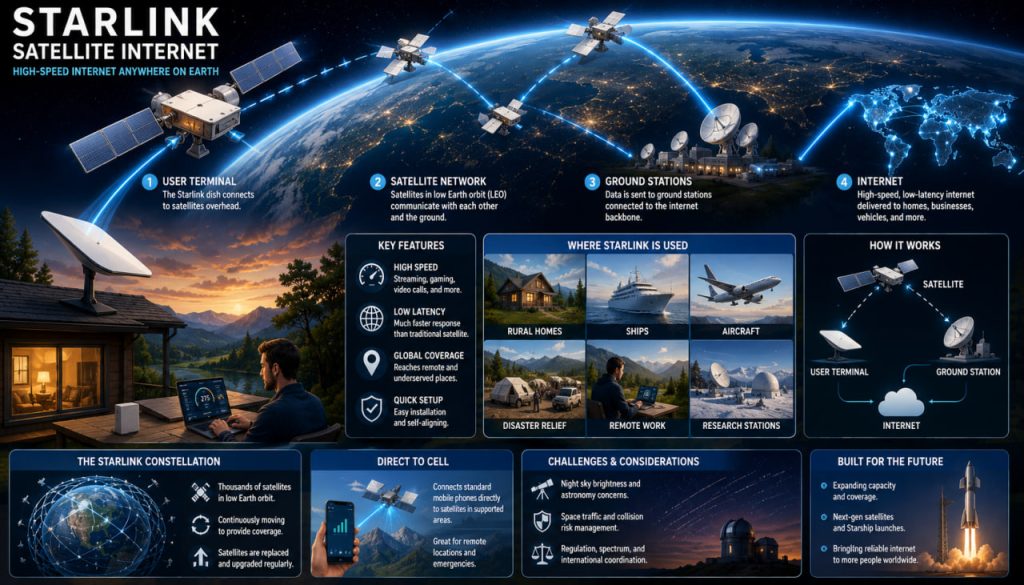
Starlink is SpaceX’s satellite internet network designed to deliver broadband connectivity through thousands of satellites in low Earth orbit. Instead of relying only on ground cables, towers, or traditional geostationary satellites, Starlink sends internet signals between user terminals, satellites, ground stations, and sometimes satellite-to-satellite laser links.
The idea is simple but ambitious: bring high-speed, low-latency internet to places where fiber, cable, and mobile networks are unavailable, unreliable, or too expensive to build.
Starlink has become especially important for rural homes, ships, aircraft, emergency responders, remote businesses, and regions affected by disasters or conflict. At the same time, it has raised serious questions about astronomy, space traffic, regulation, military use, and the future of the orbital environment.
What Is Starlink?
Starlink is a satellite broadband service operated by SpaceX. Its official technology page describes Starlink as a low Earth orbit satellite constellation built to deliver broadband internet capable of supporting activities such as streaming, online gaming, video calls, and other data-heavy uses.
Unlike older satellite internet systems that use a few large satellites far above Earth, Starlink uses many smaller satellites much closer to the planet. This lower orbit helps reduce latency, which is the delay between sending a signal and receiving a response.
That lower latency is one of Starlink’s biggest advantages over traditional satellite internet.
For users, the setup usually involves a Starlink dish, a router, power supply, and a subscription plan. The dish automatically aligns with satellites overhead and connects the user to the network.
How Starlink Internet Works
A Starlink connection begins at the user terminal, often called the dish. The terminal communicates with satellites passing overhead in low Earth orbit.
From there, data can move through different paths:
- From dish to satellite
- From satellite to ground gateway
- Through terrestrial internet infrastructure
- Between satellites using laser links in some parts of the network
- Back to another ground location or user
Because the satellites are constantly moving, the system must hand off the connection from one satellite to another without interrupting service. This requires advanced antennas, orbital coordination, network routing, and software automation.
Starlink is not just a collection of satellites. It is a moving space-based internet system.
Why Low Earth Orbit Matters
Traditional geostationary satellites orbit about 35,786 kilometers above Earth. They appear fixed in the sky, which is useful for broadcasting, but the long signal path creates noticeable delay.
Starlink satellites orbit much closer to Earth, which reduces travel time for signals. This makes Starlink more practical for video calls, cloud work, online gaming, remote operations, and other interactive tasks.
Low Earth orbit also creates challenges. Satellites move quickly, cover smaller areas at any moment, and must be replaced more often than geostationary satellites. This is why Starlink needs a large constellation rather than only a few satellites.
Where Starlink Is Most Useful
Starlink is most valuable where normal internet infrastructure is weak.
This includes:
- Rural homes
- Farms
- Mountain communities
- Islands
- Ships and offshore platforms
- Aircraft
- Disaster zones
- Remote construction sites
- Research stations
- Emergency response areas
Starlink’s residential service page describes the service as high-speed, low-latency internet with global connectivity and more than 99.9% average uptime, though actual performance depends on location, plan, congestion, weather, and local regulation.
Starlink does not replace fiber in every city, but it can be transformative where fiber does not exist.
Starlink Direct to Cell
One of Starlink’s most important developments is Direct to Cell.
This technology is designed to let ordinary LTE phones connect directly to Starlink satellites in supported areas, without a special satellite phone. Starlink’s progress page states that SpaceX completed deployment of the first-generation Direct to Cell constellation with more than 650 satellites launched to low Earth orbit.
A Starlink public file on Direct to Cell also states that SpaceX planned to expand satellite-to-mobile technology into additional countries and work toward additional services for Internet of Things devices.
This could be important for emergency messaging, rural coverage, maritime users, and backup connectivity when ground networks fail.
The long-term goal is not only satellite internet for dishes, but satellite connectivity for ordinary mobile devices.
The Scale of the Starlink Constellation
Starlink is already the largest satellite constellation ever built.
Current satellite counts change frequently because SpaceX launches new batches and older satellites deorbit. Recent independent satellite-tracking estimates in mid-2026 placed the constellation at more than 10,000 active or operational satellites, while Space.com reported around 10,876 Starlink satellites in the network as of late July 2026.
SpaceX continues launching satellites at a rapid pace. Reuters reported that the U.S. Federal Communications Commission approved SpaceX’s plan to deploy an additional 7,500 second-generation Starlink satellites, bringing the permitted total to 15,000 at that stage, although SpaceX had requested approval for a larger system.
This scale is what gives Starlink its coverage and capacity, but it is also what makes the system controversial.
Benefits of Starlink
Starlink’s biggest benefit is access.
For people outside reliable terrestrial networks, satellite internet can mean access to remote work, online education, telemedicine, business tools, government services, news, and emergency communication.
Its advantages include:
- Fast deployment
- Wide geographic coverage
- Lower latency than older satellite systems
- Portable or mobile options
- Resilience during ground infrastructure damage
- Use on ships, aircraft, and remote sites
During emergencies, satellite internet can become critical when cables, cell towers, or local power systems fail. Connectivity is no longer only a convenience; in some situations, it becomes a lifeline.
Limitations and Risks
Starlink is powerful, but it is not perfect.
Users may face:
- High hardware cost
- Monthly subscription fees
- Weather-related performance issues
- Congestion in busy areas
- Limited availability in some countries
- Power dependence
- Regulatory restrictions
- Obstructions from trees, buildings, or terrain
There are also broader concerns. Astronomers have warned that large satellite constellations can interfere with optical and radio observations. Space.com’s overview notes concerns about satellite brightness, radio astronomy disruption, collision risk, orbital debris, and atmospheric effects from reentering satellites.
These concerns do not mean Starlink has no value. They mean the world is still learning how to manage a crowded low Earth orbit responsibly.
Expert Perspective
Space and astronomy experts often describe Starlink as both a technological breakthrough and a regulatory challenge. The expert concern is not simply that satellites exist, but that mega-constellations may change the night sky, increase traffic management demands, and force governments to update rules for orbital sustainability.
The FCC’s approval of additional Starlink satellites shows that regulators see public-interest value in expanded connectivity, while still limiting approval below SpaceX’s larger request and attaching deployment requirements.
The balanced view is clear: Starlink is a major internet innovation, but its growth must be managed with serious attention to space safety, astronomy, and international regulation.
The Future of Starlink
Starlink’s future is likely to include more satellites, improved terminals, stronger mobile integration, higher-capacity spacecraft, and broader use in transport, defense, enterprise, and emergency services.
Reuters reported that SpaceX tested upgraded Starlink V3 satellites during a Starship flight, with the satellites briefly communicating with the existing network before planned reentry.
If Starship becomes fully operational for satellite deployment, SpaceX could launch larger and more capable Starlink satellites at greater scale. That could improve bandwidth and coverage, but it would also increase the urgency of solving orbital traffic and astronomy issues.
Starlink is not just an internet provider. It is part of a larger shift toward space-based digital infrastructure.
Interesting Facts
- Starlink satellites orbit much closer to Earth than traditional geostationary internet satellites.
- The Starlink dish automatically tracks satellites without the user manually pointing it.
- Starlink can be used in remote homes, boats, aircraft, emergency sites, and mobile operations.
- Direct to Cell is designed to connect ordinary mobile phones to satellites in supported areas.
- Starlink satellite numbers change regularly because new satellites launch and older satellites reenter.
- The same low orbit that reduces latency also requires many satellites for continuous coverage.
- Starlink has become one of the most visible examples of commercial space infrastructure.
Glossary
- Starlink — SpaceX’s satellite internet network using low Earth orbit satellites.
- Low Earth Orbit (LEO) — An orbit relatively close to Earth, usually much lower than geostationary orbit.
- Latency — The delay between sending data and receiving a response.
- User Terminal — The Starlink dish and equipment used to connect a customer to the satellite network.
- Ground Gateway — A ground station that links satellites to the wider internet.
- Laser Link — A satellite-to-satellite communication method using optical signals.
- Direct to Cell — Starlink technology designed to connect standard mobile phones directly to satellites.
- Constellation — A coordinated group of satellites working together as a network.
- Geostationary Satellite — A satellite that orbits high above Earth and appears fixed over one location.
- Orbital Debris — Objects in space that no longer serve a useful purpose and may create collision risks.